Helping design and engineering professionals discover, evaluate and specify technologies and processes that shorten the design cycle and enable success.


Alert!
Digital Engineering ceased publication on July 1, 2026. This website remains available as an archive of engineering content.
For inquiries or information, please email [email protected].


Sponsored
Artificial Intelligence for Design and Engineering Workflows
In this white paper, learn how artificial intelligence and machine learning can improve design and simulation.
Technology Focus: Designing for Optimization & Simulation
Simulation is pervasive, with people from different departments and backgrounds discovering new ways to put it to use, in all of its varied forms.
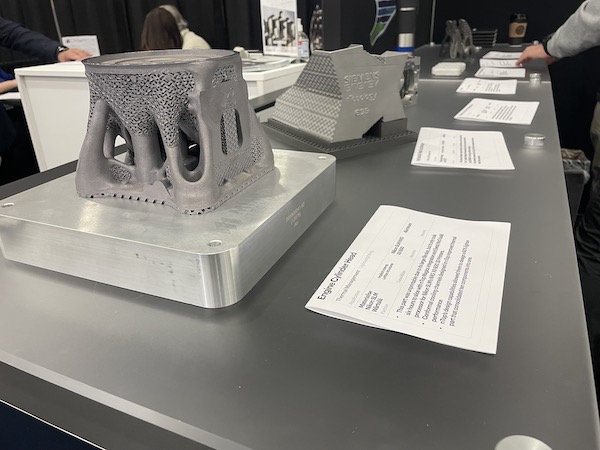
At the RAPID+TCT 2025 event in Detroit, more than 500 leading companies in the additive manufacturing space gathered with 10,000 attendees to show off the latest developments in 3D printing hardware and software. As is the case at just about any engineering or manufacturing event these days, artificial intelligence (AI) technology was prominent in many booths and presentations.
AI and machine learning (ML) are being leveraged in a number additive manufacturing use cases. Those include using AI to optimize parameters for part quality and qualification; intelligent monitoring and control of 3D printing equipment; using AI to predict and prevent build failures and detect defects in real time; and taking advantage of AI for design space exploration and generative design techniques. The latter application – using the technology to arrive at the right design decisions early in the workflow – is an important part of several new software products that were demonstrated at the event, most of which rely heavily on GPU acceleration to provide fast and accurate results.
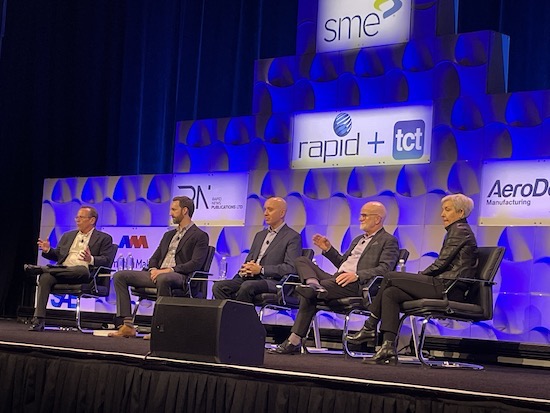
AI also came up in the opening executive panel discussion, which featured Materialise CEO Brigitte de Vet-Veithen; Formlabs Chief Revenue Officer Nick Graham; Stratasys CEO Yoav Zeif; and EOS President Glynn Fletcher. Fletcher, in particular, was enthusiastic about AI and what he had heard and seen at the recent NVIDIA GTC conference.
“I was at NVIDIA GTC and heard [CEO] Jensen Huang speak for two hours about AI,” Fletcher said. “[AI] is going to have an enormous impact on what we do and how we conduct our business in the future. I truly believe that those organizations that master AI, will master those organizations that don’t.”
On the show floor, there were plenty of examples of how AI is going to affect design for additive manufacturing workflows.
AiBuild, for example, offers a software that leverages AI for generating toolpaths for hybrid 3D printing and CNC machine environments. It can make generating complex toolpaths easier, and reduces the need for manual coding. At RAPID, the company announced new thermal simulation and optimization capabilities. “The interpass temperature (during printing) is important, because it affects process stability and the mechanical properties of the part,” said Guy Brown, head of research and development at AiBuild during a press conference at the event. According to Brown, the AIBuild tool leverages GPU compute capabilities.
With thermal simulation, users can ensure that thermals are manageable within the print process windows before printing actually starts. The tool automatically generates a finite element mesh from the printing toolpath (taking information like material and environmental conditions into account) and visualizes the thermal simulation of the build. It then optimizes the toolpath through speeds, waits and process parameters to bring the interpass temperature into a safe range. The company plans to expand into full thermo-mechanical simulation later in 2025. The software also includes an AI Copilot for recommending and performing actions.
AiBuild has also established partnerships with engineering software providers nTop and Luminary Cloud. Those two companies announced a partnership with NVIDIA earlier this year that connects nTop’s parametric geometry generation technology, Luminary Cloud’s simulation platform, and the NVIDIA PhysicsNeMo AI framework for developing physics-ML models and novel AI architectures for engineering systems.
Another exhibitor, Synera, is an AI-based engineering process automation platform that allows engineers to create complex CAE workflows without coding. The workflows can be shared with other stakeholders via a web browser. The platform also automates training data generation, can be used to train reduced order models (ROMs), and can interact with GenAI. The company is a member of the Altair Partner Alliance, and has built connectors for other common engineering software tools from Ansys, Siemens, Dassault, PTC and more.
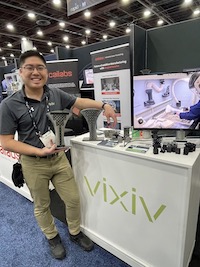
Vixiv (which was originally called Voxel) from Cincinnati, Ohio, offers an AI-based tool that helps engineers explore the design space to find the right lattice structures to reduce weight in their models based on strength, stiffness, manufacturability and other parameters.
As company CEO and co-founder Aaron Chow describes it, the tool cuts out a lot of trial and error that would otherwise go into identifying the best design options, and does so in just a few minutes. The beta release of the software is due in June 2025. Right now, the company is training its AI models using real-world test and validation data from actual printed lattices the company is building at its facilities.
To learn more about the RAPID+TCT 2025 program, visit the event website.


Since its founding in 1993, NVIDIA (NASDAQ: NVDA) has been a pioneer in accelerated computing. The company’s invention of the GPU in 1999 sparked the growth of the PC gaming market, redefined computer graphics, ignited the era of modern AI and…

Cut Retrieval-Augmented Generation (RAG) Hallucinations by 50%
Most teams hit the same wall with enterprise AI: LLMs that hallucinate, pipelines that don’t scale, and infrastructure that’s harder to design than the models themselves.

Brian Albright is the editorial director of Digital Engineering.
Contact him at [email protected].






About Us · Contact Us · Editorial Team · Advertising · Privacy Policy · Subscriber Services · © 2026 Digital Engineering 24/7 · Peerless Media