Helping design and engineering professionals discover, evaluate and specify technologies and processes that shorten the design cycle and enable success.


Alert!
Digital Engineering ceased publication on July 1, 2026. This website remains available as an archive of engineering content.
For inquiries or information, please email [email protected].

May 2026 Special Focus: Artificial Intelligence in Design and Simulation
In this Special Focus Issue, learn about the latest developments in the integration of artificial intelligence into engineering workflows.

April 2026 Special Focus Issue: Generative Design
In this Special Focus Issue, Digital Engineering takes a look at how generative design solutions can be used across different types of design problems and with a variety of manufacturing approaches to accelerate design space exploration, and…
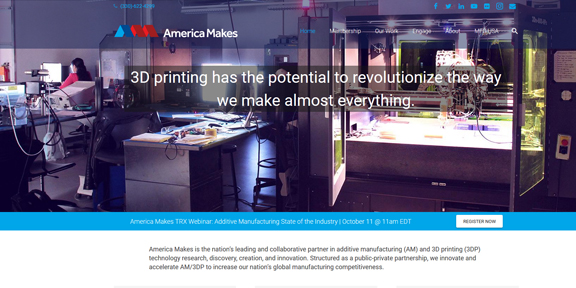
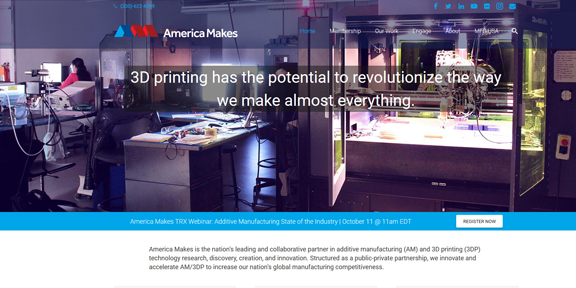 America Makes, a private-public industry consortium, sets out to promote design for additive manufacturing.
Last week Wednesday, around 9 a.m., a sizable crowd made their way up the escalator to the second floor of the Hyatt Regency Hotel by the San Francisco waterfront area. The people included academics, engineers, designers, and manufacturing executives. They had come to attend TRX+, an event organized by America Makes and Autodesk.
The two-day event included keynote talks by Terry Wohlers from Wohlers Associates, on "The Future of Design for Additive Manufacturing and 3D Printing," and Erin Bradner from Autodesk on "Generative Design: Realizing the Future of Design for Additive Manufacturing."
The void the organizers are hoping to fill is the lack of education in design for additive manufacturing (AM).
America Makes is a public-private membership organization that focuses on "advancing the additive manufacturing/3D printing industry," with "a portfolio of more than $100 million in public and private funds," according to its home page. It's managed by the National Center for Defense Manufacturing and Machining (NCDMM). Autodesk happens to be a platinum member of America Makes.
Autodesk also belongs to the Digital Manufacturing and Design Innovation Institute (DMDII), a sign that the company is betting heavily on AM becoming an integral part of design and manufacturing.
"Technology maturity from academia to production environment takes many years, with lots of hurdles to overcome," explained Patti Vrobel, research engineer, Autodesk Research. "America Makes funds projects that will accelerate the adoption of AM. The other part is education, of course. We need to start training people to use these tools."
America Makes offers AM-related training sessions in the classroom and online. In-person classes are usually held in the organization's Youngstown Business Incubator office in Ohio.
Being an emerging technology, AM still has many gaps to fill to reach maturity. Part of the evolution may be the development of AM-aware simulation tools and design programs.
"We know the way the filament are deposited affect the [3D-printed] part's quality, but it's very difficult to tell that to the finite element analysis (FEA) software," noted Dr. David Rosen of Georgia Tech, during his presentation on "A Design Guidance System for AM." He added, "We have to make the design tools AM-aware, and we should do it with the tools the designers are already using."
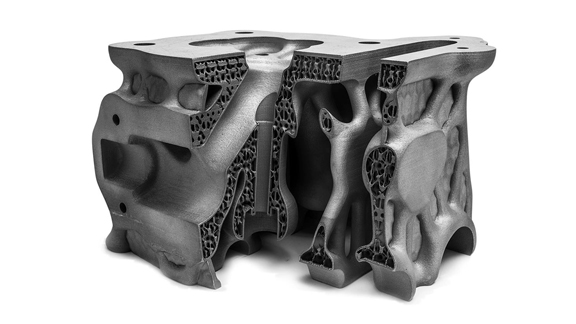 Autodesk Netfabb software allows you to simulate and analyze complex 3D printing projects (image courtesy of Autodesk).
AM advocates promote the notion that, with AM, geometry complexity comes free. What they mean is, with 3D printing, you can affordably manufacture geometrically complex objects that you cannot produce easily or economically with traditional methods like machining or injection molding.
But early adopters and pioneers are now discovering AM cannot be shoehorned into a project midway. It should be part of the project's overall strategy from the start.
"Design for AM is a very different model than design for traditional manufacturing," said Leanne Gluck, deputy director of workforce and education, America Makes. "Companies should integrate 3D printing into the workflow."
Autodesk offers Netfabb, a software program developed specifically for manufacturing simulation, including AM projects. The software is offered as Basic, Premium, or Ultimate edition. Standard includes elementary functions such as CAD import, model preparation, and analysis. Advanced operations such as lattice fills and topology optimization are confined to Premium.
"AM errors could be very expensive," noted Ulf Lindhe, AM business line manager, Autodesk. "Your support structures might break, because they're not properly designed. The print job might crash. You might have to rebuilt the part. What you lose is not just the part but also time and money. The key is, Netfabb lets you simulate what happens whey you melt metal in the AM process."
For more on America Makes, visit its home page.


Kenneth Wong is Digital Engineering's resident blogger and senior editor. Email him at [email protected] or share your thoughts or suggestions at digitaleng.news/facebook.
Follow DE






About Us · Contact Us · Editorial Team · Advertising · Privacy Policy · Subscriber Services · © 2026 Digital Engineering 24/7 · Peerless Media