Helping design and engineering professionals discover, evaluate and specify technologies and processes that shorten the design cycle and enable success.


Alert!
Digital Engineering ceased publication on July 1, 2026. This website remains available as an archive of engineering content.
For inquiries or information, please email [email protected].

Digital Engineering April 2026
In the latest issue of Digital Engineering, we take a look at the latest innovations in design for additive manufacturing, including the use of natural language inputs, social media cosplayers, and AI integration. The issue also includes a feature…

January Special Focus Issue: Design for Additive
In this Special Focus Issue of Digital Engineering, learn about the latest advancements in design for additive manufacturing, including new software tools, additive in automotive, custom medical devices, and more.
The global shortage of available transplant organs and relatively short lifespan of those organs once transplanted has spurred a significant amount of activity around growing new organs from a patient’s own cells. 3D bioprinting is one outgrowth of that work, and Chicago-based BIOLIFE4D has further advanced this particular branch of work with the successful printing of a human cardiac patch in June.
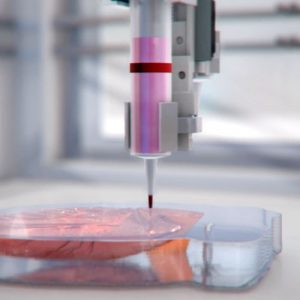 Image courtesy of BIOLIFE4D.
The company was able to print the human cardiac tissue with a few days of opening its new research facility at JLABS in Houston. The patch contains multiple cell types found in the human heart and also includes preliminary vascularization. These types of patches can be used in patients with acute heart failure.
“We are extremely excited to have achieved this milestone and to successfully demonstrate our ability to 3D print human cardiac tissue. When we began this process, we knew this would be a key step in validating our technology and scientific approach, so we are pleased to be able to have accomplished this so quickly,” said Dr. Ravi Birla, the company’s chief science officer. “We have always believed that our scientific approach, as well as the tremendous team we have assembled, positioned us for rapid scientific accomplishment. The speed at which we bioprinted 3D human cardiac patches, within days, is unheard of within the scientific community. These efforts clearly demonstrate our ability to bioprint human tissue and provide a clear and rapid pathway towards bioprinting human hearts.”
The company’s technology can reprogram a patient’s white blood cells into iPS cells and then differentiate those cells into the different types of cardiac cells required to print a patch. Ultimately, the company hopes to print an entire, functioning human heart for transplant.
Bioprinting organs is still in its infancy, but there has been some progress, particularly with less complex structures. A team at Wake Forest University in California, for example, was able to create and transplant a new bladder using a 3D mold.
Techshot and nScrypt have also designed a 3D biofabrication facility for printing thick tissue and organs using stem cells, and that device is set to be launched and installed at the International Space Station (ISS) next year. In 2016, Techshot announced that they had successfully printed cardiac and vascular structures in zero gravity.
Source: BIOLIFE4D"


Brian Albright is the editorial director of Digital Engineering.
Contact him at [email protected].






About Us · Contact Us · Editorial Team · Advertising · Privacy Policy · Subscriber Services · © 2026 Digital Engineering 24/7 · Peerless Media