Helping design and engineering professionals discover, evaluate and specify technologies and processes that shorten the design cycle and enable success.


Alert!
Digital Engineering ceased publication on July 1, 2026. This website remains available as an archive of engineering content.
For inquiries or information, please email [email protected].

Digital Engineering April 2026
In the latest issue of Digital Engineering, we take a look at the latest innovations in design for additive manufacturing, including the use of natural language inputs, social media cosplayers, and AI integration. The issue also includes a feature…

January Special Focus Issue: Design for Additive
In this Special Focus Issue of Digital Engineering, learn about the latest advancements in design for additive manufacturing, including new software tools, additive in automotive, custom medical devices, and more.
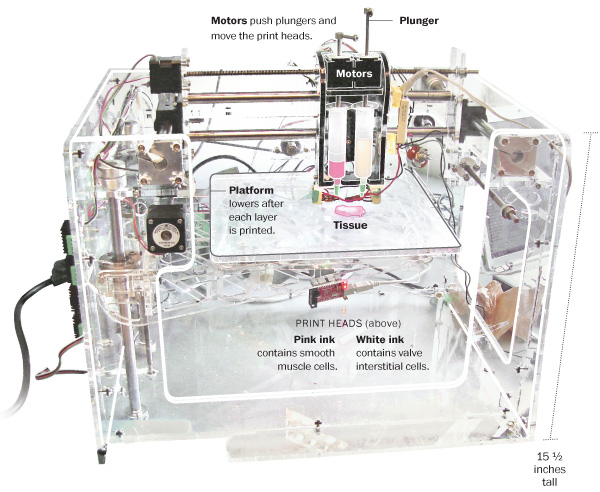
A number of institutes around the world are experimenting with bioprinting. The process uses inkjet based 3D printers and an “ink” made of human cells (as with cloning, using the patient’s own cells are the best bet) mixed with a dissolvable gel, often cellulose. From there, the process is similar to other AM techniques. The printer puts down a layer, which is then cured with heat, chemicals or UV light, before moving on to the next layer. Finally, the printed part is placed in a bioreactor, where it is subjected to the processes it is meant to facilitate (blood is pumped through heart valves, liquid through a liver, etc.).
As well as ensuring transplanted organs won’t be rejected, bioprinting can help to overcome a general shortage of organ donors. As long as the patient has enough of the proper cells to be harvested, no donor is required. Even in cases where this isn’t possible, a donated organ could theoretically be used multiple times to produce a number of organs, instead of providing for a single patient.
Nor is the process limited to the creation of internal organs. Researchers at Washington State University have used bioprinting to make new bones. Doctors at University College in London designed and printed a polymer scaffold that was used for a trachea transplant. Even skin can be produced through this method, which will have a serious impact on the treatment of burn victims.
Below you’ll find a TED Talk that discusses this technology.


John Newman is a Digital Engineering contributor who focuses on 3D printing. Contact him via [email protected] and read his posts on Rapid Ready Technology.
Follow DE






About Us · Contact Us · Editorial Team · Advertising · Privacy Policy · Subscriber Services · © 2026 Digital Engineering 24/7 · Peerless Media