Helping design and engineering professionals discover, evaluate and specify technologies and processes that shorten the design cycle and enable success.


Alert!
Digital Engineering ceased publication on July 1, 2026. This website remains available as an archive of engineering content.
For inquiries or information, please email [email protected].

Digital Engineering April 2026
In the latest issue of Digital Engineering, we take a look at the latest innovations in design for additive manufacturing, including the use of natural language inputs, social media cosplayers, and AI integration. The issue also includes a feature…

January Special Focus Issue: Design for Additive
In this Special Focus Issue of Digital Engineering, learn about the latest advancements in design for additive manufacturing, including new software tools, additive in automotive, custom medical devices, and more.
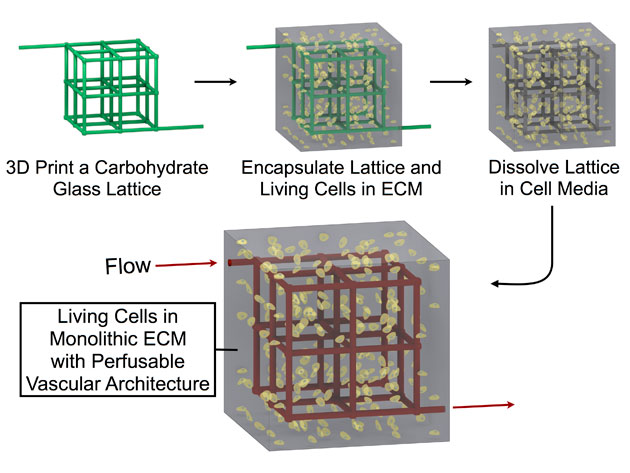
Researchers at the University of Pennsylvania (UPenn) have figured out how to use a 3D printer and sugar to create a vascular system. The research is revealed in journal Nature Materials. When mixed with bio-gels like fibrin, Matrigel or extracellular matrix (ECM) mimics, the process has the potential for building viable organs.
The problem, thus far, with the artificial production of organs has been keeping cells alive long enough for tissue to form.
"The big challenge in understanding how to grow large artificial tissue is how to keep all the cells alive in these engineered tissues, because when you put a lot of cells together, they end up taking nutrients and oxygen from neighboring cells and end up suffocating and dying," said Dr. Jordan Miller, UPenn postdoctoral fellow.
The fact I’m typing this illustrates that natural organs don’t have this issue, because blood vessels pump oxygen and nutrients throughout the body. UPenn’s solution to the problem is to create a framework of sugar using 3D printing. This lattice is then surrounded by bio-gel and the sugar is dissolved to leave vasculature through which blood (or nutrient materials) can flow.
If you create the bio-gel using cells from a patient, you could create artificial organs that are highly unlikely to be rejected. Lead research, Dr. Christopher Chen, has said doctors could begin creating new organs using a sugar lattice and bio-gel within 30 minutes.
The next step in trials for the new method is testing in animals. So far, Dr. Chen’s team has managed to create rat liver cells functioning for eight days.
Below you’ll find a short video about the process.
Sources: BBC, Royal Society of Chemistry


John Newman is a Digital Engineering contributor who focuses on 3D printing. Contact him via [email protected] and read his posts on Rapid Ready Technology.
Follow DE






About Us · Contact Us · Editorial Team · Advertising · Privacy Policy · Subscriber Services · © 2026 Digital Engineering 24/7 · Peerless Media