Helping design and engineering professionals discover, evaluate and specify technologies and processes that shorten the design cycle and enable success.


Alert!
Digital Engineering ceased publication on July 1, 2026. This website remains available as an archive of engineering content.
For inquiries or information, please email [email protected].

Digital Engineering April 2026
In the latest issue of Digital Engineering, we take a look at the latest innovations in design for additive manufacturing, including the use of natural language inputs, social media cosplayers, and AI integration. The issue also includes a feature…

January Special Focus Issue: Design for Additive
In this Special Focus Issue of Digital Engineering, learn about the latest advancements in design for additive manufacturing, including new software tools, additive in automotive, custom medical devices, and more.
The BMW Group officially opened its new Additive Manufacturing Campus in Munich. The new facility will combine production of prototype and series parts, along with research into new 3D printing technologies, and associate training for the global rollout of toolless production, the company says. The campus, which cost €15 million, will allow the BMW Group to "develop its position as technology leader in the utilization of additive manufacturing in the automotive industry," according to a company press release.
“Additive manufacturing is already an integral part of our worldwide production system today, and established in our digitalisation strategy," said Milan Nedeljković, BMW AG Board Member for Production. "In the future, new technologies of this kind will shorten production times even further and allow us to benefit even more fully from the potential of toolless manufacturing.”
“Our goal is to industrialize 3D printing methods more and more for automotive production, and to implement new automation concepts in the process chain," added Daniel Schäfer, Senior Vice President for Production Integration and Pilot Plant at the BMW Group." This will allow us to streamline component manufacturing for series production and speed up development. At the same time, we are collaborating with vehicle development, component production, purchasing and the supplier network, as well as various other areas of the company to systematically integrate the technology and utilize it effectively .”
Last year, BMW produced about 300,000 parts via additive manufacturing. The Additive Manufacturing Campus currently employs up to 80 associates and operates about 50 industrial systems that work with metals and plastics. Another 50 systems are in operation at production sites around the world.
In 2016, BMW i Ventures – the venture capital arm of the BMW Group – invested in the Silicon Valley-based company Carbon. Further investments were made in 2017, when the BMW Group became involved with Desktop Metal, That same year, BMW i Ventures invested in the U.S. start-up Xometry, a platform for on-demand manufacturing. BMW's latest investment was in the German start-up ELISE, which allows engineers to produce component DNA containing all the technical requirements for a part, from load requirements and manufacturing restrictions to costs and potential optimizations parameters. ELISE then uses this DNA, along with established development tools, to automatically generate optimum components.
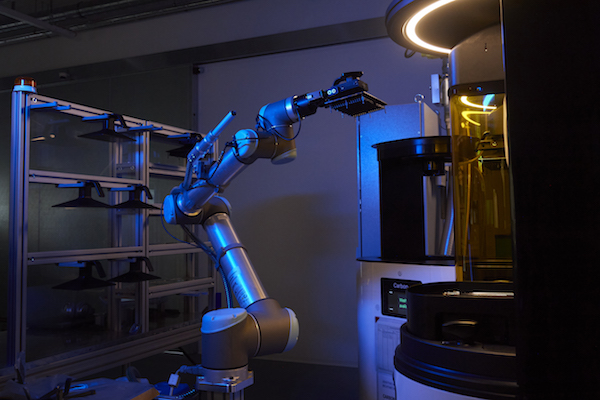
According to BMW, the pre-development unit of the Additive Manufacturing Campus optimizes new technologies and materials for comprehensive use across the company. The main focus is on automating process chains that have previously required large amounts of manual work, to make 3D printing more economical and viable for use on an industrial scale over the longer term.
BMW is also supporting research projects, such as the Industrialis ation and Digitization of Additive Manufacturing for Automotive Series Production (IDAM) project as well as the IDAM project, both supported by the German Ministry of Education and Research. With IDAM, the BMW Group and its 12 project partners are enabling the integration of additive manufacturing into series production environments within the automotive industry. At the Additive Manufacturing Campus, a production line is being set up that replicates the entire process chain, from the preparation of digital production through to manufacture and reworking of components. According to BMW, the IDAM team are now preparing it for the specific requirements of series, individual and spare-part production. Output is expected to total at least 50,000 series components a year, the company says.
The POLYLINE project focuses on aspects such as digitally linking process steps, and the development of a consistent quality assurance methodology for the entire process chain. The Additive Manufacturing Campus will provide the backdrop for the project’s consortium of 15 partners to develop and test a future-proof, fully linked, automated production line for plastic components. Findings from the project are expected to help reduce manufacturing costs by as much as 50 percent.
As well as manufacturing components, the team at the Campus provides personal consultations and training courses for associates across the company. “To roll these technologies out successfully, we need well-trained colleagues across the network who fully understand their advantages and features. To use them, designers will need to adopt a new way of thinking and an entirely new approach as they devise the upcoming components. 3D printing allows almost any shape to be produced, paving the way for new designs and functions. Nowadays, there are countless components that can only be manufactured additively,” says Jens Ertel, Director of the Additive Manufacturing Campus.


DE's editors contribute news and new product announcements to Digital Engineering. Press releases may be sent to them via [email protected].
Follow DE






About Us · Contact Us · Editorial Team · Advertising · Privacy Policy · Subscriber Services · © 2026 Digital Engineering 24/7 · Peerless Media