Helping design and engineering professionals discover, evaluate and specify technologies and processes that shorten the design cycle and enable success.



Digital Engineering April 2026
In the latest issue of Digital Engineering, we take a look at the latest innovations in design for additive manufacturing, including the use of natural language inputs, social media cosplayers, and AI integration. The issue also includes a feature…

January Special Focus Issue: Design for Additive
In this Special Focus Issue of Digital Engineering, learn about the latest advancements in design for additive manufacturing, including new software tools, additive in automotive, custom medical devices, and more.
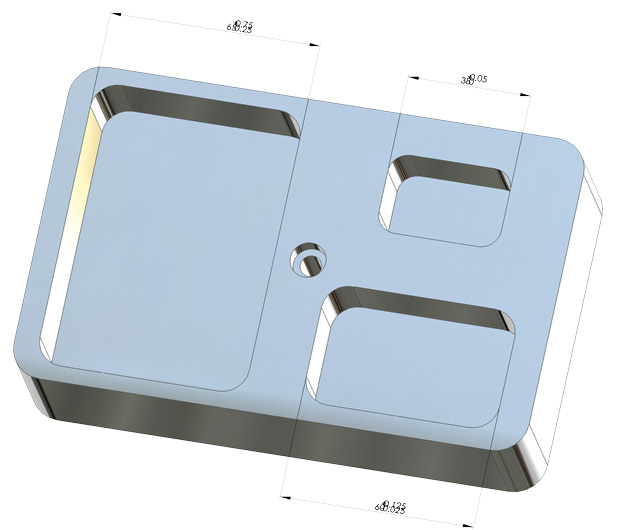 CAMWorks has “Machining to the Mean” capabilities, which work to eliminate issues surrounding differences among design practices. Image courtesy of Geometric.
The CAM industry is undergoing various changes that have affected the number of vendors in the market, as well as the types of tools available. Merger and acquisition activity, as well as tighter integration with design tools and the development of new features, are expanding the options companies have when it comes to programming and machining.

For many years, CAM software vendors defined “integration” as the ability to use, take in, or import 3D CAD models and design data for the purpose of generating toolpaths and automating manufacturing processes. But once geometry was imported into the CAM package, it became completely removed or disassociated from the CAD system. For a CAM application to be truly integrated with CAD software, it must support seamless, single-window integration and be completely associative with the CAD system. In other words, the CAD program must be embedded as the modeling and geometry engine of the CAM system itself.
-- “Making the Job Easier,” DE, November 2006
Initiatives such as Industry 4.0, or smart manufacturing, are driving design-focused companies to more closely integrate with manufacturing technologies, but what effect the acquisition activity is having on CAM is unclear. In some cases, these acquisitions have not necessarily led to any sort of closer integration between the design side of the business and the manufacturing tools.
There is an evolution in CAM software, however, that will result in closer integration with CAD, more automation and multi-tasking, and greater efficiency in programming and machining.
At this month’s IMTS 2016 conference, Autodesk plans to outline a broader vision and software portfolio to support manufacturers. The portfolio will include its CAM tools along with Autodesk’s 3D design and manufacturing offerings.
FeatureCAM 2017, for instance, has been updated to reduce programming time while increasing consistency. The new version includes the ability to import and view product and manufacturing information directly from a model to help visualize design specifications, in addition to other features. The previous release incorporated Autodesk 360, which improved project collaboration. PartMaker 2017, which enables high-precision part manufacturing with Swiss-type lathes, is available within the FeatureCAM 2017 Ultimate product tier.
Efforts to combine CAD and CAM have met with mixed success, but according to Mike Galinac, senior vice president of GTI Precision Components, having a CAD interface to use when healing models, moving holes and building geometries can make a world of difference in a machine shop. “When you see the power of the two systems working together under the same roof, it’s incredible,” he says.
Still, the two systems are very different animals. “There’s a natural benefit to combining some of these [CAD and CAM] functions, but there are some natural drawbacks as well,” says Ben Mund, senior market analyst at CNC Software. CNC’s Mastercam is primarily focused on CAM functionality, but the company does offer a CAD tool as part of its Mastercam X8 offering. “CAM, despite what anyone wants to tell you, requires a tremendous amount of skill at the machine.”
Mund says CNC has focused on forging partnerships with CAD vendors and tool manufacturers. “We have to be open to everybody,” Mund says. “Whatever CAD system they use, we have to be able to flawlessly machine those parts because that’s what the shops have to do. Even with our own CAD product, we are really focused on getting the part off the machine quickly.”
According to Jim Foster, VP of Global Channel Sales & Marketing at Geometric, one area where greater interaction between the CAD and CAM world is beneficial is in enabling companies to go drawing-less. Instead of relying on the drawings to get information about critical dimensions, tolerances and other data, machine shops could manufacture directly from the CAD model.
Earlier this year, Geometric demonstrated this functionality at SOLIDWORKS World. Called “Machining to the Mean,” the feature helps eliminate issues surrounding differences among design practices and machining needs. “Instead of making a 2D drawing, you can put the critical information on a 3D model and ship that off. With SOLIDWORKS, we can read the critical data off the SOLIDWORKS model for tolerances, surfaces and other information, and use that to directly drive automated toolpath generation,” Foster says. “That’s a big change. You aren’t doing all that extra work for documentation, and you can save huge amounts of time.”
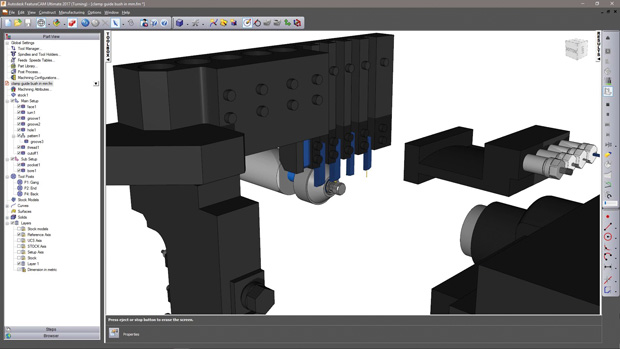 FeatureCAM 2017 has been updated to reduce programming time while increasing consistency. Image courtesy of Autodesk.
The new feature extracts manufacturing features from the model, and then automatically picks the tools and sets the feeds and speeds to automate toolpath generation. “It automates that entire aspect of manufacturing,” Foster says. “It reduces the time it takes to program the part and improves quality and consistency. Having that information in the model that can go directly to a manufacturing tool, it’s easy to see the value in that. Otherwise, someone has to keep notes next to them to figure out what they are doing to do when they select the tools for the project. With automation, none of that is required.”
Atlanta-based GTI specializes in complex aircraft parts and high-tech applications, and operates two five-axis machining centers. When the company first invested in five-axis machines, they used a less expensive CAM system that unfortunately did not provide enough toolpath accuracy and lacked the sophisticated CAD capabilities that Galinac was looking for. The shop had difficulty creating, modifying and repairing models.
GTI switched to a high-end CAD system that was too expensive and too complex given the size of the shop, and lacked enough CAM functionality to make it workable. “It was killing me that CAD systems had such a nice interface, and CAM just didn’t keep pace,” Galinac says. “I wanted a modern, CAD-like feel but in the CAM solution so we could stay in one environment.”
Eventually, the company deployed TopSolid, which includes design features as well as the postprocessors GTI needed in the shop. “One of the things that attracted me was the approach you have in programming the process,” Galinac says. “You have real-time stock model updates.”
One key advantage is also that it is relatively easy to bring the model back into the process if there is a major design revision. “When you start a job you are immediately into the machine,” Galinac says. “From the moment you put down the first toolpath, you can see things like travel limits and material removal. You get immediate feedback and can make decisions based on where the part is relative to the stock. We’re getting something useful so much faster. We are making fewer mistakes.”
Both Mund and Foster agree that the industry is focusing on reducing the time it takes to program and machine a part.
Mund says there is a rapidly growing interest in mill-turn machines that allow shops to finish an entire part with one setup, which is a huge time saver. That is evident in the multitasking machining support available in products like SINUMERIK Operate 4.7 from Siemens.
Improved simulation is also improving efficiency, in much the same way they do in design. “Simulation gives the machinist the ability to turn more parts because they can run a complicated part through a variety of setups quickly to see how they can do a portion of a part that might not be obvious,” Mund says.
Using TopSolid, Galinac at GTI says he is able to use the simulation features in the programming environment. “You get all of the feedback right from the beginning,” Galinac says. “It can make decisions based on the condition of the stock relative to the finished part model. When you combine that with the simulation of the tools and the machine, you really have a different experience than just seeing the tools zipping around a model.”
There are also advances that can make the machining process itself more efficient. CNC Software has introduced a concept called dynamic motion that leverages advances in computing power to develop complex, almost erratic looking toolpaths to increase the speed of the machining process. “The motion is always changing to make sure there is a constant chip load on the tool,” Mund says. “It’s much faster and much easier to use.”
And while CAM is associated with subtractive processes, 3D printing and additive manufacturing capabilities are also having an impact. “You can produce things that were un-producible before,” Mund says. “That’s the beauty of additive.”
Some hybrid applications are emerging that use additive processes to create a rough shape, while incorporating subtractive techniques to finish a part. “The machine programming is not very problematic, because at its core the basic concepts are really the meat and potatoes of what CNC manufacturing has been doing, which is controlling the motion of a head,” Mund says. “Whether that head is laying down material or removing material doesn’t make a difference.”
These innovations, and the transition to smart manufacturing, will drive what Business Advantage Group says is a 37% usage increase in CAM software according to the company’s 2016 CAD Trends Survey. According to the survey, 70% of CAM users think the use of 3D CAD models to automatically generate machining instructions will be important, and 60% want to see software developers to better integrate CAD and CAM.
“There are significant efforts in smart manufacturing and Industry 4.0,” Foster says. “Companies are trying to change manufacturing to be more modern and effective in many areas. The industry is pushing for more integration and really trying to change the status quo. That’s going to be a good thing for end users.”
More Info


Brian Albright is the editorial director of Digital Engineering.
Contact him at [email protected].

Join over 90,000 engineering professionals who get fresh engineering news as soon as it is published.






About Us · Contact Us · Editorial Team · Advertising · Privacy Policy · Subscriber Services · © 2026 Digital Engineering 24/7 · Peerless Media