Helping design and engineering professionals discover, evaluate and specify technologies and processes that shorten the design cycle and enable success.



Digital Engineering April 2026
In the latest issue of Digital Engineering, we take a look at the latest innovations in design for additive manufacturing, including the use of natural language inputs, social media cosplayers, and AI integration. The issue also includes a feature…

January Special Focus Issue: Design for Additive
In this Special Focus Issue of Digital Engineering, learn about the latest advancements in design for additive manufacturing, including new software tools, additive in automotive, custom medical devices, and more.
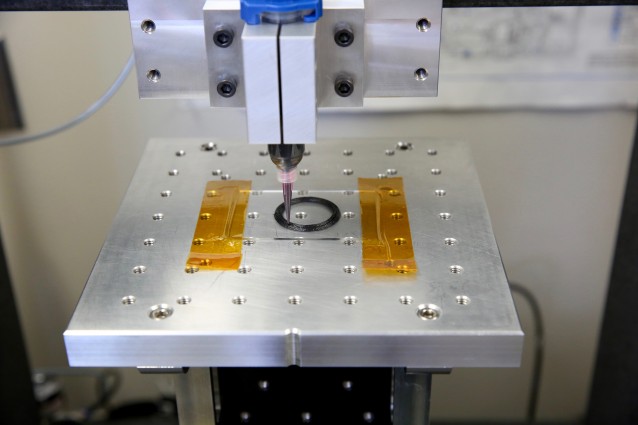
Researcher at Lawrence Livermore National Laboratory leveraged simulation and supercomputing technology to develop a way to 3D print the material using micro-extrusion, making it easier to create more elaborate parts and components.
The team published their research in Scientific Reports earlier in March.
LLNL researchers were able to print complex 3D structures using modified direct ink writing (DIW) technology. Lead researcher Jim Lewicki and his colleagues also created a new chemistry to cure the material in just seconds.
This was accomplished by using simulation to create highly accurate models of the flow of the carbon fiber filaments through the printing process. The team used LLNL’s supercomputers to simulate thousands of carbon fibers as they flowed through an ink nozzle.
"How we got past the clogging was through simulation," Lewicki said. "This has been successful in large part because of the computational models."
"We developed a numerical code to simulate a non-Newtonian liquid polymer resin with a dispersion of carbon fibers. With this code, we can simulate evolution of the fiber orientations in 3D under different printing conditions," said fluid analyst Yuliya Kanarska. "We were able to find the optimal fiber length and optimal performance, but it's still a work in progress. Ongoing efforts are related to achieving even better alignment of the fibers by applying magnetic forces to stabilize them."
The printing process also provides more control over the resultant parts’ mesostructure. The materials used in the research also provide enhanced mechanical and thermal performance compared to thermoplastics. Because the carbon fibers can be printed all in the same direction, the material can outperform similar materials that are created using random alignment.
The researchers claim this would allow them to use two-thirds less carbon fiber to achieve the same material properties.


Brian Albright is the editorial director of Digital Engineering.
Contact him at [email protected].

Join over 90,000 engineering professionals who get fresh engineering news as soon as it is published.






About Us · Contact Us · Editorial Team · Advertising · Privacy Policy · Subscriber Services · © 2026 Digital Engineering 24/7 · Peerless Media