Helping design and engineering professionals discover, evaluate and specify technologies and processes that shorten the design cycle and enable success.


Alert!
Digital Engineering ceased publication on July 1, 2026. This website remains available as an archive of engineering content.
For inquiries or information, please email [email protected].
Sponsored

May 2026 Special Focus: Artificial Intelligence in Design and Simulation
In this Special Focus Issue, learn about the latest developments in the integration of artificial intelligence into engineering workflows.

Design & Simulation Software Guide 2025
In this Special Issue, Digital Engineering presents its second annual guide to design and simulation software vendors.
Dear Desktop Engineering Reader:
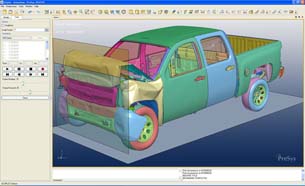 |
Today's Check It Out features Tim Palmer, Software Product Manager at ETA, in a Q&A vodcast. You probably know Engineering Technology Associates (ETA) for its VPG and DYNAFORM applications. Awhile back, ETA announced a new enterprise product development solution called the Inventium Suite. The first product in the Inventium Suite, PreSys, has been released, and Mr. Palmer focuses his remarks on both it and Inventium.
The idea of Inventium Suite is to give you a unified and streamlined architecture to access the suite's analysis, simulation, and third-party applications that you need to do your job. By the way, we're talking here of high-level simulation tools, including such specialties as vehicle durability, NVH, metal forming, crashworthiness, and occupant safety as well as verticals like military applications.
OK, now, the keep-in-mind thing here ETA tells me is that Inventium is architected with flexibility and configurability in mind. That means you can change how your application appears and behaves: You can create new menus or toolbars or modify the pre-configured menus so that everything works as you like it. You can also capture, replay, and modify entire processes.
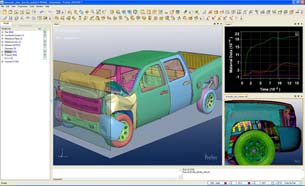 |
Now, what this all means is that you can push powerful CAE down, up, and around your enterprise so that product development engineers and simulation specialists alike can use Inventium's applications to access design data and create their unique simulation models. And one key that unlocks the Inventium Suite is PreSys, a pre- and post-processor core finite element (FE) modeling toolset.
PreSys is the successor to ETA’s VPG/PrePost and FEMB products. It is solver-neutral, said to seamlessly interface with LS-DYNA, MSC/NASTRAN, NX NASTRAN, and NEI NASTRAN. It also interfaces with major CAD applications such as AutoCAD, CATIA, NX, Pro/ENGINEER, and SolidWorks. It enables you to open and work on multiple models. It has complete results visualization and reporting capabilities.
You can learn more about PreSys and Inventium from the link over there. The vodcast is short, but it may have a long-term effect at how you understand the simulation process. After all, analysis grew out of engineering and science labs as dedicated applications to solve some difficult problem. Over time, they migrated to Windows, but many retained their jerry-rig, get-the-job done feel, constricting their use by engineers who could leverage their power. The Inventium Suite could change that for you.
Thanks, pal. -- Lockwood
Anthony J. Lockwood
Editor at Large, Desktop Engineering
Check out Tim Palmer, Software Product Manager at ETA, in a Q&A vodcast.


Anthony J. Lockwood is Digital Engineering's founding editor. He is now retired. Contact him via [email protected].
Follow DE






About Us · Contact Us · Editorial Team · Advertising · Privacy Policy · Subscriber Services · © 2026 Digital Engineering 24/7 · Peerless Media