Helping design and engineering professionals discover, evaluate and specify technologies and processes that shorten the design cycle and enable success.


Alert!
Digital Engineering ceased publication on July 1, 2026. This website remains available as an archive of engineering content.
For inquiries or information, please email [email protected].

Digital Engineering April 2026
In the latest issue of Digital Engineering, we take a look at the latest innovations in design for additive manufacturing, including the use of natural language inputs, social media cosplayers, and AI integration. The issue also includes a feature…

January Special Focus Issue: Design for Additive
In this Special Focus Issue of Digital Engineering, learn about the latest advancements in design for additive manufacturing, including new software tools, additive in automotive, custom medical devices, and more.
In response to industry demand, Clemson University has partnered with the State of South Carolina to launch a full-spectrum advanced materials research and development center to drive innovation for the state’s automotive, aerospace, defense and energy clusters.
The Clemson Composites Center combines decades of expertise and equipment to bring all stages of the engineering lifecycle in one institution, from fundamental science and molecular engineering to rapid prototyping and full-scale commercialization.
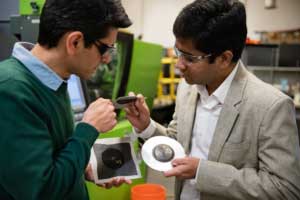
“The complexity of high-impact innovation requires collaboration across partners from multiple sectors, which is why we continue to prioritize and invest in advanced manufacturing expertise and infrastructure,” Clemson President Jim Clements says. “This Center has already proven to be a research and development catalyst for the state and will continue to do so for many decades into the future.”
The 6,500-square-foot Center will strengthen the University and South Carolina’s national reputation for composites research for the mobility industry, including the engineering of lighter, stronger, affordable, more sustainable composites solutions for cars, planes and beyond.
“Lightweight and advanced materials are crucial for a more sustainable and efficient future,” Clemson Composites Center Founding Director Srikanth Pilla says. “Everything we’ve built is designed to catalyze breakthrough innovation, from the Center’s integrated physical infrastructure to our holistic, interdisciplinary research and development approach. By working hand in hand with our partners, we’re can better deliver high-TRL research that moves us towards that goal.”
The heart of the Center—a new composites material laboratory—is being commissioned at the Greenville Technical College’s Center for Manufacturing Innovation (CMI), adjacent to the Clemson University International Center for Automotive Research (CU-ICAR). The lab will come online as early as Q1 2021.
As part of CMI, the Center can expand aspects of technical training for Greenville Technical College’s advanced manufacturing and engineering students. A key component of the Center’s vision is to address workforce development challenges by offering graduate and technical students to chance to collaborate, learn and innovate in the same research space.
The Center’s first project will be the completion of Pilla’s $5.8M research project to redesign a driver’s side door to be lighter, stronger and smarter using advanced composites. The interdisciplinary project team—which includes the U.S. Department of Energy and Honda R&D Americas, among other partners—will use the Center’s specialized equipment to build and validate the final prototype. The project has pushed the limits of component and material design for lightweighting, according to the university.
Working closely with companies, the Center is designed to accelerate the development and validation of high impact technologies, acting as a catalyst for economic growth. By transforming and commercializing cost-effective, efficient and sustainable solutions, the Center supports South Carolina’s economic development efforts, industry priorities and the development of a highly skilled workforce.
“The Clemson Composites Center is part of South Carolina’s broader strategy to develop innovative resources for the aerospace and automotive sectors, which are critical to continued economic development within our borders,” says South Carolina Secretary of Commerce Bobby Hitt. “This is a powerful tool to both attract new industry and help existing businesses grow and succeed in our state.”
The advanced materials industry, which includes composite materials, has brought 10,200 advanced materials jobs and $7.2 billion in capital investment to the state since 2011, according to the S.C. Department of Commerce. South Carolina is home to more than 800 advanced materials and composites companies.
“From OEMs to suppliers in automotive, aerospace and beyond, the global reputation of CU-ICAR is directly tied to our ability to support our partners and advance economic development in South Carolina,” says David Clayton, CU-ICAR Executive Director and assistant vice president for the Office of Corporate Partnerships and Strategic Initiatives.
The Clemson Composites Center will launch with a cross-disciplinary leadership team and professional staff, and will be driven by support from research assistants, PhD students and CU-ICAR technicians.
Sources: Press materials received from the company and additional information gleaned from the company’s website.


DE's editors contribute news and new product announcements to Digital Engineering. Press releases may be sent to them via [email protected].
Follow DE






About Us · Contact Us · Editorial Team · Advertising · Privacy Policy · Subscriber Services · © 2026 Digital Engineering 24/7 · Peerless Media