Helping design and engineering professionals discover, evaluate and specify technologies and processes that shorten the design cycle and enable success.


Alert!
Digital Engineering ceased publication on July 1, 2026. This website remains available as an archive of engineering content.
For inquiries or information, please email [email protected].

Digital Engineering April 2026
In the latest issue of Digital Engineering, we take a look at the latest innovations in design for additive manufacturing, including the use of natural language inputs, social media cosplayers, and AI integration. The issue also includes a feature…

January Special Focus Issue: Design for Additive
In this Special Focus Issue of Digital Engineering, learn about the latest advancements in design for additive manufacturing, including new software tools, additive in automotive, custom medical devices, and more.
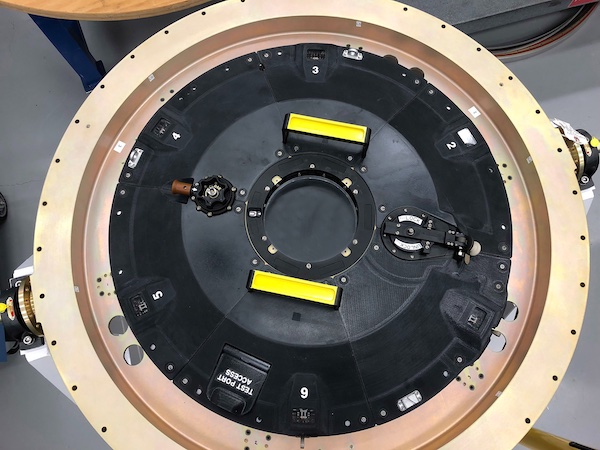
Lockheed Martin’s mission to launch spacecraft with 3D printed end-use parts took another step forward thanks to a collaboration delivering qualification data for a PEKK-based high-performance thermoplastic designed for Stratasys production-grade 3D printers.
Working with Stratasys and Metropolitan State University of Denver (MSU), Lockheed Martin collected the data necessary to qualify the Antero 840CN03 material for flight parts, enabling it to expand its use beyond the initial application designed for the Orion vehicle. Designed for space-ready performance, the material is a PEKK-based high-performance, ESD thermoplastic composite material specifically crafted for Stratasys FDM printers that meets the ESD performance and NASA outgassing requirements. The material also exceeds the flame, smoke, and toxicity characteristics required for aviation applications.
Companies like Lockheed Martin need this baseline set of data to support a usage agreement with customers, according to Cris Robertson, associate manager of Advanced Manufacturing at Lockheed Martin. “We need to detail processes, mechanical properties, electrostatic dissipation, and outgassing performance of the material,” he explains. “By studying material behavior under a variety of conditions and generating mechanical design values, we can establish a baseline to mark our process improvements against.”
During this first phase of qualification, the baseline data was collected by printing over 280 test coupons in Antero 840CN03 on Stratasys Fortus F900 3D printers at Lockheed Martin and Stratasys Direct Manufacturing facilities. Coupons were tested for tensile strength properties, and the data collected confirmed the high performance of the Antero material, officials said. MSU of Denver, which upgraded its AM lab to play a role, served as an alternative printing site and its staff contributed to the development and review of the process and the filament specifications, according to Mark Yoss, director of the Advanced Manufacturing Sciences Institute at MSU.
The collaboration is also a good opportunity to train the future workforce and prepare students to work in industry. “The school stands ready to support printing in the next phase and is excited to provide students with experiential learning opportunities,” Yoss says.
Moving forward, Lockheed Martin plans to leverage this collaboration to do a full characterization of the Antero material expanded to include items such as compression, flexure, and other design guidance properties, Robertson says. The plan is also to use the data published by MSU and the resources available at their Advanced Manufacturing Institute to help other companies demonstrate equivalency to this tensile data set, with the goal being to benefit the entire AM community, he adds.
In the end, the idea is to accelerate the speed of AM adoption across aerospace applications. “The ultimate goal of collecting data is to install confidence in the performance of the material and the manufacturing process for flight applications,” says Norm Stucker, commercial leader—aerospace, for Stratasys.
Check out this video for a deep dive webinar on Antero family of Stratasys FDM 3D printing materials.


Every day, our customers find simpler, smarter approaches to stubborn design problemsand greater confidence to confront towering human and technological challenges. Less hindered by the usual constraints, they can imagine, design, iterate and…
Rapid Prototyping in The Automotive Industry
Henry Ford may not have invented the automobile, but his pioneering spirit did transform the way cars were made. His assembly line process drastically reduced costs with standardized parts and greater efficiency which led to lower cost, higher quality and greater reliability.

Beth Stackpole is a contributing editor to Digital Engineering. Send e-mail about this article to [email protected].
Follow DE
Join over 90,000 engineering professionals who get fresh engineering news as soon as it is published.






About Us · Contact Us · Editorial Team · Advertising · Privacy Policy · Subscriber Services · © 2026 Digital Engineering 24/7 · Peerless Media