Helping design and engineering professionals discover, evaluate and specify technologies and processes that shorten the design cycle and enable success.


Alert!
Digital Engineering ceased publication on July 1, 2026. This website remains available as an archive of engineering content.
For inquiries or information, please email [email protected].

May 2026 Special Focus: Artificial Intelligence in Design and Simulation
In this Special Focus Issue, learn about the latest developments in the integration of artificial intelligence into engineering workflows.

Design & Simulation Software Guide 2025
In this Special Issue, Digital Engineering presents its second annual guide to design and simulation software vendors.
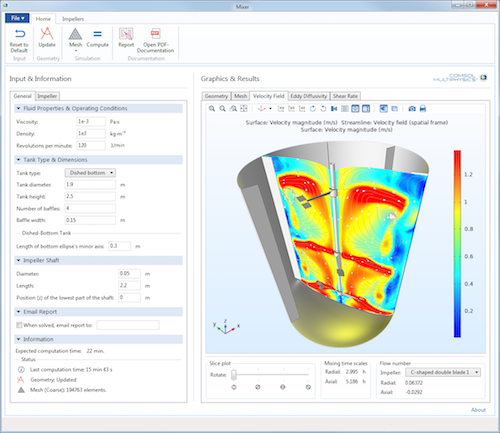
After 20 years in the making, COMSOL just made good on a long-standing promise to customers, releasing a compiler that enables easy distribution of simulation applications as part of its latest multiphysics release.
The compiler capability, which helps democratize simulation applications beyond what is possible with the COMSOL Server, has been a difficult promise to pull off given the historical limitations of engineering workstation environments. Applications compiled with the compiler are bundled with COMSOL Runtime, so there is no additional license necessary, which allows users to extend simulation-based tools both internally as well as to partners and customers.
“It took us 20 years to deliver an ability to create standalone apps that don’t require a full COMSOL Multiphysics or COMSOL Server license,” said Svante Littmarck, COMSOL president and CEO, at its recent user conference. “We couldn’t do it then because it would take forever to run a model, but today, computers are so much more powerful than they were 20 years ago.”
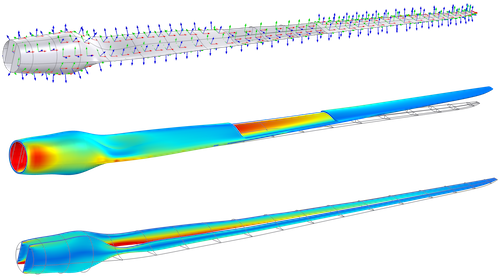
COMSOL’s new Composite Materials Module delivers modeling tools for working with layered materials. Image Courtesy of COMSOL.
The COMSOL Compiler joins a number of other features headlining the COMSOL Version 5.4 release. Also new is the Composite Materials Module, a toolset aimed at helping engineers working with layered materials such as the laminated structures used in aerospace and wind turbine applications. Unlike other composite simulation packages, COMSOL is enabling composite simulation in a multiphysics context, which greatly expands functionality for testing against heat transfer or electromagnetics, for example. For instance, the ability to couple composite simulation with thermal analysis would allow design engineers to explore the impact of lightning strikes on aircraft wings or on wind turbine blades.
While coupling composite simulation with other modalities might have been possible before, it was laborious and potentially error-prone. “Typically engineers would be using three different software packages, which means there was a lot of complex hand offs,” explains Valerio Marra, COMSOL marketing director. “How do engineers want to spend their time, modeling or making software tools work together?”
Accompanying these two new modules are a variety of other enhancements throughout the platform, including numerous performance improvements such as an updated memory allocation scheme that delivers faster computations for Windows 7 and 10 operating systems and on computers with more than eight processor cores.
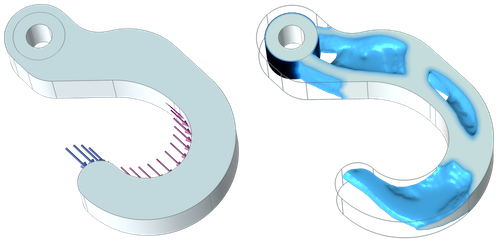
COMSOL 5.4’s topology optimization tool finds the optimal material distribution when the structural part is subjected to two load cases. Image Courtesy of COMSOL.
Other new enhancements:
Watch this tutorial to learn more about how to build COMSOL apps.


COMSOL is a global provider of simulation software for product design and research to technical enterprises, research labs, and universities. Its COMSOL Multiphysics® product is an integrated software environment for creating physics-based models…

Ebook download: Powering Clean Energy Solutions
In this ebook, we explore 6 cases where modeling and simulation were used to help overcome these new design challenges. Topics include water turbines, sand-based heat storage, hydrogen fuel cells, and more.

Beth Stackpole is a contributing editor to Digital Engineering. Send e-mail about this article to [email protected].
Follow DE






About Us · Contact Us · Editorial Team · Advertising · Privacy Policy · Subscriber Services · © 2026 Digital Engineering 24/7 · Peerless Media