Helping design and engineering professionals discover, evaluate and specify technologies and processes that shorten the design cycle and enable success.



May 2026 Special Focus: Artificial Intelligence in Design and Simulation
In this Special Focus Issue, learn about the latest developments in the integration of artificial intelligence into engineering workflows.

April 2026 Special Focus Issue: Generative Design
In this Special Focus Issue, Digital Engineering takes a look at how generative design solutions can be used across different types of design problems and with a variety of manufacturing approaches to accelerate design space exploration, and…
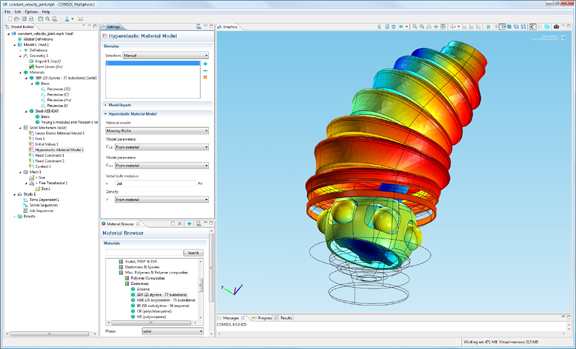
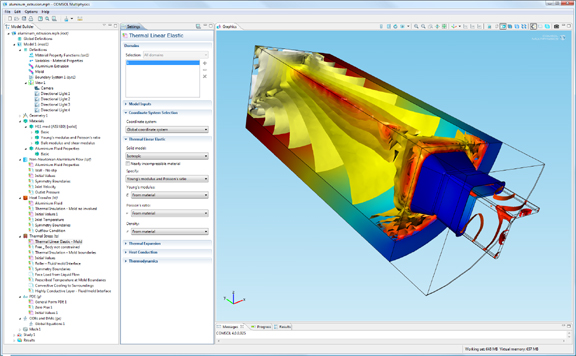
With the inclusion of basic stress analysis functions in CAD programs, many designers and engineers became familiar with the general work flow: meshing, applying constraints, defining loads, and simulating the event. But multiphysics -- simulating events involving more than one physics model -- could stop cold even experienced analysts.
David Kan, COMSOL's VP of sales for southwestern U.S., offered to dispel some myths about multiphysics, including the popular notion that it's so computationally intense it can only be done in high-performance computing (HPC). "To do a multiphysics model 15 years ago on a single desktop machine would have been nearly impossible," he said. "These days you can do multiphysics with a fairly modest machine right away. There's really nothing holding you back."
"Behind every physics model, say, a thermal model or a mechanical model, there's a mathematical representation of that physical reality," explained Kan. "What we [analysis software products] simulate are a continuum of mathematical models. For each and every physics you have, you have another set of physics that must be solved. So the more physics there is, the more computation intensive it is. So a multiphysics model is always going to be more computation intense than a single physics model."
In some cases, multiphysics simulation may be made possible by code-coupling, the practice of cojoining two sets of code, each written to represent one physical behavior. "I have a code for structural mechanical here, another for fluid mechanical here," explained Kan. "And I want to solve a fluid-structure interaction problem. Therefore I'm going to try to glue these two different programs together ... That process is a lot less stable than doing the code-coupling within COMSOL's multiphysics [interface]."
Earlier this month, at the sixth annual COMSOL Conference in Boston, Massachusetts, the company unveiled release 4.0 of its flagship multiphysics modeling platform. In the announcement highlighting new features, the company wrote, "Users can now copy and paste nodes within the Model Builder -- a huge time-savings that avoids repeated sequences of commands. Now with a single click of a button, users can duplicate selected nodes as functions, geometry selections, plot settings and visualization effects, or they can use duplicated nodes to create new images, to study the steps that control solver settings and analysis type, or prepare data for export."
For more, listen to my recorded interview with Kan below.



Kenneth Wong is Digital Engineering's resident blogger and senior editor. Email him at [email protected] or share your thoughts or suggestions at digitaleng.news/facebook.
Follow DE
Join over 90,000 engineering professionals who get fresh engineering news as soon as it is published.






About Us · Contact Us · Editorial Team · Advertising · Privacy Policy · Subscriber Services · © 2026 Digital Engineering 24/7 · Peerless Media