Helping design and engineering professionals discover, evaluate and specify technologies and processes that shorten the design cycle and enable success.




May 2026 Special Focus: Artificial Intelligence in Design and Simulation
In this Special Focus Issue, learn about the latest developments in the integration of artificial intelligence into engineering workflows.

April 2026 Special Focus Issue: Generative Design
In this Special Focus Issue, Digital Engineering takes a look at how generative design solutions can be used across different types of design problems and with a variety of manufacturing approaches to accelerate design space exploration, and…
Siemens Digital Industries Software debuts two product updates.
D-Cubed 2D components are integrated by software developers to add functionality to the sketching environment of CAD/CAM/CAE and architecture, engineering, construction software applications. These applications are used to design, analyze, visualize and manufacture products from consumer goods to aircraft engines and commercial buildings.
D-Cubed 2D DCM (2D Dimensional Constraint Manager) is a 2D geometric constraint solver. In addition to driving the sketcher in many CAD products, 2D DCM is used in CAM, CAE and other geometry-based applications.
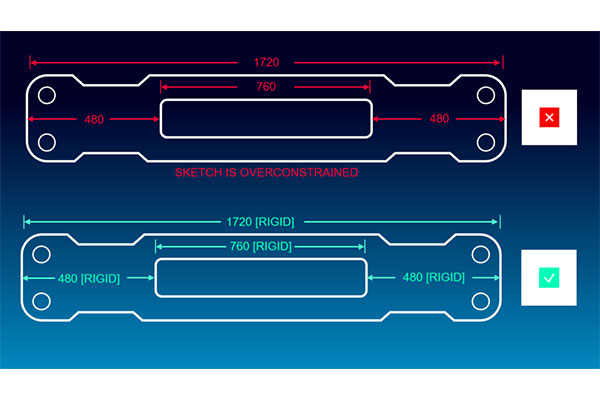
Changes to a parametric sketch can be driven by modifying the values of dimensions. In models where a dimension cannot be modified and solved independently of another dimension, 2D DCM will mark the model as over-defined, even if the current values of the dimensions are consistent. In cases where such dimension values are known to be fixed, these can be classified as a rigid dimensions, enabling 2D DCM to solve the model.
Version 74 more strictly controls situations where the value of a rigid dimension may be changed to improve the reliability of the solving process.
D-Cubed PGM (Profile Geometry Manager) enhances sketcher productivity. It does this by working with higher level geometric data and not individual curves. Examples include offsetting loops while inserting, extending and trimming edges, adding constraints to loops rather than to individual curves, and solving the shape of loops while maintaining their perimeter length or area. PGM is often used to add capabilities to a 2D DCM-based sketcher.
New in Simcenter Femap 2022.2 is a next-generation cloud collaboration with Xcelerator Share.
You can now instantly, securely and easily collaborate with colleagues, partners and customers with Siemens’ next-generation, cloud-based collaboration solution, Xcelerator Share—now available in Simcenter Femap 2022.
Xcelerator Share and Simcenter Femap offer a wide range of collaboration features. Share’s rich set of capabilities addresses your cloud collaboration needs by providing teams with secure, central storage with optional data management tools. It also enables ad-hoc collaboration with internal and external stakeholders, thanks to easy email address-based project and file sharing.
New capabilities enabled by Xcelerator Share and Simcenter Femap include:
Xcelerator Share is the first cloud component of Siemens' new Xcelerator as a Service (or XaaS) subscriptions.
For more on Xcelerator Share, read here.
Sources: Press materials received from the company and additional information gleaned from the company’s website.


Simcenter™ software, from Siemens Digital Industries Software, uniquely combines system simulation, 3D CAE and test to help you predict performance across all critical attributes earlier and throughout the entire product lifecycle. By combining…
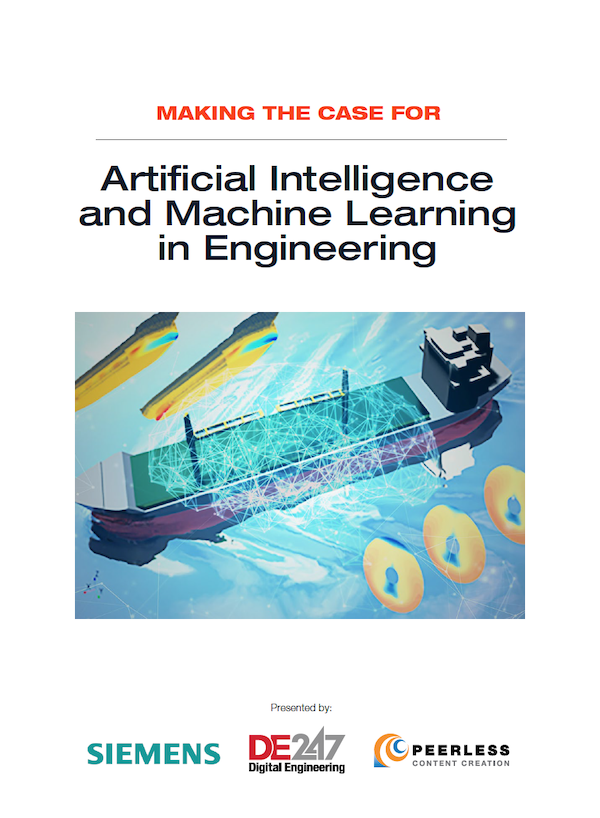
Making the Case for Artificial Intelligence and Machine Learning in Engineering
In this paper, Siemens Digital Industries Software and Digital Engineering will provide an overview of how AI/ML-enabled software can improve design workflows, while also addressing common questions and concerns around implementing this technology in an engineering organization.

DE's editors contribute news and new product announcements to Digital Engineering. Press releases may be sent to them via [email protected].
Follow DE
Join over 90,000 engineering professionals who get fresh engineering news as soon as it is published.






About Us · Contact Us · Editorial Team · Advertising · Privacy Policy · Subscriber Services · © 2026 Digital Engineering 24/7 · Peerless Media