Helping design and engineering professionals discover, evaluate and specify technologies and processes that shorten the design cycle and enable success.


Alert!
Digital Engineering ceased publication on July 1, 2026. This website remains available as an archive of engineering content.
For inquiries or information, please email [email protected].
Sponsored
Dear DE Reader:
Good planning once meant that you'd start a simulation or visualization job before you went to a meeting or home for the night. It may well still be if your workstation is, say, four years old. Detailed design, particularly simulation and visualization, is a complex, time-intensive business. But within the last three years, advances in GPUs (graphics processing units) and related technologies have changed that picture.

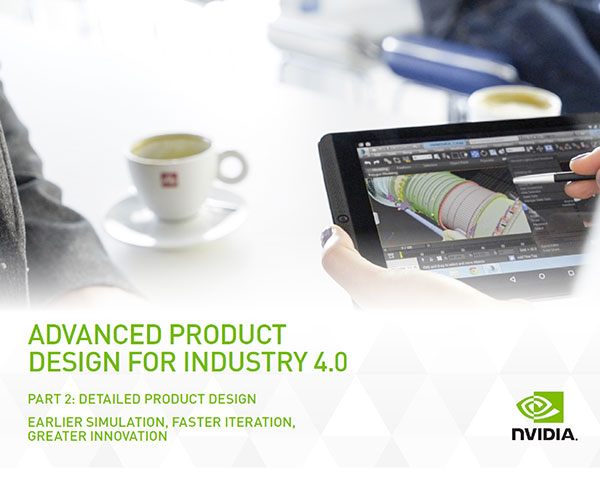
The paper “Advanced Product Design for Industry 4.0, Part 2: Detailed Product Design” is the second installment of a four-part series exploring the rapidly changing technologies for product development. (Read part 1 here.) Developed by NVIDIA, this paper homes in on the capabilities found in new-generation GPUs and the potential they offer users leveraging such technologies as artificial intelligence (AI), generative design, photorealistic rendering and virtual reality.
In “Part 2: Detailed Design,” the heart of the matter is that the productivity and performance of the modern GPU-CPU combination, whether in a workstation, a cluster, a mobile device or through cloud hosting enables engineering and manufacturing companies to reinvent their advanced product development workflows and processes. Additionally, they’re resetting project timeline expectations for faster development cycles.
This paper focuses on how these processes for design simulation and design visualization jobs can be reinvented. Fast, scalable physics-based GPU-accelerated physically based rendering is key here. It provides the speed with which users can interactively adjust, say, realistic materials or boundary parameters then visualize early-stage prototype designs and validate or reject the tweaks in near real time. It's the game changer on a number of levels such as rapid decision-making and cross-disciplinary collaboration.
A strength of this paper is that it's neither a peppy brochure nor a teeth-breaking technical grind. What it does best is explain key GPU technologies you often read about, say, AI-driven denoising, and tells you how it operates in digestible terms for the user rather than the programmer. It links a given technology to the role it performs in product development. It frequently cites the visualization capabilities of many widely deployed CAD and analysis solutions supporting the technology. Quotes from users in the real world, cool images and breakout sidebars enhance the discussion throughout.
“Advanced Product Design for Industry 4.0, Part 2: Detailed Product Design” is an engaging, informative read. If you've wondered what the new generation of GPUs means for design and simulation, this is for you. Hit today's link for your copy.
Thanks, Pal. – Lockwood
Anthony J. Lockwood
Editor at Large, DE


Since its founding in 1993, NVIDIA (NASDAQ: NVDA) has been a pioneer in accelerated computing. The company’s invention of the GPU in 1999 sparked the growth of the PC gaming market, redefined computer graphics, ignited the era of modern AI and…

Cut Retrieval-Augmented Generation (RAG) Hallucinations by 50%
Most teams hit the same wall with enterprise AI: LLMs that hallucinate, pipelines that don’t scale, and infrastructure that’s harder to design than the models themselves.

Anthony J. Lockwood is Digital Engineering's founding editor. He is now retired. Contact him via [email protected].
Follow DE






About Us · Contact Us · Editorial Team · Advertising · Privacy Policy · Subscriber Services · © 2026 Digital Engineering 24/7 · Peerless Media