Helping design and engineering professionals discover, evaluate and specify technologies and processes that shorten the design cycle and enable success.


Alert!
Digital Engineering ceased publication on July 1, 2026. This website remains available as an archive of engineering content.
For inquiries or information, please email [email protected].

Digital Engineering April 2026
In the latest issue of Digital Engineering, we take a look at the latest innovations in design for additive manufacturing, including the use of natural language inputs, social media cosplayers, and AI integration. The issue also includes a feature…

January Special Focus Issue: Design for Additive
In this Special Focus Issue of Digital Engineering, learn about the latest advancements in design for additive manufacturing, including new software tools, additive in automotive, custom medical devices, and more.
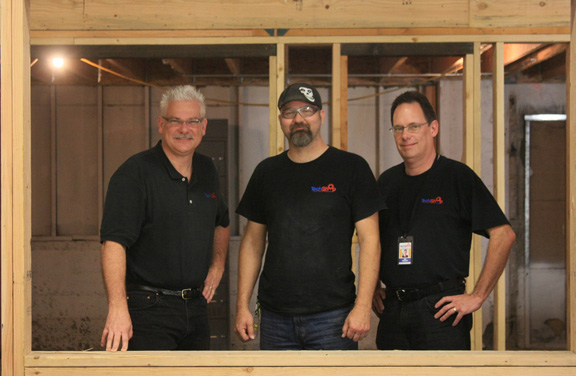
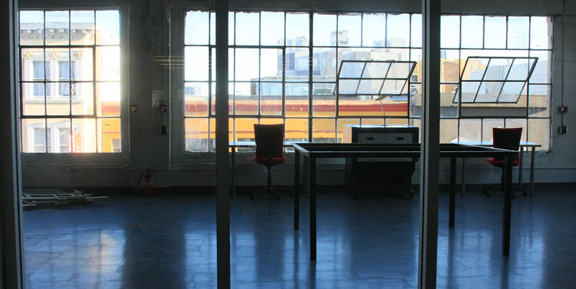
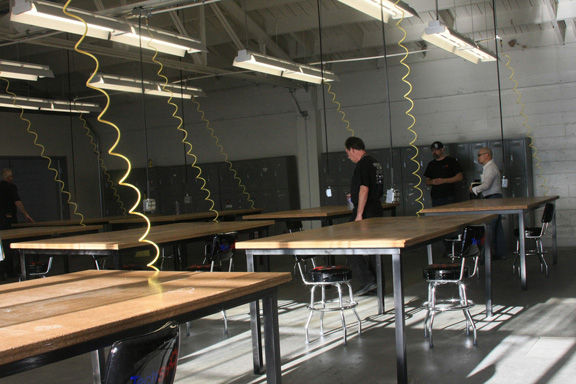
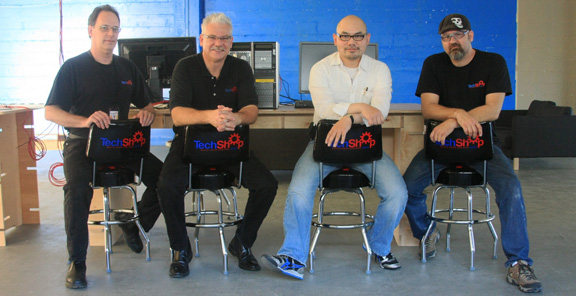
Several blocks away from the heart of downtown San Francisco, where pubs and clubs commingle with warehouses, clean, bold typefaces enclosed in a yellow-and-black border painted on a wall announce the pending arrival of TechShop. The two story, 17,000 sq. ft. space is currently empty, save a series of workbenches, dangling ceiling lights, metal cutters, and woodcutters. Come January, the sunny, spacious building will become a members-only do-it-yourself workshop, the fifth in a chain.
Much like its counterparts spread across the U.S. from California to North Carolina, the San Francisco TechShop location will be outfitted with CNC machines, vacuum forming machines, sheet-metal punchers, drill presses, 3D scanners, and HP Z600 workstations. For $125 a month, this could become your manufacturing facility for low production runs and one-of-a-kind hobby projects.
Design software gives people a way to visualize their ideas in 3D, be it a stylized surfboard or a custom hot rod. But turning detailed geometry into a physical prototype is, for most people, not an affordable proposition. Most machine shops and mold facilities are designed to churn out hundreds and thousands of identical units, not two to twenty units of experimental objects with dubious profit margins.
When Jim Newton launched TechShop in 2006, he sparked a wildfire of self-made merchandises and creations. The company now has four open locations: San Jose, California; Detroit, Michigan; Raleigh, North Carolina; and Portland, Oregon. More are scheduled to open following the San Francisco site. Check out the TechShop member gallery and you'll find that they're building everything imaginable, from chocolate bars (CNC cut), robots, and woodcut dinosaurs to lunar landing vehicles.
There's something else you should know about the workstations installed at TechShop -- they're preloaded with Autodesk software (AutoCAD, Autodesk Inventor, Autodesk Alias, to name but a few). Should you need guidance on using the software, TechShop offers classes (9 hours of Inventor training for $499; 8 hours of SolidWorks training for $395). Same goes for hardware too (1.5 hour CNC vinyl cutter training for $45; 2 hour metal shop training for $60).
"Using a mill the old-school way requires lots of math, plus six months to multiple years of experience on the machine to be fluent on it, to learn its nuances, so you'd have to go to a trade school or become an apprentice," observed Mark Hatch, CEO of TechShop. "With the power of the software, if you can learn to use the software, you can skip the apprenticeship and go straight to production."
"With the advent of so many new composite materials," saidTerry Sandin, who will be managing the new SF location of TechShop, "people could run their ideas through [CAD-driven finite element analysis or stress analysis] to see if it'll work."
TechShop-style engineering reaches a much broader audience, including craft fair folks and artistic types. It's not confined to the testosterone-driven industrial builders and handymen (as type-casted in the sit-com Home Improvement's fictional lead Tim Taylor).
"We are in the beginning of the largest creativity innovation the world has ever seen, driven by extremely powerful tools [CAD software] that allow you to visualize things before you make them," said Hatch. "With TechShop capabilities, you can produce [your prototypes] in days, not months or years. Combine that with the long tail of the internet, you get friction-free ability to market things -- we're in a new space."
Some TechShop members have reportedly succeeded in turning their ideas into commercial projects, building them in manageable volumes and selling them directly to consumers through eBay, Etsy, and other outlets.


Kenneth Wong is Digital Engineering's resident blogger and senior editor. Email him at [email protected] or share your thoughts or suggestions at digitaleng.news/facebook.
Follow DE






About Us · Contact Us · Editorial Team · Advertising · Privacy Policy · Subscriber Services · © 2026 Digital Engineering 24/7 · Peerless Media