Helping design and engineering professionals discover, evaluate and specify technologies and processes that shorten the design cycle and enable success.


Alert!
Digital Engineering ceased publication on July 1, 2026. This website remains available as an archive of engineering content.
For inquiries or information, please email [email protected].
Dear DE Reader:
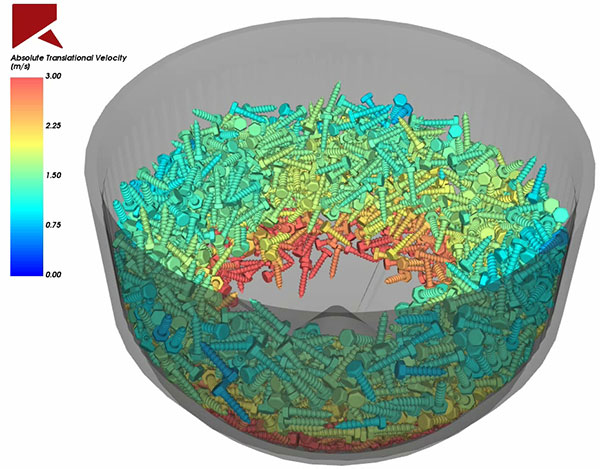
A few months ago, I met with some people from ESSS who gave me the skinny on Rocky DEM (discrete element method) particle simulation software. Using Rocky DEM to model, animate then predict how bulk materials flow and affect equipment can be mesmerizing. Rocky DEM 4.2 just came out. It sounds like a fascinating release.

Particle flows to Rocky DEM means things like material behaviors in pill tumblers, articulated arms dumping stones into a tram, dust particles affecting air flow in conveyor chutes, granular drying, slurry flows, you name it. You can simulate round and non-round particle shapes. You can use custom 3D bodies, 2D shells and fibers. You can mix and match shapes, sizes, material flexibility and adhesion combinations. It has two kinds of breakage models, thermal modeling capabilities and modest system requirements.
Version 4.2 sees some new particle collision analysis functionality, improvements to fiber modeling, spring and damper motion capabilities and tighter ANSYS Workbench integrated fluid-particle simulation abilities. Other enhancements include a new CFD (computational fluid dynamics) mesh decomposition functionality on multi-GPU (graphics processing unit) workstations and a new Particle Generation Preview that provides immediate feedback of an estimated number of particles to be released into a system.
Rocky DEM's new intra-particle collision statistics should help you improve particle abrasion, edge chipping and damage predictions. Statistics types debuting include duration, impact and shear.
For fiber modeling, Rocky DEM 4.2 introduces an ability to configure different elastic ratios for each fiber segment. A new search algorithm is said to speed up packed-fiber system simulation by two times.
Current users will be interested to know that version 4.2 sees its motion body dynamics kernel enhanced with spring and damper motion capabilities. ESSS explains that this makes for broader simulation potential as well as simpler configuration and post-processing. It also eliminates the need to couple with external motion-body dynamic software to simulate models like passive valves and gates or independent multi-wheel suspensions.
Rocky DEM integrates with ANSYS Workbench for coupled CFD and FEA (finite element analysis) applications. This includes one- and two-way coupling abilities with ANSYS Fluent. Version 4.2 also enables ANSYS SpaceClaim and Rocky DEM geometry-unit handling for simulations on different scales inside the same project schematic.
Today's main write-up has more on Rocky DEM 4.2. Check out the short but fascinating video link. You can also sign up for a webinar or a 30-day trial too. Good stuff.
Thanks, Pal. – Lockwood
Anthony J. Lockwood
Editor at Large, DE


Anthony J. Lockwood is Digital Engineering's founding editor. He is now retired. Contact him via [email protected].
Follow DE






About Us · Contact Us · Editorial Team · Advertising · Privacy Policy · Subscriber Services · © 2026 Digital Engineering 24/7 · Peerless Media