Helping design and engineering professionals discover, evaluate and specify technologies and processes that shorten the design cycle and enable success.


Alert!
Digital Engineering ceased publication on July 1, 2026. This website remains available as an archive of engineering content.
For inquiries or information, please email [email protected].

May 2026 Special Focus: Artificial Intelligence in Design and Simulation
In this Special Focus Issue, learn about the latest developments in the integration of artificial intelligence into engineering workflows.

Design & Simulation Software Guide 2025
In this Special Issue, Digital Engineering presents its second annual guide to design and simulation software vendors.
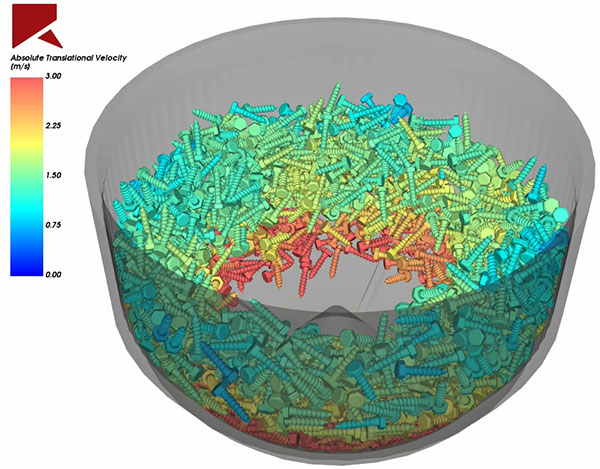
The latest version of Rocky DEM high-fidelity particulate software from ESSS adds to and deepens modeling capabilities, including particle collision analysis, spring and damper motion, fiber modeling improvements, and ANSYS Workbench integrated fluid–particle simulation.
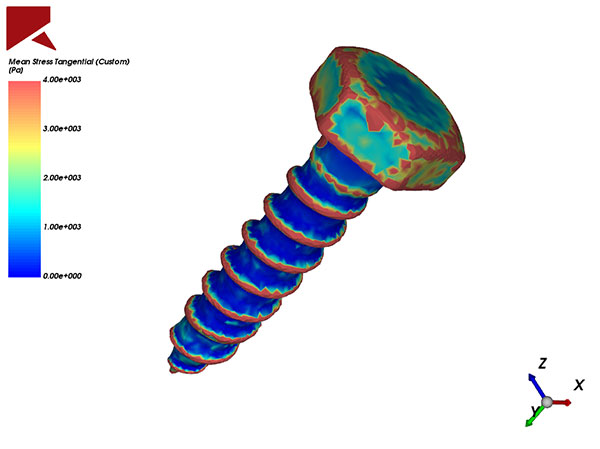
Rocky DEM 4.2 predicts how collisions happen within a particle, adding more value to its collision energy spectra. Statistical information like duration, impact and shear help designers accurately estimate particle abrasion, edge chipping and damage—as well as determine how collisions affect the system.
Rocky’s motion body dynamics kernel incorporates spring and damper motion capabilities designed to enable broader simulation while simplifying configuration and post-processing. Users no longer need to couple with external motion-body dynamic software to simulate complete models like passive valves and gates, independent multi-wheel suspensions, damped actuators and pre-tensioned systems, according to the company.
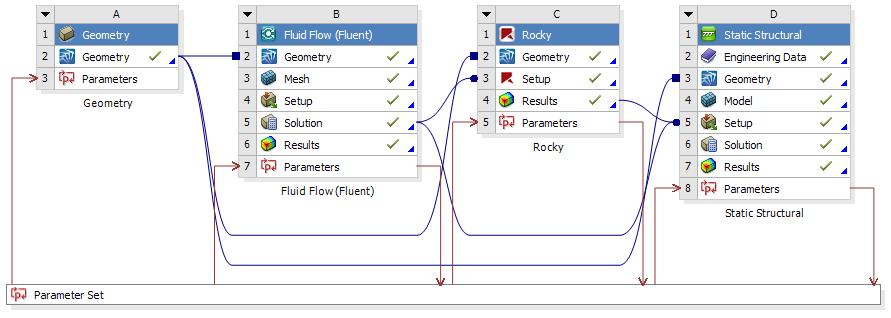
Rocky 4.2 offers more-robust Workbench integration when coupling with ANSYS Fluent. The project schematic shows on-the-fly simulation progress updates and robust multiple design-point projects, including computational fluid dynamics (CFD) to discrete element method (DEM). ESSS says the seamless ANSYS SpaceClaim–Rocky geometry-unit handling enables simulations on different scales inside the same project schematic.
The 4.2 release expands the modeling range of real fibers and particles, and it further improves simulation speed. A new search algorithm speeds up packed-fiber system simulation by an average of two times, along with the ability to configure different elastic ratios for each fiber segment.
According to ESSS, other Rocky DEM 4.2 enhancements include:
Source: Press materials from the company.


DE's editors contribute news and new product announcements to Digital Engineering. Press releases may be sent to them via [email protected].
Follow DE






About Us · Contact Us · Editorial Team · Advertising · Privacy Policy · Subscriber Services · © 2026 Digital Engineering 24/7 · Peerless Media