Helping design and engineering professionals discover, evaluate and specify technologies and processes that shorten the design cycle and enable success.


Alert!
Digital Engineering ceased publication on July 1, 2026. This website remains available as an archive of engineering content.
For inquiries or information, please email [email protected].

Digital Engineering April 2026
In the latest issue of Digital Engineering, we take a look at the latest innovations in design for additive manufacturing, including the use of natural language inputs, social media cosplayers, and AI integration. The issue also includes a feature…

January Special Focus Issue: Design for Additive
In this Special Focus Issue of Digital Engineering, learn about the latest advancements in design for additive manufacturing, including new software tools, additive in automotive, custom medical devices, and more.
Dear DE Reader:
Additive manufacturing cognoscenti can get their knickers in a twist over the pros and cons of DLP (digital light processing) technology versus other methodologies that also use light to build 3D parts. Sorry, no such partisanship today. You're smart enough to decide what technology fits your workflows, so here's a little light shining on a new series of DLP 3D printers that sounds well worth checking out.

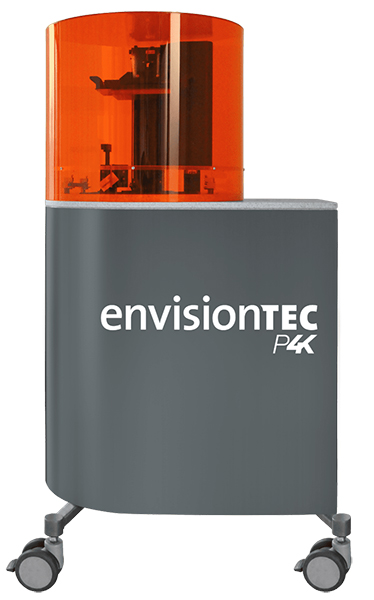
EnvisionTEC recently introduced its Perfactory P4K Series of DLP-based 3D printers. There are four models in the line. They are named after their native pixel size XY resolution specification. So, you have the Perfactory P4K 35, which has 35µm resolution. Its siblings are the Perfactory P4K 62, P4K 75 and the P4K 90.
Their build volumes range from 3.5x2.2x7.9 in. for the P4K 35 to the P4K 90's 9.1x5.7x7.9 in. They all can use various materials and can handle jobs ranging from end-use modeling to fast design verification, prototyping, casting and end-use parts. They're equally at home in 24/7 manufacturing environments in aerospace, automotive, medical devices and consumer goods. Aside: EnvisionTEC has a big footprint in the dental and hearing aid industries.
Two big things make these rigs interesting. One is that the photopolymer materials don't require a vat and that changing over materials appears to be fast and painless. At the end of today's write-up, hit the link to the Perfactory P4K landing page to peruse a huge list of available materials.
But the big enchilada is the Perfactory P4K Series 3D printers deploy what the company calls “a true 4M pixel projector” with UV optics tuned to 385nm wavelength. The pixel projector has a high, 2560x1600 pixel WQXGA (wide quad extended graphics array) resolution.
Still, the kicker here is that the 4M pixel projector leverages pixel-tuning artificial intelligence modulation techniques to help you achieve accurate, high-quality 3D prints with smooth finishes. (The pic of dentures in the data sheet linked off today's main write-up gives you an example to chew on.) Depending on the material you use, the P4K units can provide a 25—150μm Z axis dynamic voxel resolution.
You can learn some about the Perfactory P4K Series 3D printers series in today's Editor's Pick of the Week write-up. You'll find links to a couple of white papers and to EnvisionTEC's library where you can read more about what DLP technology can offer. It's fascinating stuff.
Thanks, Pal. Happy New Year.
Anthony J. Lockwood
Editor at Large, DE

EnvisionTEC is a leading global provider of professional-grade 3D printing solutions. Our company invents, develops, manufactures and sells 3D printers and proprietary materials worldwide. Founded in 2002 with its pioneering commercial DLP…

Anthony J. Lockwood is Digital Engineering's founding editor. He is now retired. Contact him via [email protected].
Follow DE






About Us · Contact Us · Editorial Team · Advertising · Privacy Policy · Subscriber Services · © 2026 Digital Engineering 24/7 · Peerless Media