Helping design and engineering professionals discover, evaluate and specify technologies and processes that shorten the design cycle and enable success.


Alert!
Digital Engineering ceased publication on July 1, 2026. This website remains available as an archive of engineering content.
For inquiries or information, please email [email protected].


Cut Retrieval-Augmented Generation (RAG) Hallucinations by 50%
Most teams hit the same wall with enterprise AI: LLMs that hallucinate, pipelines that don’t scale, and infrastructure that’s harder to design than the models themselves.

What Is Intelligent BOM Management? A Guide to Smarter Product Development
Learn how intelligent Bill of Materials (BOM) management helps teams collaborate, reduce errors, and bring innovative products to market faster with cloud-based PLM tools.
 Dear DE Reader:
NVIDIA has begun shipping its new Quadro GV100 GPU (graphics processing unit) to engineering workstation manufacturers like HP, distributors like PNY Technologies and do-it-yourself end users. It sounds like one heckuva piece a gear.
The GV100 has lots going on for it. But, basically, think of it as engineered to handle next generation, extreme design, simulation and engineering workflows that are beyond the ability of this generation’s desktop workstations to execute in a practical manner. That means you're talking about real-time ray tracing, AI (artificial intelligence), simulation and VR (virtual reality) enhanced workflows on your workstation with the speed and the 3D visual acuity that today can only inspire techno-dreaming.
That’s a tall order, but that’s what this GPU could do.
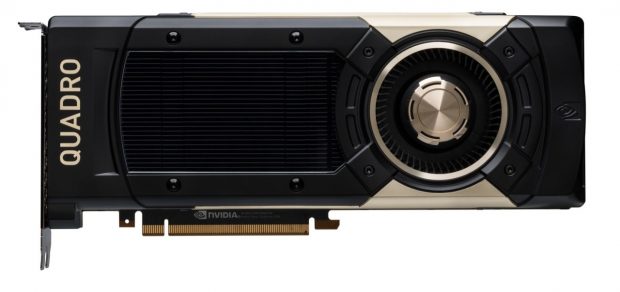 The Quadro GV100 combines 7.4 TFLOPS (one trillion floating-point operations per second) double precision and 14.8 TFLOPS of single-precision performance with a dedicated 118.5 TFLOPS of deep learning performance. Image courtesy of NVIDIA Corp.
Key to how the GV100 delivers such performance is its Volta architecture. There's a link to more information on what Volta could mean for you at the end of today's Editor’s Pick of the Week write-up. For now, it suffices to say that the GV100 is designed for AI-enhanced and other extreme workflows.
For example, it sports lots of cores: 5120 NVIDIA CUDA parallel-processing cores and 640 Tensor Cores backed by 32GB of HBM2 (high bandwidth, second generation) memory. You can couple a pair of GV100s with NVIDIA’s NVLink interconnect technology to scale up to 64GB of that HBM2.
Now, those Tensor Cores are AI-dedicated. On the GV100 they deliver 118.5 TFLOPS performance for deep learning operations. The GV100’s Volta architecture also provides 7.4 TFLOPS double precision and 14.8 TFLOPS single precision performance. That mixed precision performance is what should have the oomph and speed needed for extreme deep learning, simulation, VR and photorealistic applications that crunch extraordinary amounts of data while consuming tons of computational power.
NVIDIA, as always, has libraries, frameworks and SDKs to help developers script Volta-optimized applications. That means your applications will soon be able to run bigger, more complex simulations in less time and with less need to compromise accuracy for speed. VR should take on whole new dimensions, while AI-enhanced workflows will change your entire way of working. Such are the things that dreams are made of.
You can learn more about the NVIDIA GV100 GPU starting with today’s Editor's Pick of the Week write-up. Embedded links and more links after the text will take you to deeper details including videos, animations and papers on the technologies in play here. It’s fascinating stuff.
Thanks, Pal. – Lockwood
Anthony J. Lockwood
Editor at Large, DE


Since its founding in 1993, NVIDIA (NASDAQ: NVDA) has been a pioneer in accelerated computing. The company’s invention of the GPU in 1999 sparked the growth of the PC gaming market, redefined computer graphics, ignited the era of modern AI and…
Cut Retrieval-Augmented Generation (RAG) Hallucinations by 50%
Most teams hit the same wall with enterprise AI: LLMs that hallucinate, pipelines that don’t scale, and infrastructure that’s harder to design than the models themselves.

Anthony J. Lockwood is Digital Engineering's founding editor. He is now retired. Contact him via [email protected].
Follow DE






About Us · Contact Us · Editorial Team · Advertising · Privacy Policy · Subscriber Services · © 2026 Digital Engineering 24/7 · Peerless Media