Helping design and engineering professionals discover, evaluate and specify technologies and processes that shorten the design cycle and enable success.


 Dear DE Reader:
BETA CAE Systems deserves kudos for continuously enhancing its powerhouse simulation software suite in big ways. Although the latest point release, version 18.1.0, surely has a bug fix here and there, this version, like most of its point releases, is loaded with goodies that'll interest current and potential users across industries as diverse as automotive, biomechanics, chemical processing, electronics, energy and heavy machinery. Here are some highlights.
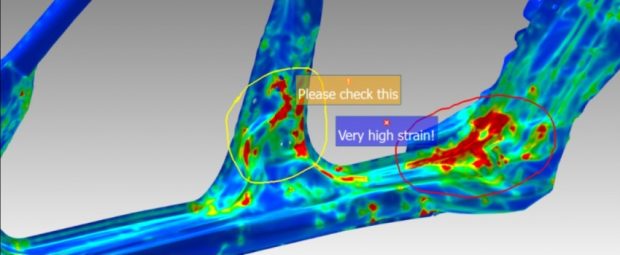
The ANSA preprocessor sees a lot of action in version 18.1.0 as does the META post-processor, and the big show-me improvement is a new Sketch tool implemented in both. Elegantly simple to use and understand, this collaboration tool lets you highlight something in a model and add in some notes.
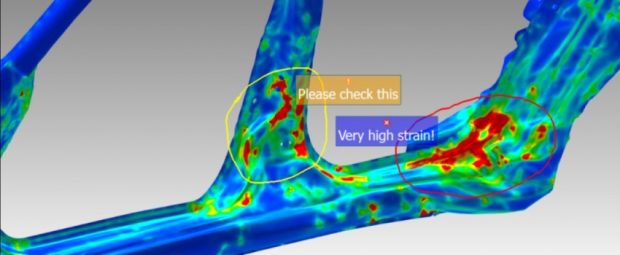 A new Sketch tool debuts in the 18.1.0 versions of the ANSA preprocessor and META post-processor. With it, users can highlight areas of interest on a model and add notes. Image courtesy of BETA CAE Systems.
Simplification and faster performance is something of a theme with release 18.1.0. ANSA now offers a new approach to synthesize modular assemblies that have interdependent subsystems. BETA CAE Systems says that the approach relieves bottlenecks, makes maintenance easier and speeds up the assembly process.
Also new is an Octree tree data structure entity for creating and previewing the results of Octree-based algorithms like Surface Wrapping and Cavity meshing. This also provides quick leak detection and cutting planes visualization tools as well as contour plots of mesh size distribution that CFD (computational fluid dynamics) users will be able to exploit.
The META post-processor sees more capabilities for VR (virtual reality) in the form of full support for Oculus Rift and HTC Vive VR equipment. Other improvements include faster animation speed for high-quality rendering and modal parameter estimation with NVH (noise, vibration harshness) calculations. If you deploy the company's RETOMO toolset for 3D modeling of CT (computer tomography) data of physical objects, you can now import volumes into META and render.
The suite's EPILYSIS FEA (finite element analysis) solver sees new manufacturing constraints for enhanced topology optimization. Also new is sizing optimization that you can apply to composites if needed and a mode analysis functionality. Performance is improved, as is accuracy.
Version 18.1.0 of BETA CAE Systems' simulation software suite offers a slew of new tools and enhancements. You can learn about it in today's Editor's Pick of the Week write-up. Hit the link at the end of the main text for a landing page with much more detail. On that page, current users can find details on new documents, compatibility with earlier releases and instructions for downloading this release.
Thanks, Pal. – Lockwood
Anthony J. Lockwood
Editor at Large, DE


Anthony J. Lockwood is Digital Engineering's founding editor. He is now retired. Contact him via [email protected].
Follow DE
Join over 90,000 engineering professionals who get fresh engineering news as soon as it is published.






About Us · Contact Us · Editorial Team · Advertising · Privacy Policy · Subscriber Services · © 2026 Digital Engineering 24/7 · Peerless Media