Helping design and engineering professionals discover, evaluate and specify technologies and processes that shorten the design cycle and enable success.



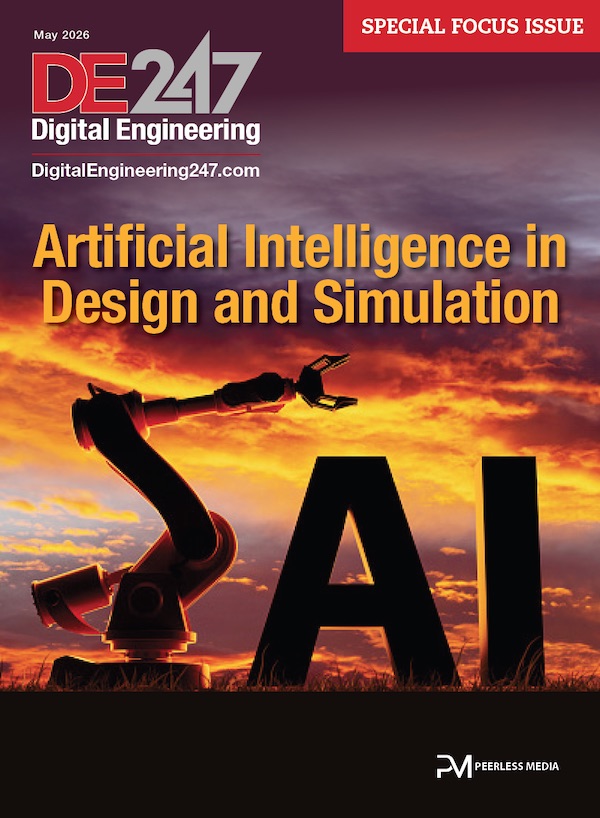
May 2026 Special Focus: Artificial Intelligence in Design and Simulation
In this Special Focus Issue, learn about the latest developments in the integration of artificial intelligence into engineering workflows.

April 2026 Special Focus Issue: Generative Design
In this Special Focus Issue, Digital Engineering takes a look at how generative design solutions can be used across different types of design problems and with a variety of manufacturing approaches to accelerate design space exploration, and…
As we reach the end of 2025, Digital Engineering has asked its design and engineering readers once again to provide insight into their use of design and simulation technology. It has been an interesting couple of years in this particular space, with major consolidation in the simulation software sector, several high-profile mergers and bankruptcies in the 3D printing market, and a huge push across all sectors to incorporate artificial intelligence (AI) and machine learning (ML) into engineering workflows.
We have also seen increased adoption of GPU acceleration, the emergence of new cloud-based and AI-focused simulation software products, and word from Autodesk that a future update to its Fusion product would allow designers to create CAD files using natural language prompts. Most vendors have introduced AI assistants or chatbots to their tools, and several have either released or announced AI-based tools for creating surrogate models or reduced order models (ROMs). We added some new questions in the survey this year to find out how our readers view these types of AI tools.
For this year’s survey, we received responses from 194 readers. The largest group of respondents described their primary role as product or system design engineering (26%), followed by engineering management (12%), research & development (12%), and consultant/engineering service provider (11%). Respondents were spread among market sectors, with the majority working in aerospace/aviation/defense, industrial machinery and products, electronic products and equipment, medical products, and automotive.
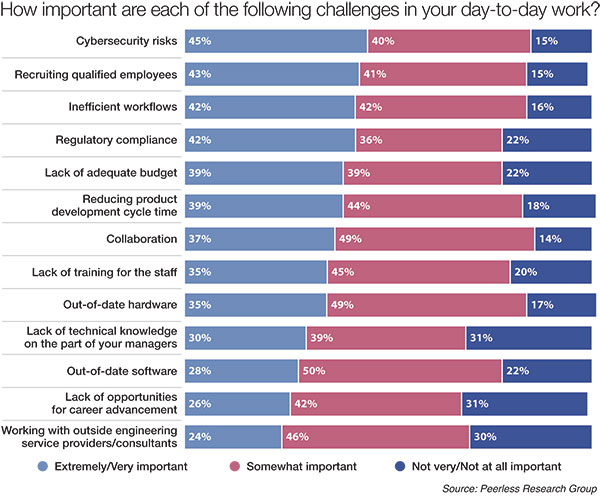
While recruitment has been the top challenge for readers the past few years, in 2025 collaboration leaped to the top of the list with 86% saying it was an extremely or somewhat important challenge. Cybersecurity risks came in a close second at 85%, while recruitment and inefficient workflows tied for third at 84%. Other top challenges included reducing product development cycle times (83%), and regulatory compliance and lack of adequate budget (tied at 78%).
AI has only become more ubiquitous online and in the general public discourse, and the same is true in engineering. According to the survey, 33% of readers report already using AI, generative AI or machine learning, with 29% planning to use it within the next two years.
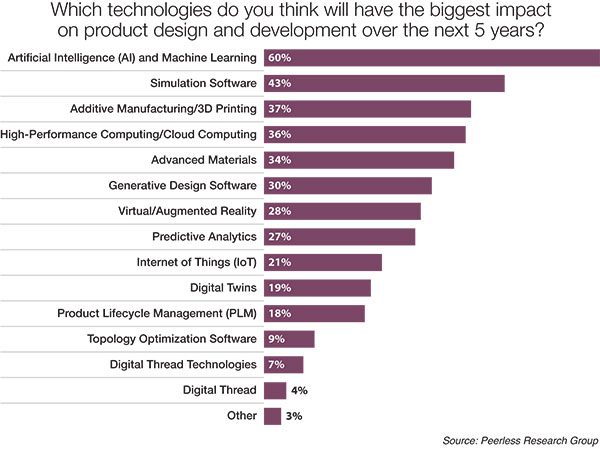
When we asked which technologies readers thought would have the biggest impact on product development in the next five years, AI once again took the top spot at 60% (down from 64% last year). Simulation was second at 43%, followed by additive manufacturing (37%, up from 34% last year), high-performance computing (HPC)/cloud computing (36%), advanced materials (34%, up from 28% last year), generative design software (30%), and virtual/augmented reality (28%).
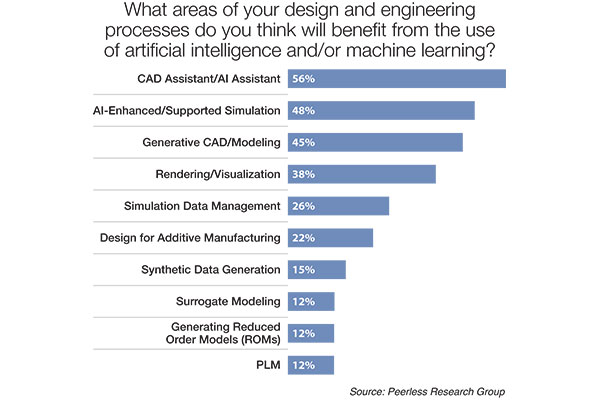
Asked what areas of design/engineering processes they thought would benefit the most from AI and machine learning, readers picked CAD assistant/AI assistant solutions first at 56%, followed by AI-supported simulation (48%), generative CAD/modeling (45%), rendering/visualization (38%), and simulation data management (26%).
Based on reader responses, right now, engineers are using AI in the workflow for everything from report generation and project management to printed circuit board (PCB) placement and routing/schematic development, spec writing, and design optimization.
Reader comments on the value and utility of AI in engineering were open-minded but cautious:
AI and ML are essentially tools for pattern recognition, prediction, and automation. They excel at: Processing large datasets quickly and efficiently. Identifying trends and anomalies that humans might miss. Learning from feedback to improve performance over time. They’re not just about replacing human effort—they’re about augmenting it, often unlocking capabilities that weren’t feasible before.
AI seems to be “clunky,” but is getting better. It needs to be watched over, like a hawk over a mouse. I’ve heard of machine learning, but have not seen examples. I imagine it currently is a solution looking for a problem. I don’t really know. AI is being heavily invested in; hopefully not a market bubble about to burst.
I believe the vision we have of AI in the near future, as a whole, is flawed. The companies making the LLMs are not sustainable, financially. Before long, the type of AI we see and use will be different, hopefully more specialized. What is currently called an “agent” is likely the future of AI in business, and if the models can make this in an open-source way, the agents will be very useful to implement.
My impression of AI and Machine Learning is that it has great potential, but I am unsure of how to practically apply these technologies.
The advancements of future technology lies in the usage of AI and machine learning. Medical, educational and scientific research will depend on artificial intelligence development and machine learning throughout multiple industries. Product designs and development will be driven by AI and machine learning over the next ten years.
There is a lack of fully trained models and commercially available AI/Machine tools. As far as product designs and development, these are treated no differently than any other libraries that assist the designer with crafting a solution but still requires heavy customization, training, and model development to meet basic goals. Most of the existing AI/Machine Learning and models today still seem to have real difficulty with enterprise scalability. Should a solution require AI to operate for hundreds of endpoints at speed, the cost is still very prohibitive.
AI and Machine Learning are just new terms for different approaches to problem solving. Product and solution designers have been using the same concepts and techniques in commercial solutions for some time but they are customized to meet the specific requirements of the solution. The promise of models and tools that could be used for more robust product design are not new, but these AI/Machine Learning items still feel like they are not fully baked, requiring heavy customization to meet requirements and their models do not seem to scale well as the models cannot currently process things fast enough for enterprise needs.
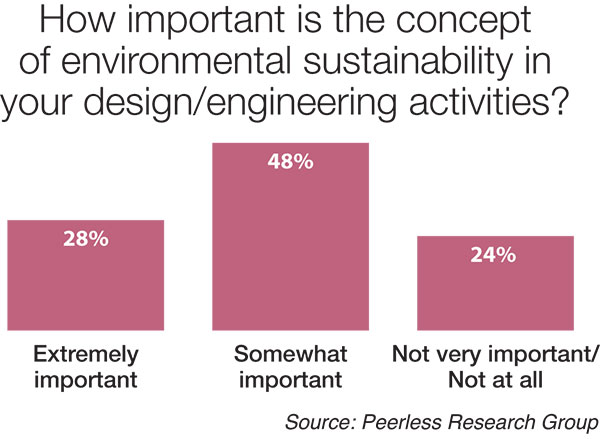
We also asked readers about the importance of sustainability in design. The number of respondents who said sustainability was extremely important increased from 25% in 2024 to 28% in 2025, while those who thought it was somewhat important dropped from 53% to 48%. Respondents who said it was not important at all rose from 19% last year to 24% in the current survey.
We again asked readers what technologies they were currently using or developing products for, as well as which technologies they expected to adopt in the next two years. Simulation software once again ranked as the top technology that most readers were currently using, with 48% reporting that they were doing so followed by additive manufacturing (36%), AI (33%), the Internet of Things (30%), and product lifecycle management (PLM; also 30%).
In the next two years, 29% of respondents plan to incorporate AI/machine learning in their design/development processes (compared to 38% last year), with HPC (22%), predictive analytics (22%), digital twins (21%), and topology optimization (20%) also ranking high on the tech shopping list.
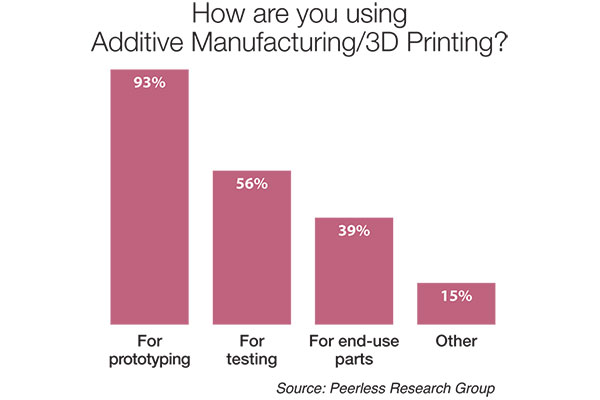
The number of additive manufacturing users that focused primarily on prototyping increased from 82% last year to 93%. Testing applications dropped to 56% this year from 68% last year. End-use part printing dropped from 48% of current users to 39%. This probably reflects trouble in the 3D printing hardware market, where a number of vendors are on shaky financial footing as the end user base focuses more on using additive service bureaus rather than buying their own printers.
Reducing or controlling manufacturing costs, engineering productivity, fostering innovation, and shortening product development schedules were at the top of the motivation list for deploying additive manufacturing, with all users saying those factors were extremely or somewhat important. Reducing/controlling development costs, discovering new designs, and improving product quality were cited by 90% of users.
When it came to satisfaction with additive manufacturing solution benefits, 90% of users were extremely or somewhat satisfied with the technology’s ability to shorten product development cycles, followed by fostering innovation in development (89%), reducing or controlling development costs (88%), and improving engineering productivity (86%).
Generative design adoption remains slow, with just 12% of respondents reporting they are using the technology (down from 16% last year). Moving forward, 18% plan to deploy it in the next two years, also down from last year. With the Autodesk announcement and other new AI-based tools, generative design may be falling a bit into the background as a standalone solution.
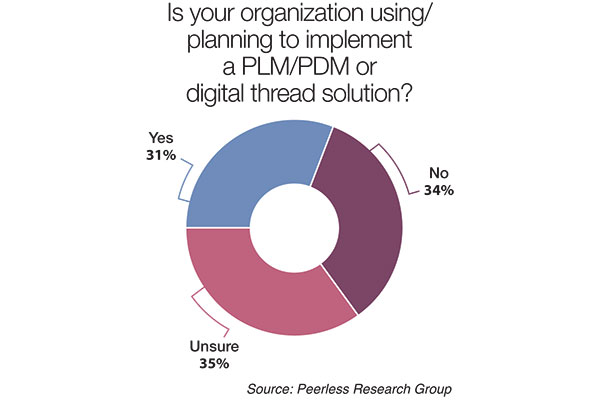
Digital twin adoption also remains slow, with 55% of respondents reporting that they do actually know what a digital twin is (down from 58% last year). Just 11% of respondents report they are currently using digital twins; 21% reported they plan to deploy digital twins within the next two years. Asked if currently using or planning to implement a PLM/product data management or digital thread solution, just 30% said yes.
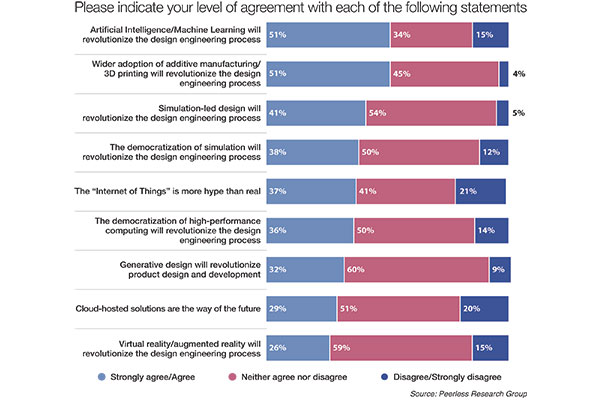
The majority of respondents agreed that AI and wider adoption of additive manufacturing will revolutionize the engineering process, with 51% strongly agreeing or agreeing. Simulation-led design fell to second place, with just 41% agreeing.
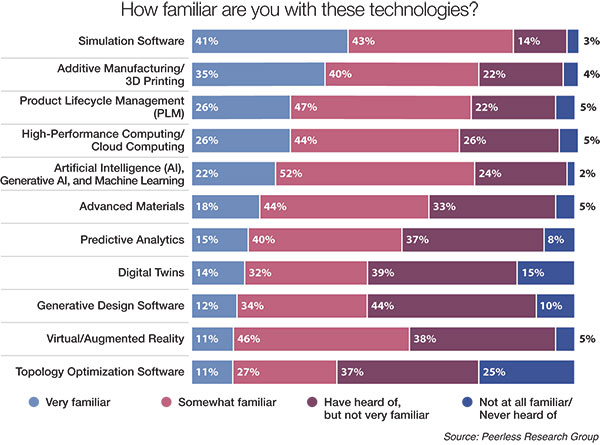
Asked about familiarity with various technologies, simulation again led with 84% of respondents being very or somewhat familiar, followed by additive manufacturing (75%), PLM (73%), and HPC/cloud computing (70%). Respondents were least familiar with generative design software (46%), digital twins (46%), and virtual/augmented reality (57%).


Brian Albright is the editorial director of Digital Engineering.
Contact him at [email protected].

Join over 90,000 engineering professionals who get fresh engineering news as soon as it is published.






About Us · Contact Us · Editorial Team · Advertising · Privacy Policy · Subscriber Services · © 2026 Digital Engineering 24/7 · Peerless Media