Helping design and engineering professionals discover, evaluate and specify technologies and processes that shorten the design cycle and enable success.


Sponsored


May 2026 Special Focus: Artificial Intelligence in Design and Simulation
In this Special Focus Issue, learn about the latest developments in the integration of artificial intelligence into engineering workflows.

Design & Simulation Software Guide 2025
In this Special Issue, Digital Engineering presents its second annual guide to design and simulation software vendors.
To fulfill its promise of rapid, precise, and customizable production, additive manufacturing (AM) demands more than just a retooling of factory equipment; it also calls for new approaches to factory operation and management. This is why Britain’s Manufacturing Technology Centre (MTC) has enhanced its in-house metal powder bed fusion AM facility with a simulation model and app to help factory staff make informed decisions about its operation.
"The model helps predict how heat and humidity inside a powder bed fusion factory may affect product quality and worker safety," says Adam Holloway, a technology manager within the MTC's modeling team. The simulation app, meanwhile, shows the potential for pairing a full-scale AM factory with a so-called "digital twin" of itself. "When combined with data feeds from our facility, the app helps us integrate predictive modeling into day-to-day decision-making."
Maintaining careful control of heat and humidity is essential at the MTC factory. "The metal powder used for the powder bed fusion process is highly sensitive to external conditions," says Holloway. "It can begin to oxidize and pick up ambient moisture even while it sits in storage. Exposure to heat and moisture will change how it flows, how it melts, how it picks up an electric charge, and how it solidifies," he says. "All of these factors can affect the resulting quality of the parts you’re producing."
Careless handling of powdered metal can threaten the health and safety of workers as well. "The metal powder used for AM processes is flammable and toxic, and as it dries out, it becomes even more flammable," Holloway says. "We need to continuously measure and manage humidity levels as well as how loose powder propagates throughout the facility."
To maintain proper atmospheric conditions, a manufacturer could augment its factory's ventilation with a full climate control system, but that could be prohibitively expensive. Using multiphysics simulation for careful process management could provide a cost-effective alternative.
"We created a model of our facility using the computational fluid dynamics (CFD) capabilities of the COMSOL® software. Our model (Figure 1) uses the finite element method to solve partial differential equations describing heat transfer and fluid flow across the air domain in our facility," says Holloway. "This enabled us to study how environmental conditions would be affected by multiple variables, from the weather outside to the way machines were positioned inside the shop. A model that accounts for those variables helps factory staff adjust ventilation and production schedules to optimize conditions," he explains.
The team made its model more accessible by building a simulation app of it with the Application Builder in COMSOL Multiphysics® (Figure 2). "We’re trying to present the findings of some very complex calculations in a simple-to-understand way," Holloway explains. "By creating an app from our model, we can empower staff to run predictive simulations on laptops during their daily shifts."
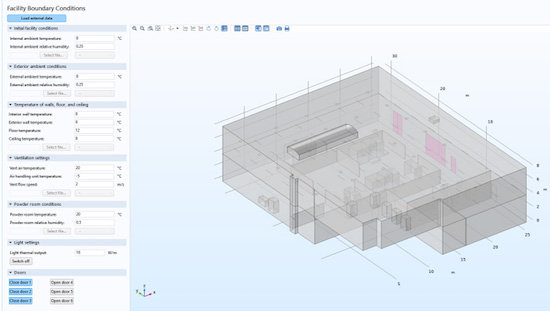
The app user can define relevant boundary conditions for the beginning of a factory shift and then make ongoing adjustments. Over the course of a shift, heat and humidity levels will inevitably fluctuate. Perhaps factory staff should alter the production schedule to maintain part quality, or maybe they just need to open doors and windows to improve ventilation. Users can change settings in the app to test the possible effects of actions like these. For example, Figure 3 presents isothermal surface plots that show the effect that opening the AM machines’ build chambers has on air temperature.

The app currently requires workers to manually input relevant data. Looking ahead, the team envisions something more integral and, therefore, more powerful: a "digital twin" for its AM facility. "To make our factory environment model a digital twin, we'd first provide it with ongoing live data from the actual factory," Holloway explains. "Once our factory model was running in the background, it could adjust its forecasts in response to its data feeds and suggest specific actions based on those forecasts."
"We want to integrate our predictive model into a feedback loop that includes the actual factory and its staff. The goal is to have a holistic system that responds to current factory conditions, uses simulation to make predictions about future conditions, and seamlessly makes self-optimizing adjustments based on those predictions," Holloway says.
The simulation app has already proven its worth. "Our manufacturing partners may already see how modeling can help with planning an AM facility, but not really understand how it can help with operation," Holloway says. "We're showing the value of enabling a line worker to open up the app, enter in a few readings or import sensor data, and then quickly get a meaningful forecast of how a batch of powder will behave that day."
Beyond its practical insights for manufacturers, the overall project may offer a broader lesson as well: By pairing its production line with a dynamic simulation model, the app project has made the entire operation safer, more productive, and more efficient. The team has achieved this by deploying the model where it can do the most good — into the hands of the people working on the factory floor.
This article has been abridged. The full story of MTC's use of COMSOL Multiphysics can be found here.
COMSOL and COMSOL Multiphysics are registered trademarks of COMSOL AB.


COMSOL is a global provider of simulation software for product design and research to technical enterprises, research labs, and universities. Its COMSOL Multiphysics® product is an integrated software environment for creating physics-based models…
Ebook download: Powering Clean Energy Solutions
In this ebook, we explore 6 cases where modeling and simulation were used to help overcome these new design challenges. Topics include water turbines, sand-based heat storage, hydrogen fuel cells, and more.

Join over 90,000 engineering professionals who get fresh engineering news as soon as it is published.






About Us · Contact Us · Editorial Team · Advertising · Privacy Policy · Subscriber Services · © 2026 Digital Engineering 24/7 · Peerless Media