Helping design and engineering professionals discover, evaluate and specify technologies and processes that shorten the design cycle and enable success.



Digital Engineering April 2026
In the latest issue of Digital Engineering, we take a look at the latest innovations in design for additive manufacturing, including the use of natural language inputs, social media cosplayers, and AI integration. The issue also includes a feature…

January Special Focus Issue: Design for Additive
In this Special Focus Issue of Digital Engineering, learn about the latest advancements in design for additive manufacturing, including new software tools, additive in automotive, custom medical devices, and more.
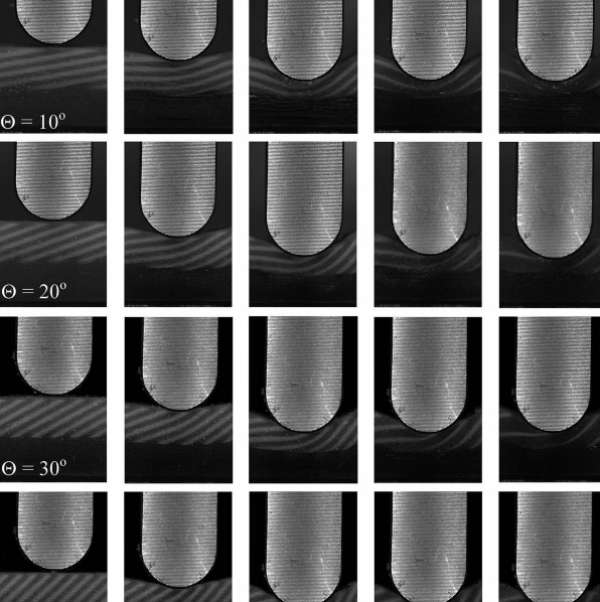
The MIT researchers (with support from the U.S. Army Research Office and MIT Institute for Soldier Nanotechnologies) wanted to create protective, flexible armor and turned to fish scales as an inspiration. Specifically, they looked at the imbricated scale-tissue flexible armor of elasmoid fish, and used 3D printing to realize the composite design.
"The secret behind this material is the combination of hard scales above with soft, flexible tissue below," said mechanical engineer Stephan Rudykh.
The research, titled "Flexibility and Protection By Design: Imbricated Hybrid Microstructures of Bio-Inspired Armor," was published in Soft Matter.
The team developed a single metric for the armor's value called protecto-flexibility, which is a ratio between normalized indentation and normalized bending stiffness.
"Indentation and bending tests on bio-inspired 3D-printed prototype materials show that both protection and flexibility are highly tunable by geometrical parameters of the microstructure (plate inclination angle and volume fraction). We show that penetration resistance can be amplified by a factor of 40, while flexibility decreases in less than 5 times."
The researchers created prototypes of layered stiff plate/soft matrix composite materials using an Objet Connex500 3D printer. They used two photo-sensitive polymeric materials: an acrylic-based photo-polymer, VeroWhite, for the stiffer plates, and a soft elastomeric material, TangoPlus for the soft matrix.
The research provides guidelines for developing material architectures that are flexible and strong, and can be tuned for specific applications.
According to Rudykh:
"This work is part of a revolution in materials properties. Once we can gain control over a material's micro properties, using 3-D printing we can create materials of an entirely different type, each with the ability to be adjusted to fit the wearer, the need, and the environment."
The team plans to test the material with fast-moving projectiles such as bullets and shrapnel.
Source: Popular Science


Brian Albright is the editorial director of Digital Engineering.
Contact him at [email protected].

Join over 90,000 engineering professionals who get fresh engineering news as soon as it is published.






About Us · Contact Us · Editorial Team · Advertising · Privacy Policy · Subscriber Services · © 2026 Digital Engineering 24/7 · Peerless Media