Helping design and engineering professionals discover, evaluate and specify technologies and processes that shorten the design cycle and enable success.



May 2026 Special Focus: Artificial Intelligence in Design and Simulation
In this Special Focus Issue, learn about the latest developments in the integration of artificial intelligence into engineering workflows.

Design & Simulation Software Guide 2025
In this Special Issue, Digital Engineering presents its second annual guide to design and simulation software vendors.
General Electric claims it has found a way to leverage machine learning and simulation to vastly accelerate the design process for its jet engines and power turbines – cutting lead times in half in some cases, and evaluating millions of design variations in just a few minutes.
This artificial intelligence (AI) driven process, called surrogate modeling, could be in widespread use within two to five years, according to this article in Forbes.
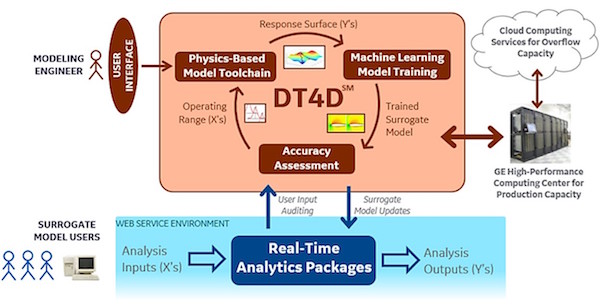
GE’s version of surrogate modeling uses a neural network that is trained with using the results of standard computation fluid dynamics (CFD) analysis of design variations. It then estimates the potential conclusions of the CFD process.
According to the Forbes article:
In one test case, in which the researchers trained the surrogate model with about 100 CFDs to figure out the optimum shape for the crown of a piston in a diesel engine, the model was able to evaluate roughly a million design variations in 15 minutes, an increase in speed of 5 billion times. More typically the researchers expect to achieve an improvement of 10 million to 100 million times.
That AI training will get a boost from a new virtual design knowledge library that will store petabytes of simulation and test data, along with schematics. “We can, say, take all the knowledge that went into designing the GE9X or the LEAP [jet engines] and apply it to developing a hypersonic or apply it to a next-gen narrow-body,” says said GE engineer Jim Tallman. “We’re confident that it will provide insights that we wouldn’t have otherwise.”
The surrogate modeling work is part of what GE refers to as Digital Thread for Design (DT4D), which allows for the rapid creation of AI surrogate models, and socialization and threading of the data associated with the models.
Source: Forbes


Brian Albright is the editorial director of Digital Engineering.
Contact him at [email protected].

Join over 90,000 engineering professionals who get fresh engineering news as soon as it is published.






About Us · Contact Us · Editorial Team · Advertising · Privacy Policy · Subscriber Services · © 2026 Digital Engineering 24/7 · Peerless Media