Helping design and engineering professionals discover, evaluate and specify technologies and processes that shorten the design cycle and enable success.


Alert!
Digital Engineering ceased publication on July 1, 2026. This website remains available as an archive of engineering content.
For inquiries or information, please email [email protected].
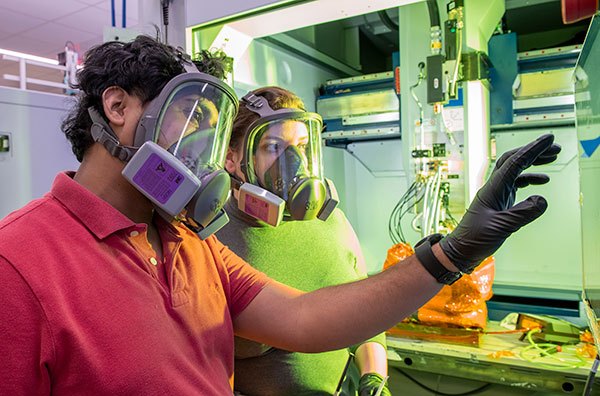

Digital Engineering April 2026
In the latest issue of Digital Engineering, we take a look at the latest innovations in design for additive manufacturing, including the use of natural language inputs, social media cosplayers, and AI integration. The issue also includes a feature…

January Special Focus Issue: Design for Additive
In this Special Focus Issue of Digital Engineering, learn about the latest advancements in design for additive manufacturing, including new software tools, additive in automotive, custom medical devices, and more.
Design for additive manufacturing (DfAM) has a fundamentally different look and feel from traditional product and component design. With traditional design you are often bound by the limitations of traditional manufacturing methods, designing your product based on the mold, cast or assembly capabilities available. With far less constraints, DfAM allows designers to home in on the product or component’s function and performance. Additionally designers can play around with endless complex geometries, new shapes and lattice structures—all within a budget. This piece checks in on how vendors and engineering schools are collaborating to impart new DfAM skills to students.
Jesse Roitenberg, North American education manager at Stratasys, works with many prominent universities throughout the United States as well as U.S. high schools and younger grades.
Stratasys first identified the need for DfAM-related coursework as a result of the working relationship the company had already built with the schools.
“Stratasys has been selling with focus to the educational segment for 20 years. With the support of our partner network, it became very clear that educators desired support and content. Stratasys has the experience, the knowledge, the equipment and the know-how, so we worked with our customers and partners to develop the Stratasys AM Certification,” Roitenberg says.
EOS also saw an opportunity for collaboration with the academic sector to address the gap between industry demand and workforce skill deficiencies.
“We identified a clear gap between industry demand and workforce readiness. Many companies were investing in AM but struggling to find engineers with both the technical knowledge and the practical design skills needed to fully leverage it,” says Fabian Alefeld, global director of Business Development and Additive Minds Academy at EOS. “By creating scalable, accessible, and industry-aligned coursework, we help ensure that universities can prepare students for the realities of modern manufacturing while also supporting our customers with a highly capable talent pipeline.”
Stratasys works directly with engineering, design, and STEM institutions by offering structured, module-based materials, hands-on activities, and access to industry tools, including GrabCAD Print and professional 3D printers, according to Roitenberg. “The content is designed to integrate directly into existing courses, guiding students from CAD design through manufacturing and post-processing, with emphasis on DfAM principles like wall thickness, tolerances, support strategies, orientation, and infill optimization.”
At EOS, the company heads up the Additive Minds Academy, which offers training programs to streamline AM education and onboarding processes. Additive Minds Academy runs what’s called the Ignite Program, where EOS partners with universities and colleges to integrate Additive Minds Academy content directly into the curriculum.
EOS’s Alefeld says the Ignite Program approach is twofold: curriculum integration and real-world application.
Regarding curriculum, he shares: “We provide modular, expert-developed online training for additive manufacturing, focusing on the most widely adopted production technology—Laser Powder Bed Fusion [LPBF].”
But curriculum extends beyond DfAM principles. “Engineers must not only understand the ‘design rules’ but also gain a deep understanding of the AM process itself to fully leverage the technology,” Alefeld adds. Content can then be blended into already existing engineering programs at universities.
As for the real-world application, Alefeld notes: “We combine theory with practical exercises, case studies, and project-based learning based on real industrial use cases.”
A sampling of topics covered are: AM processes and material behaviors (with focus on LPBF); DfAM principles; workflow from CAD to build preparation; and cost and sustainability considerations in AM part design.
For Stratasys, it’s important that students learn conceptual and practical AM skills, including:
“The curriculum addresses a clear industry gap: many engineers are proficient in CAD but not in designing specifically for additive processes. By aligning coursework with industry best practices and real equipment capabilities, Stratasys ensures students graduate with job-ready AM skills,” Roitenberg shares, adding that part of the curriculum includes hands-on use of Stratasys GrabCAD Print software; Stratasys printers; soluble support systems; and post-processing stations.
Alefeld sees the DfAM coursework currently available as integrating with other technologies. “We expect LPBF coursework to become increasingly integrated with other disciplines such as robotics, AI-driven design, and advanced materials science. Future programs will place greater emphasis on cross-functional collaboration and the complete advanced manufacturing ecosystem—from design through to post-processing and quality assurance,” he says.
After completing courses, Stratasys’ Roitenberg says students should have skills to
Roitenberg also notes there’s a wide range of career paths for students once they gain the knowledge. “Graduates can enter roles such as: additive manufacturing engineer / technician; product design engineer with AM focus; prototyping specialist; advanced manufacturing process engineer; AM applications engineer or technical sales; equipment service technician; [and] lab management within an additive lab, innovation space or makerspace,” he says.
Likewise, EOS’ Alefeld adds, “students who complete these courses are equipped with skills that extend far beyond theory. They can evaluate whether AM is the right manufacturing method for a given application; design and prepare parts for AM production efficiently and cost-effectively; [and] communicate with engineers, designers, and production teams using industry-standard tools and terminology.:
Additional career paths, according to Alefeld, range from aerospace, defense and automotive engineering to medical device generation to energy and industrial equipment engineering. Up-and-coming fields to watch include robotics and computing technology.
Although the coursework teaches the skills, school-supported design challenges offer students even further hands-on experience. Roitenberg says at Stratasys, the company’s approach is to “encourage participation in real-world design challenges (FIRST Robotics, SKILLS USA, NASA HUNCH, SAE Challenges) to reinforce skills in creative problem-solving, functional design, and manufacturability.”
Alefeld says that to keep content on the cutting edge, EOS is actively partnering with institutions on future content development. For example, EOS recently signed a Space Act Agreement with NASA to launch a Metal AM Masterclass, which Alefeld says offers deep expertise in multiple metal AM technologies.
Critical to the success of any vendor-supported educational initiatives are healthy partnerships. At Stratasys, Roitenberg highlights how the company will partner with institutions interested in the Stratasys program, but one obvious requirement is needed: schools need Stratasys equipment to teach the hands-on course.
The original target audience of its collaborative efforts was U.S. technical colleges, but, according to Roitenberg, “We had too much interest from high schools and universities, so they are now welcome to the party. Collaboration typically involves: providing software, printer access, and training materials; supplying structured activities and challenge projects (reinforcing what is taught in the courses); and encouraging students to share results with Stratasys via GrabCAD or email.”
EOS collaborates with institutions globally, from technical colleges to research universities. The company, through its Additive Minds Academy, provides online modules, instructor resources, and project templates. The schools provide an academic framework, facilitation, and in some instances access to AM equipment for hands-on projects.
Mastering these types of skills equip students for the future workforce, according to Stratasys’ Roitenberg. “Mastery of AM-specific design and production methods prepares students to innovate without traditional manufacturing constraints, rapidly iterate designs for faster product development cycles, and integrate AM into hybrid manufacturing workflows.” Additionally, students can impact industries in the process of adopting or advancing AM, such as aerospace, medical devices, automotive, and consumer products, while deepening their knowledge of … “the place for additive vs subtractive manufacturing.”
Roitenberg also anticipates expansion of the current DfAM curriculum. Look for “greater integration of simulation and topology optimization into DfAM modules; expansion into multi-material printing and composite AM workflows; expansion into hardware improvements and implementation; cloud-based collaboration tools and remote printer management; and integration with AI-driven design assistance and automated post-processing workflows.”
AM will have a sustainable role in the future of modern manufacturing, according to Alefeld. “As AM becomes an integral part of modern manufacturing, graduates with DfAM expertise are better positioned to innovate, adapt, and lead in a digital-first, sustainability-driven industrial landscape,” he says.
Universities interested in building or enhancing their AM curriculum are welcome to reach out to EOS or Stratasys directly.
Carnegie Mellon University’s (CMU) School of Engineering teaches additive manufacturing (AM) at the undergrad, graduate, and Ph.D. levels. It offers three metal AM courses, covering topics such as the technology itself and what enables modern printers to turn CAD files into parts; materials used in AM and microstructure-property relationships (in metals); as well as a lab course introducing students to 3D printing technologies and systems, how they operate, and how to design and use them for various applications.
“The skills being taught include theoretical bases for heat input in metals and polymer printers; relevant analytical skills; know-how for 3D printing; scientific basis for materials used; characteristics of AM parts compared to conventional manufacturing; understanding of how different AM technologies operate; and feedstocks for AM,” reports Jack Beuth, Carnegie Mellon professor of mechanical engineering and faculty co-director, Next Manufacturing Center.
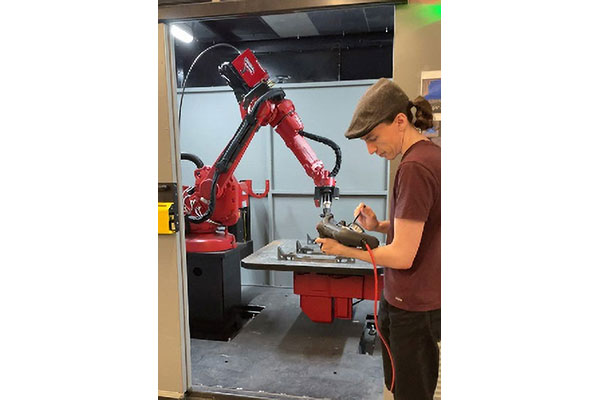
“We have a stronger emphasis on process development and hands-on learning in our additive manufacturing education,” Beuth adds. “With two AM labs and a wide range of 3D printing equipment, our students have an impressive level of access to printing technology.”
Currently dozens of students have successfully completed training to use 3D printers through the school’s curriculum, with skills to perform basic simulations, set up and run a build on at least one platform, Beuth notes.
Intended Goal
“For all levels of our education programs, we intend for students to be well-equipped for any job that involves AM,” Beuth says. “In more detail, we intend for our students to be comfortable with the physics and chemistry of how AM printers work so that they can diagnose problems with 3D printing. In terms of career path, our programs equip students to employ AM without needing to learn on the job.”
Unique to CMU is its Next Manufacturing Center, which “provides an ecosystem for students to learn broadly through courses, lab work, research, seminars, events, industry/government interactions… interdisciplinary teams and opportunities to learn outside of their own project and small research team,” Beuth explains of the research center for AM. “It leverages the engineering and data science expertise from across CMU to advance additive manufacturing. The center brings together students, faculty, and many industry and government partners who contribute to both the research and education mission of the center.”
CMU views itself as one of the pioneer college-level adopters of the technology. “Carnegie Mellon College of Engineering faculty were early adopters and innovators of additive manufacturing technologies, which led to the introduction of related courses in 2018,” Beuth notes.
As for a future outlook, Beuth says he’d like to see AM courses infused with more machine learning. “The college offers machine learning courses, but integrating those skills with AM would be a good way to move forward.”


Every day, our customers find simpler, smarter approaches to stubborn design problemsand greater confidence to confront towering human and technological challenges. Less hindered by the usual constraints, they can imagine, design, iterate and…
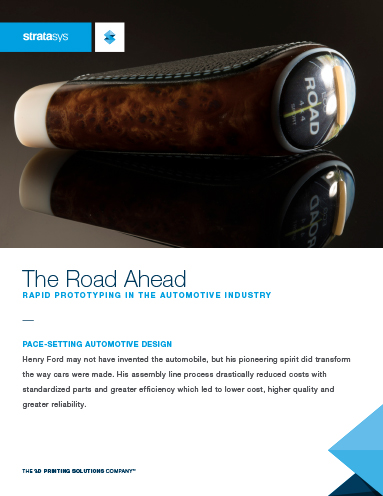
Rapid Prototyping in The Automotive Industry
Henry Ford may not have invented the automobile, but his pioneering spirit did transform the way cars were made. His assembly line process drastically reduced costs with standardized parts and greater efficiency which led to lower cost, higher quality and greater reliability.

Stephanie is the Associate Editor of Digital Engineering.
Follow DE






About Us · Contact Us · Editorial Team · Advertising · Privacy Policy · Subscriber Services · © 2026 Digital Engineering 24/7 · Peerless Media