Helping design and engineering professionals discover, evaluate and specify technologies and processes that shorten the design cycle and enable success.


Alert!
Digital Engineering ceased publication on July 1, 2026. This website remains available as an archive of engineering content.
For inquiries or information, please email [email protected].

Cut Retrieval-Augmented Generation (RAG) Hallucinations by 50%
Most teams hit the same wall with enterprise AI: LLMs that hallucinate, pipelines that don’t scale, and infrastructure that’s harder to design than the models themselves.

What Is Intelligent BOM Management? A Guide to Smarter Product Development
Learn how intelligent Bill of Materials (BOM) management helps teams collaborate, reduce errors, and bring innovative products to market faster with cloud-based PLM tools.
Editor’s Note: This is an excerpt of Chapter 6 from The Design Engineer’s High-Performance Computing Handbook. Download the complete version here.
Memory-intensive engineering and analysis work requires a lot of computer horsepower. Traditionally, that has meant a certified tower-style workstation, but that is slowly changing. Interest in mobile workstations for engineering applications is increasing, and will likely be further boosted by new processor developments. In the second quarter of 2015, for example, mobile workstation shipments rose 5.4% year over year while desktop shipments declined over the same period, according to IDC, and mobile workstations account for nearly 30% of overall certified workstation sales.
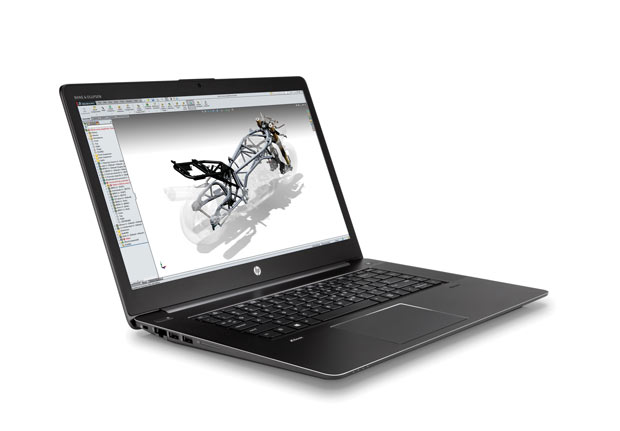 The HP ZBook Studio is the company’s first quad-core workstation Ultrabook. It can be equipped with Intel’s new Xeon mobile processor and up to 32GB of RAM. Image courtesy of HP.
The release of Intel’s mobile Xeon CPUs for laptops is expected to open up that market even further. The 4-core CPUs support vPro business management features, along with error-correcting code (ECC) memory and other features on par with the Xeon desktop chips.
“The OEMs (original equipment manufacturers) we work with see that there is a market for portable, business-class devices that can be used for CAD, rendering, and other applications,” says Chris Silva, director of marketing for premium notebooks at Intel. “What was missing was an industry-grade branding and capabilities that the Xeon name provide.”
“The Xeon brand is really well known in enterprise spaces, and is synonymous with higher end desktop workstations,” adds Scott Ruppert, worldwide workstation portfolio manager at Lenovo. “There’s a recognition by customers that it provides stability and quality.”
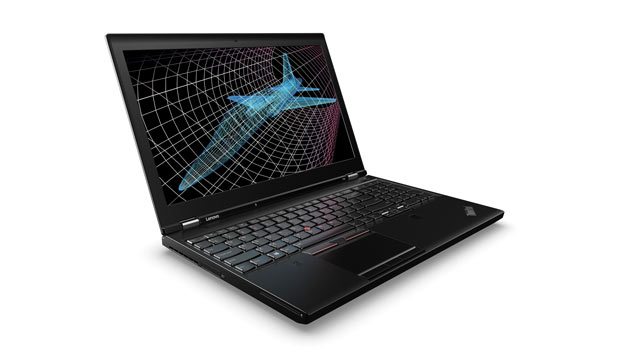 Lenovo’s ThinkPad50 (pictured) and ThinkPad70 feature Intel’s new mobile Xeon processor and a new FLEX Performance Cooling system with a dual-fan design. Image courtesy of Lenovo.
It will also likely provide a performance boost for mobile users. “We’re seeing 15 and 20% improvements in overall performance with the new CPUs,” says Scott Hamilton, Precision specialist at Dell. “The Xeons are now just as fast if not faster on the mobile side as the Core i7 processors. Support for ECC is also important for people who are doing analysis work, because it guarantees the reliability of the calculation.”
Dell is offering its new Precision 7710 and 7510 mobile workstations with the mobile Xeons, and a choice of NVIDIA Quadro M or AMD FirePro GPUs (graphics processing units), as well as options for Intel’s integrated graphics.
Most of the other major manufacturers have now announced mobile workstations featuring the Xeons, including Lenovo’s ThinkPad P50 and P70. The 17-inch P70 includes a 2TB hard disk, 1TB PCIe SSD, and a DVD-RW that can be replaced with an additional 1TB hard disk or smaller SSD. HP has announced the HP ZBook Studio, its first quad-core workstation Ultrabook, dual 1-TB HP Z Turbo Drive G2, dual Thunderbolt 3, dual cooling fans and an optional 4K display.
“Xeon provides good performance with extra added reliability,” says Josh Peterson, director of Worldwide Product Management, Workstations at HP. “It will take time for customers to understand what Xeon really means for the mobile space, but it is proliferating beyond the desktop.”
Graphics, CPUs and storage have all advanced to the point that users are seeing significant productivity gains with mobile workstations. In fact, they are powerful enough to serve as desktop replacements for some applications. Intel’s Iris Pro also provides sufficient entry-level graphics capabilities for mobile users with lighter loads. OEMs offer docking solutions that can help provide more flexibility for notebooks, as well as Thunderbolt capabilities and access to high performance storage.
Desktops still have an edge, particularly for applications that need a significant amount of computing power. Simulation, analysis and rendering benefit from the higher core counts on these systems. “For GPU computing, you can also put more robust graphics cards in the towers, and more of them. You can offload some of the compute onto those cards,” Hamilton says.
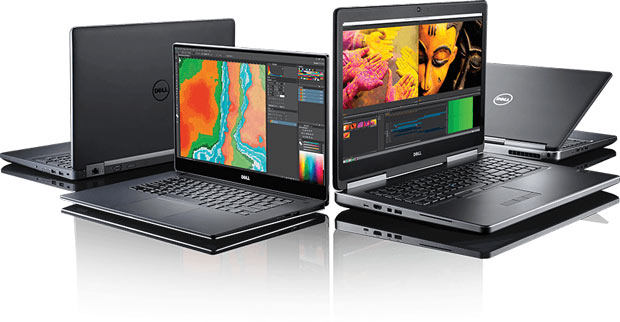 The Dell Precision mobile product family includes the new Precision 7710 and 7510 mobile workstations with Intel’s new mobile Xeon processors. Image courtesy of Dell.
Mobile workstations are generally limited to four cores and around 64GB of memory. That’s enough to support the typical engineer, but there’s little room for expansion. “You can upgrade the memory if you didn’t already fill up those slots, but the configurability is much more limited with mobile workstations,” Peterson says.
Even with these limitations, many engineers use mobile workstations to replace towers. Others use both types of hardware.
“You can get the power of a desktop in a mobile form factor now,” Ruppert says. “The capabilities have really gone up a notch. If the horsepower in the mobile workstation fits the user’s needs, they may just invest in a couple of monitors and a docking station on the desk, maybe get the same thing at home, and keep that single device with them.”
Many users still have both types of machines, and Silva says that roughly 60% of notebook users also have a desktop. Some companies are still reluctant to allow team members to take design files on the road (or home) because of intellectual property concerns. In those cases, the mobile workstations may be used to remotely access the desktop system.
“You still get the biggest bang from a tower workstation, but with the versatility of being able to take that work mobile, we are seeing customers move to that platform,” Peterson says.
As mobile workstations add compute power, it’s been easier for certain types of users to shift their work completely to a mobile device. With faster CPUs and GPU-enabled applications, some analysis and simulation work can even be done on these mobile workstations.
“Mobile graphics have definitely taken a big step forward and are keeping up with desktop systems,” Ruppert says. “So a lot of the things that used to require a desktop can now be done on a mobile workstation.”
“Each year there is a little better performance, and this generation of workstations is a big step because of the Xeon and ECC support,” Peterson says. “Depending on the applications they are using, we are seeing more customers move from desktop to mobile.”
In addition, mobile workstations can be augmented with separate rendering appliances or cloud-based storage and computing resources.


DE's editors contribute news and new product announcements to Digital Engineering. Press releases may be sent to them via [email protected].
Follow DE






About Us · Contact Us · Editorial Team · Advertising · Privacy Policy · Subscriber Services · © 2026 Digital Engineering 24/7 · Peerless Media