Helping design and engineering professionals discover, evaluate and specify technologies and processes that shorten the design cycle and enable success.


Alert!
Digital Engineering ceased publication on July 1, 2026. This website remains available as an archive of engineering content.
For inquiries or information, please email [email protected].
Kistler has introduced its K-Beam high-sensitivity, low-noise MEMS capacitive accelerometer family. The K-Beam family is designed to support single axis and triaxial measurement requirements within automotive, aerospace, civil engineering, OEM, R&D and in-laboratory test applications, particularly those in which the use of an instrument-grade accelerometer for low-frequency measurements is required.
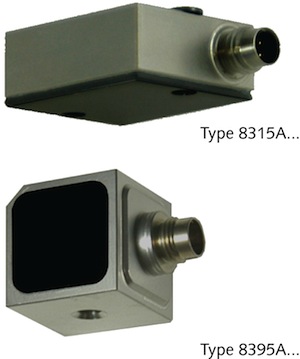 The K-Beam family is offered in ranges from ±2 g to ±200 g and with frequency response from DC to 1000 Hz (5%). Accelerometers are available in four different models of either single axis (Type 8315) or triaxial (Type 8395A) versions and incorporate a MEMS variable capacitance sensing element, consisting of a small inertial mass and flexure element sandwiched between two parallel plates (electrodes). All units offer excellent thermal stability and reliability over an operating temperature range of -65 °F to +250 °F (-55 °C to +125 °C), with 6,000 g pk shock survivability.
The Type 8315 single axis version is powered by a single wide range supply between +6 and +50 VDC. Type 8315 models are offered with three different housing (AC, TA, TB) options, which determine available output signal formats. The Type 8395A triaxial version is designed to simultaneously measure acceleration and low-frequency vibration in three mutually perpendicular axes (x, y and z).
For more information, visit Kistler.
Sources: Press materials received from the company and additional information gleaned from the company's website.


DE's editors contribute news and new product announcements to Digital Engineering. Press releases may be sent to them via [email protected].
Follow DE






About Us · Contact Us · Editorial Team · Advertising · Privacy Policy · Subscriber Services · © 2026 Digital Engineering 24/7 · Peerless Media