Helping design and engineering professionals discover, evaluate and specify technologies and processes that shorten the design cycle and enable success.


Alert!
Digital Engineering ceased publication on July 1, 2026. This website remains available as an archive of engineering content.
For inquiries or information, please email [email protected].
Sponsored
Dear DE Reader:
All this technology—mechatronics, lightweighting, connected systems, additive manufacturing, multi-axis machinery, simulation and data-driven design, and so on—has converged on the design workflow. For those schooled in the old modern ways, this means the tried and true is getting tired and about through. It needs a reimagining and renewal. Or so argues the paper at the other end of today's Check it Out link. But it doesn't leave you hanging there.

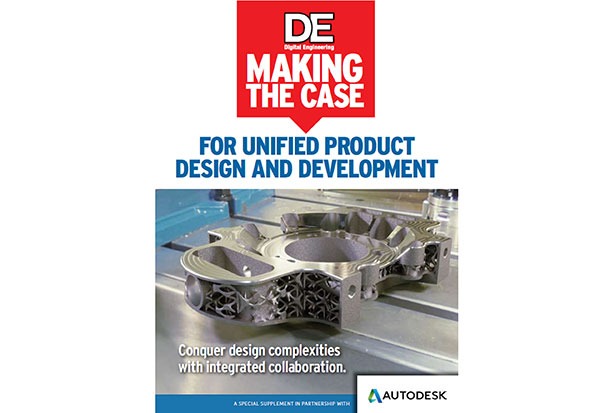
The title of the “Making the Case for Unified Product Design and Development” special supplement by the editors at DE in partnership with Autodesk says it all. But what does it mean? The short answer is you need to integrate all the tools of the trade as well as all product development participants on an open, centralized platform that supports (and encourages) cross-disciplinary collaboration while managing data.
The exploration begins with the technological trends affecting product development and manufacturing workflows. To wit: Industry 4.0. The promise, the potential and the requisites of Industry 4.0's technological innovations overwhelm traditional serial product development workflows. The paper explains why and how with sufficient grimness, so we need not itemize them here. For now, just think of the productivity and money burnt fixing geometry or late redesigns.
The paper proposes a holistic approach to complex product development enabled by a platform like Autodesk Fusion 360 could be your ticket for redefining your workflows. This is no hagiography idealizing Fusion 360. But it does tell you what it can do to help your organization thrive in this new era. It intermingles product overview, research and case study elements, and that makes it interesting.
When this paper turns its focus onto the cloud-based Fusion 360, it gets right to the heart of it: purpose, cost and capabilities. Basically this is a platform where you can build a unified, collaborative workflow across product development disciplines; $495 annual subscription; free-form, solid and parametric CAD modeling; generative design; CAE; CAM; versioning; document management; mobile functionality; and additive manufacturing support. Further, its cloud delivery means that individual user workstation preferences and software maintenance are non-issues.
Seamlessly woven into “Making the Case for Unified Product Design and Development” are a bunch of nifty screen shots and real-life testimonials on such benefits as project cost reductions. Combined, it makes a compelling case for reimagining your design workflows for increasingly complex products. Hit the link to get your copy.
Thanks, Pal. – Lockwood
Anthony J. Lockwood
Editor at Large, DE


Anthony J. Lockwood is Digital Engineering's founding editor. He is now retired. Contact him via [email protected].
Follow DE






About Us · Contact Us · Editorial Team · Advertising · Privacy Policy · Subscriber Services · © 2026 Digital Engineering 24/7 · Peerless Media