Helping design and engineering professionals discover, evaluate and specify technologies and processes that shorten the design cycle and enable success.



Digital Engineering April 2026
In the latest issue of Digital Engineering, we take a look at the latest innovations in design for additive manufacturing, including the use of natural language inputs, social media cosplayers, and AI integration. The issue also includes a feature…

January Special Focus Issue: Design for Additive
In this Special Focus Issue of Digital Engineering, learn about the latest advancements in design for additive manufacturing, including new software tools, additive in automotive, custom medical devices, and more.
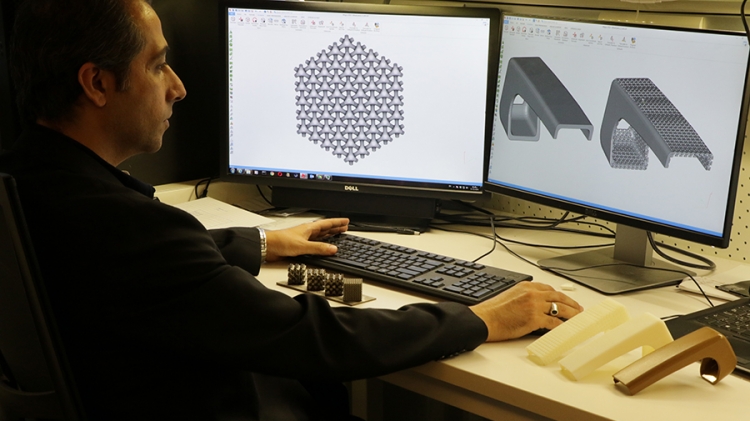 Masdar Institute's Dr. Rashid Abu Al-Rub and his team have developed "architected foams" that can create very lightweight structures. Image: Masdar Institute
Every material has its own mechanical, thermal, and structural properties that have to be taken into consideration when it comes to using them in a design. A new research project in the United Arab Emirates, however, combines computer models and 3D printing to effectively change those properties for a given material by altering geometries.
The research team at the Masdar Institute in the UAE have created a way to change the internal geometric structure of materials like plastic, metals, ceramics and composites to control their mechanical, thermal and electrical properties.
The researchers created a computer model that can generate new geometric arrangements for each material, affecting mechanical properties via changes in geometries. The models can be designed to maximize specific properties depending to the application. The only way to create these highly complex geometries: 3D printing.
Dr. Rashid Abu Al-Rub, associate professor of mechanical and materials engineering, is leading the research. The team refers to these structures as “architected foams,” and they can potentially make vehicle bodies lighter and stronger, as well as improve water production and oil and gas operations.
“The foam structures have the potential to become a platform technology, driving innovations across key industries and markets,” said Masdar Institute’s Dr. Steve Griffiths, vice president for research. “This project demonstrates how Masdar Institute’s strong advanced materials research capabilities support disruptive technology-based innovations in the Institute’s core research areas of water and energy while benefiting other sectors of importance to the UAE.”
The foams can be printed at nanoscale or macro scale. The findings were published in a number of journals, including Composites Science and Technology.
“We are not creating new materials. Rather, we are re-architecting a given material, such as steel or plastic, by manipulating its internal geometry so that we can deliver the desired properties – whether stiffness, electrical conductivity, or porosity – to the material,” Abu Al-Rub said.
The researchers are working with several companies to commercialize the foams. There are a number of potential applications. The structures can be used to better control the flow distribution of a gas or liquid in oil/gas operations, seawater desalination, wastewater treatment, or in catalytic converters.
“We have introduced a paradigm shift in how materials are being designed. Currently, people design materials based on a material’s existing chemistry, structure and its corresponding properties. Our vision for material design instead looks first at the desired properties you are targeting in a material for a product application and then applies our proprietary design methods to optimize the structure and its internal geometry so that it will give you those desired properties,” Dr. Abu Al-Rub said.
Source: Masdar Institute


Brian Albright is the editorial director of Digital Engineering.
Contact him at [email protected].

Join over 90,000 engineering professionals who get fresh engineering news as soon as it is published.






About Us · Contact Us · Editorial Team · Advertising · Privacy Policy · Subscriber Services · © 2026 Digital Engineering 24/7 · Peerless Media