Helping design and engineering professionals discover, evaluate and specify technologies and processes that shorten the design cycle and enable success.



May 2026 Special Focus: Artificial Intelligence in Design and Simulation
In this Special Focus Issue, learn about the latest developments in the integration of artificial intelligence into engineering workflows.

April 2026 Special Focus Issue: Generative Design
In this Special Focus Issue, Digital Engineering takes a look at how generative design solutions can be used across different types of design problems and with a variety of manufacturing approaches to accelerate design space exploration, and…
NVIDIA announced the start of production of its NVIDIA DRIVE Orin autonomous vehicle computer, showcased new automakers adopting the NVIDIA DRIVE platform, and unveiled the next generation of its NVIDIA DRIVE Hyperion architecture at the GTC conference this week.
According to NVIDIA, more than 25 vehicle makers have adopted the DRIVE Orin system-on-a-chip (SoC). Starting this year, they are introducing software-defined vehicles, built on the centralized AI compute platform.
“Future cars will be fully programmable, evolving from many embedded controllers to powerful centralized computers — with AI and AV functionalities delivered through software updates and enhanced over the life of the car,” said Jensen Huang, founder and CEO of NVIDIA. “NVIDIA DRIVE Orin has been enormously successful with companies building this future, and is serving as the ideal AV and AI engine for the new generation of EVs, robotaxis, shuttles and trucks.”
At GTC, BYD and Lucid Group announced they are adopting NVIDIA DRIVE for their next-generation fleets.
BYD will roll out next-generation NEVs built on the DRIVE Hyperion software-defined platform starting in early 2023. These fleets will leverage DRIVE Orin to enable intelligent driving, parking capabilities and other capabilities.
Lucid revealed that its DreamDrive Pro advanced driver-assistance system is built on NVIDIA DRIVE. The NVIDIA centralized compute architecture is integrated with the ADAS hardware of all Lucid Air sedans. DreamDrive Pro is designed to grow in capability with over-the-air software updates through future-ready hardware already in place in the vehicle, the company said.
In addition to BYD and Lucid, NEV startups such as NIO, Li Auto, XPeng, SAIC’s IM Motors and R Auto Brands, JiDU, Human Horizons, VinFast, WM Motor and others are all developing software-defined fleets on DRIVE.
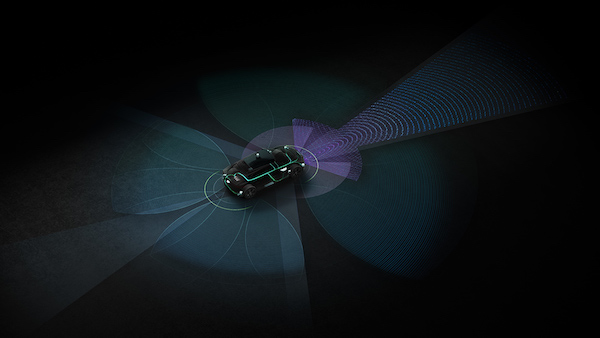
At his GTC keynote, Huang also announced the next-generation of the DRIVE Hyperion architecture, built on the Atlan computer, for vehicles starting to ship in 2026. According to NVIDIA, the next-generation platform will increase performance for processing sensor data and extend the operating domains of full self-driving. DRIVE Hyperion 9 will feature 14 cameras, nine radars, three lidars and 20 ultrasonics as part of its sensor suite.


Since its founding in 1993, NVIDIA (NASDAQ: NVDA) has been a pioneer in accelerated computing. The company’s invention of the GPU in 1999 sparked the growth of the PC gaming market, redefined computer graphics, ignited the era of modern AI and…

Cut Retrieval-Augmented Generation (RAG) Hallucinations by 50%
Most teams hit the same wall with enterprise AI: LLMs that hallucinate, pipelines that don’t scale, and infrastructure that’s harder to design than the models themselves.

DE's editors contribute news and new product announcements to Digital Engineering. Press releases may be sent to them via [email protected].
Follow DE
Join over 90,000 engineering professionals who get fresh engineering news as soon as it is published.






About Us · Contact Us · Editorial Team · Advertising · Privacy Policy · Subscriber Services · © 2026 Digital Engineering 24/7 · Peerless Media