Helping design and engineering professionals discover, evaluate and specify technologies and processes that shorten the design cycle and enable success.



May 2026 Special Focus: Artificial Intelligence in Design and Simulation
In this Special Focus Issue, learn about the latest developments in the integration of artificial intelligence into engineering workflows.

Design & Simulation Software Guide 2025
In this Special Issue, Digital Engineering presents its second annual guide to design and simulation software vendors.
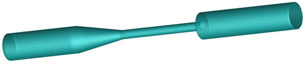 Round-robin 1: Conduct the first round robin test on the nozzle design (Sept. 2008 – Dec. 15, 2008). |
The U.S. Food and Drug Administration (Washington, DC) invites collaboration in a project, "Standardization of Computational Fluid Dynamic (CFD) Techniques Used to Evaluate Performance and Blood Damage Safety in Medical Devices."
The purpose of this FDA Critical Path Initiative project is to determine how computational fluid dynamics (CFD) can be effectively used to characterize fluid flow and to predict blood damage in medical devices. To address this complex issue, FDA has partnered with academia and industry under the Critical Path Initiative program to advance the application of CFD technology in the development and evaluation of medical devices.
In order to better understand the current state of the art of how CFD is applied to medical devices, a practical evaluation will be conducted of two different flow models, which were developed by the project’s Technical Steering Committee. Collaborators on the project may perform computational simulations of the two models using the parameters described in the detailed project plan; this is essentially a Round Robin investigation of virtual models.
For comparison and validation of the computational simulations, three select laboratories will perform quantitative flow visualization measurements on physical models. The FDA will collect the data, analyze the results in a blinded fashion, and then compare and present the collective results. The results will be available in a public database. Hence, the two models will also serve as benchmarks for future CFD evaluations.
Participants will also be invited to predict the amount of blood damage (i.e., hemolysis), which might occur in the models under different flow conditions.
Please navigate to the CFD/Blood Damage Website to find updated information (or e-mail [email protected] to collaborate in the first Round robin, now under way. In Round Robin 2, the plan is to conduct the second round robin test on the simple ventricular assist design (starting summer 2009).
To send comments or suggestions, e-mail the FDA.
Sources: Press materials received from the company and additional information gleaned from the company's website.


DE's editors contribute news and new product announcements to Digital Engineering. Press releases may be sent to them via [email protected].
Follow DE
Join over 90,000 engineering professionals who get fresh engineering news as soon as it is published.






About Us · Contact Us · Editorial Team · Advertising · Privacy Policy · Subscriber Services · © 2026 Digital Engineering 24/7 · Peerless Media