Helping design and engineering professionals discover, evaluate and specify technologies and processes that shorten the design cycle and enable success.


Alert!
Digital Engineering ceased publication on July 1, 2026. This website remains available as an archive of engineering content.
For inquiries or information, please email [email protected].

Digital Engineering April 2026
In the latest issue of Digital Engineering, we take a look at the latest innovations in design for additive manufacturing, including the use of natural language inputs, social media cosplayers, and AI integration. The issue also includes a feature…

January Special Focus Issue: Design for Additive
In this Special Focus Issue of Digital Engineering, learn about the latest advancements in design for additive manufacturing, including new software tools, additive in automotive, custom medical devices, and more.
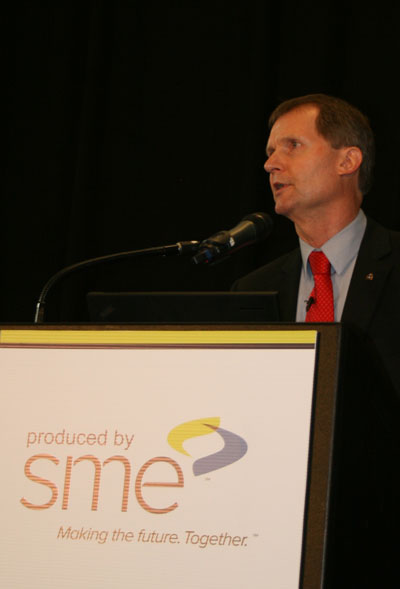
Terry Wohlers of the consulting and research firm, Wohlers Associates, kicked off the second day of the RAPID 2013 Conference and Exhibition in Pittsburgh this morning (read about the first day's keynote here). As he has in years past, Wohlers presented findings from his annual Wohlers Report, which tracks the additive manufacturing industry.
Wohlers took a global perspective of the technology and provided perspective on where the industry might go in the future. But first, he looked back to 1988 when 3D Systems first commercialized additive manufacturing.
"It hasn't been until relatively recently that we've applied additive manufcaturing to making final products," he said. "We're just getting started, really. We have so much to learn about this process."
While it was learning last year, the industry grew 28.6%, according to Wohlers, who said the media attention surrounding 3D printing grew by 100%. "It's creating the illusion that this is brand-new technology" and has advanced rapidly overnight, he said. "That's not the case. We've seen steady advancement over the past 25 years."
Industrial Unit sales of machines that sell for $5,000 or more grew by 19.3%, while low-cost personal 3D printers that sell for $200-$5,000 sales have slowed. Wohlers said personal 3D printer sales grew, on average, by 346% since 2007. Last year personal 3D printer sales grew by 46.6%, accounting for 6.5% of total system sales revenues in 2012.
"I really think that at the current level of quality of these personal 3D printers, the low-hanging fruit has been picked," Wohers said. He added that the quality will need to improve if the segment will see double-digit growth again.
Part of that strong base comes from companies like Honeywell and GE Aviation driving AM, especially with their use of the technology in aerospace. Wohlers says GE Innovation, for example, plans to spend $3.5 billion over the next five years on additive manufacturing. The automotive industry is also paying attention to AM, though only three people raised their hands when Wohlers asked who in the audience was from the auto industry.
"We need to light a fire under these companies," he said. "I would encourage auto companies to re-engage, even though the volumes aren't like medical and aerospace," there are many low-volume applications, especially in luxury sports cars and tooling needs.
Other companies you might not expect, such as Nike and New Balance have used AM for years, and have begun commercializing the 3D printing of show soles for the first time, according to Wohlers. Amazon also has a new section dedicated to 3D printing.
When President Obama said: "3D printing has the potential to revolutionize the way we make almost everything" in the State of the Union address, it had repurcussions beyond our borders.
Wohlers, just back from the 2013 World 3D Printing Technology Industry Conference in China, said that statement focused galvanized countries' support for AM. He said China's central government is funding AM to the tune of $245 million for a 7-year pilot program.
"One strategy the country may pursue is to buy its way in," Wohlers said, to meet its goal to become the No. 1 country in the AM industry in the next three years.
Wohlers noted other countries' AM activity:
"We're going to see a whole new way of thinking and new business models," Wohlers said. "However, we've lost some of our edge" as other countries now have many more large-scale AM system manufacturers than the U.S. does.

Wohlers noted the following challenges to the AM industry:
"I think children will be a big market, as for parents ..." Wohlers said. "We'll have professionals shipping parts to consumers, rather than consumers making their own. I could be wrong, but that's my opinion. We will, however, have much more variety because we can make products that weren't practical before."


Jamie Gooch is the former editorial director of Digital Engineering.
Follow DE






About Us · Contact Us · Editorial Team · Advertising · Privacy Policy · Subscriber Services · © 2026 Digital Engineering 24/7 · Peerless Media