Helping design and engineering professionals discover, evaluate and specify technologies and processes that shorten the design cycle and enable success.


Alert!
Digital Engineering ceased publication on July 1, 2026. This website remains available as an archive of engineering content.
For inquiries or information, please email [email protected].


Digital Engineering April 2026
In the latest issue of Digital Engineering, we take a look at the latest innovations in design for additive manufacturing, including the use of natural language inputs, social media cosplayers, and AI integration. The issue also includes a feature…

January Special Focus Issue: Design for Additive
In this Special Focus Issue of Digital Engineering, learn about the latest advancements in design for additive manufacturing, including new software tools, additive in automotive, custom medical devices, and more.
Researchers at the University of Minnesota have found a way to use 3D printing to further integrate people and electronics. They have demonstrated a way to use a 3D printer to print electronics on human skin.
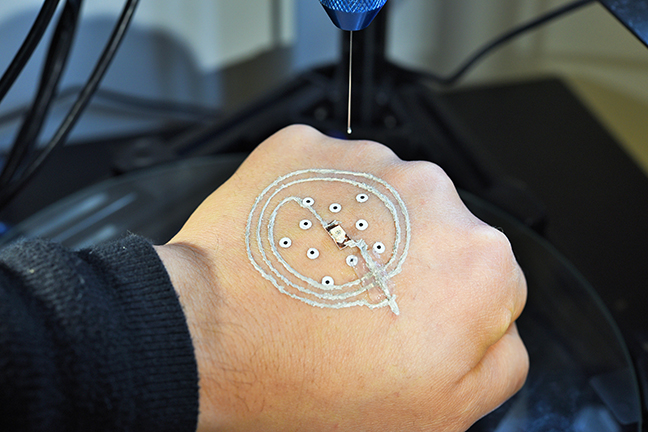
The technology could be used to print temporary sensors on the bodies of soldiers, for example, to detect chemical or biological weapons. Printed solar cells could also be used to charge electronics. And the team also printed biological cells on the skin wound of a mouse, which could open up new types of wound treatment processes.
“We are excited about the potential of this new 3D-printing technology using a portable, lightweight printer costing less than $400,” said Michael McAlpine, the study’s lead author and the University of Minnesota Benjamin Mayhugh Associate Professor of Mechanical Engineering. “We imagine that a soldier could pull this printer out of a backpack and print a chemical sensor or other electronics they need, directly on the skin. It would be like a ‘Swiss Army knife’ of the future with everything they need all in one portable 3D printing tool.”
The human body is an imperfect (and often twitchy) build platform, so the team came up with a technique that allows the printer to adjust to small movements during the printing processes. The printer uses computer vision to follow a pattern based on temporary markers placed on the skin. The process also uses an ink that can be cured at room temperature.
“No matter how hard anyone would try to stay still when using the printer on the skin, a person moves slightly and every hand is different,” McAlpine said. “This printer can track the hand using the markers and adjust in real-time to the movements and contours of the hand, so printing of the electronics keeps its circuit shape.”
The printed electronics can be peeled or washed off after use.
The research was published in the journal Advanced Materials.
Source: University of Minnesota


Brian Albright is the editorial director of Digital Engineering.
Contact him at [email protected].






About Us · Contact Us · Editorial Team · Advertising · Privacy Policy · Subscriber Services · © 2026 Digital Engineering 24/7 · Peerless Media