Helping design and engineering professionals discover, evaluate and specify technologies and processes that shorten the design cycle and enable success.


Alert!
Digital Engineering ceased publication on July 1, 2026. This website remains available as an archive of engineering content.
For inquiries or information, please email [email protected].

Digital Engineering April 2026
In the latest issue of Digital Engineering, we take a look at the latest innovations in design for additive manufacturing, including the use of natural language inputs, social media cosplayers, and AI integration. The issue also includes a feature…

January Special Focus Issue: Design for Additive
In this Special Focus Issue of Digital Engineering, learn about the latest advancements in design for additive manufacturing, including new software tools, additive in automotive, custom medical devices, and more.
The team of engineers at Robotic Research LLC, a provider of autonomy and robotic technologies for government and commercial customers, is applying its engineering capabilities to create new solutions for health care workers to help fight the COVID-19 crisis in the Washington area and around the world.
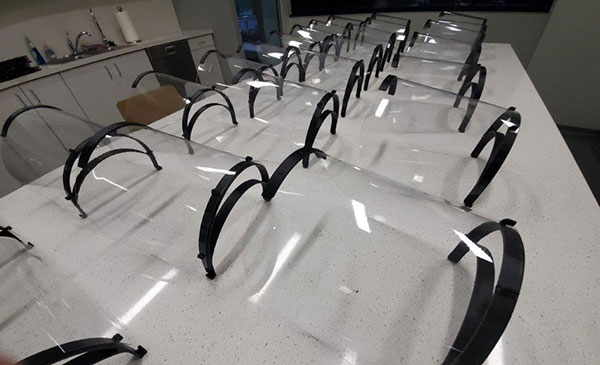
The company has created a design for reusable face shields and is providing them to health care teams in hospitals around the Greater Washington Metro area. The company also just opened up its patented design of its sterile 3D printer by waiving licensing fees globally for any application of the printers related to fighting the current public health pandemic.
The face shields, which Robotic Research is printing on standard industrial 3D printers at its robotics engineering facility in Clarksburg, MD, are being delivered to support teams at local hospitals in the Montgomery County area. The face shield design provides comfort and protection, and features an improved disinfection process capability using materials that are compatible with the cleaning methods used at a hospital. The design has been approved for use in select departments, with broader uses currently under evaluation.
“Our team wanted to help out in any way we could to support the local frontline health care providers who are working around the clock to assist those impacted by the COVID-19 public health crisis,” says Alberto Lacaze, president of Robotic Research. “We are producing a face shield that modifies a design that is based off the blueprint provided by the National Institutes of Health. The design includes some enhancements to further protect from aerosol in the temple area, allow the masks to be cleaned and therefore reusable, as well as comfortable to wear over prolonged use.”
Robotic Research has sourced materials from across the country to support the production of approximately 2,000 face shields. The company is seeking a grant through Montgomery County and the state of Maryland to boost production to approximately 500 shields a day. Robotic Research is a provider of autonomy and robotic technologies for government and commercial customers. The company normally uses its standard 3D printers to support many of its products and solutions.
Materials used for polymer 3D printing are often damaged by the high temperatures, chemicals or radiation used in standard sterilization processes. Robotic Research’s process overcomes this challenge by using a sterile chamber around a 3D printer where unsterilized plastic is brought into the chamber. The possibly contaminated plastic is sterilized by the printing process and packaged maintaining the sterile field. This system was initially designed for a U.S. government agency to allow sterile medical materials to be printed at locations where commonly used sterilization methods might not be possible.
“Because this printer can create sterile materials, which are sterile from the inside out once produced, we are eliminating the need for hospitals to resterilize equipment before use,” says Lacaze. “At a time when efficiency and supplies are critical, we hope this technology will be able to help alleviate some of the immense pressure hospitals and medical facilities are currently facing. It is our hope that providing the use of this process at no cost may help bring solutions to the health care teams working to save lives during this crisis.”
This printer process enables the manufacturing of sterile medical equipment and implantable device components, such as intubation tubes and other materials required during invasive procedures, in a manner that eliminates the need for additional sterilization.
Robotic Research’s sterile 3D printing process (USPTO 10,406,758) will be available royalty free for a minimum of one year for any COVID-19 applications across the globe.
The company is committed to continuing to use its resources and facilities to develop solutions for the ongoing challenges of the COVID-19 pandemic.
Sources: Press materials received from the company and additional information gleaned from the company’s website.


DE's editors contribute news and new product announcements to Digital Engineering. Press releases may be sent to them via [email protected].
Follow DE






About Us · Contact Us · Editorial Team · Advertising · Privacy Policy · Subscriber Services · © 2026 Digital Engineering 24/7 · Peerless Media