Helping design and engineering professionals discover, evaluate and specify technologies and processes that shorten the design cycle and enable success.



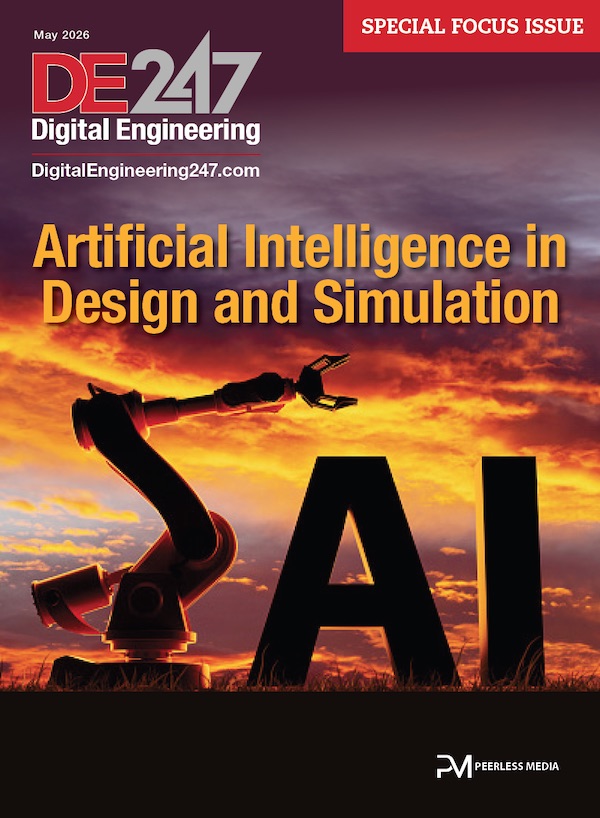
May 2026 Special Focus: Artificial Intelligence in Design and Simulation
In this Special Focus Issue, learn about the latest developments in the integration of artificial intelligence into engineering workflows.

Design & Simulation Software Guide 2025
In this Special Issue, Digital Engineering presents its second annual guide to design and simulation software vendors.
Siemens Digital Industries Software has shared details of its ongoing collaboration with PhysicsX, a startup leveraging generative artificial intelligence (AI) to enable engineering in advanced industries, Siemens reports. The collaboration is aimed at creating the next generation of AI-based deep physics simulation to accelerate performance prediction and optimization. PhysicsX is building its latest pretrained deep physics model for aerodynamics on high-fidelity simulation data generated with the Siemens Xcelerator portfolio.
“AI represents a truly transformative opportunity for the simulation community, and we are exploring its potential at an accelerated rate,” says Jean-Claude Ercolanelli, senior vice president, Simulation and Test Solutions, Siemens Digital Industries Software. “To scale AI adoption, open collaboration is key and Siemens is delighted to see PhysicsX unveil to the world what it is working on—together, we’re exploring an AI-enhanced simulation industry that has the potential to change how products are ideated and engineered.”
“The basis for successful AI deployment into engineering hinges on highest-quality synthetic data, robust integrations between computer-aided engineering (CAE) and AI and building on the trust customers have in our respective technologies," says Robin Tuluie, founder and chairman of PhysicsX. "We are thrilled to be building into the opportunity space together with Siemens with the release of our latest Large Geometry Model [LGM) for aerodynamics, LGM-Aero, trained on high-fidelity data generated with Siemens Xcelerator portfolio tools.”
PhysicsX’s LGM-Aero is trained on a corpus of more than 25 million geometries and associated physics simulation. The training data contains tens of billions of mesh elements and tens of thousands of computational fluid dynamics and finite Element Analysis (FEA) simulations using high-quality Simcenter STAR-CCM+ software and Simcenter Nastran software.
PhysicsX has also released Ai.rplane, a free public-access reference application offering a set of tools focused on aerodynamics and aircraft structures with AI-shape generation. Powered by LGM-Aero, Ai.rplane shows a fully trained model that generalizes to a set of aeroelastic applications. LGM-Aero is used as a zero-shot model to infer aero performance, flight stability and structural stress for any flying shape generated. The application demonstrates the creation of geometry and the assessment of physics performance in less than a second.
Starting with instructions, users can explore the generative design space offered by Ai.rplane, and modify or optimize for a desired performance characteristic in seconds. Later, PhysicsX aims to add new features, including cargo packaging, selection of commercial powertrains, and controls.
Ai.rplane was developed using a set of simulation technologies from Siemens to automate generation of high-quality training data. LGM-Aero and Ai.rplane are available on the PhysicsX AI engineering platform.
To access Ai.rplane go to airplane.physicsx.ai.
Sources: Press materials received from the company and additional information gleaned from the company’s website.


Simcenter™ software, from Siemens Digital Industries Software, uniquely combines system simulation, 3D CAE and test to help you predict performance across all critical attributes earlier and throughout the entire product lifecycle. By combining…
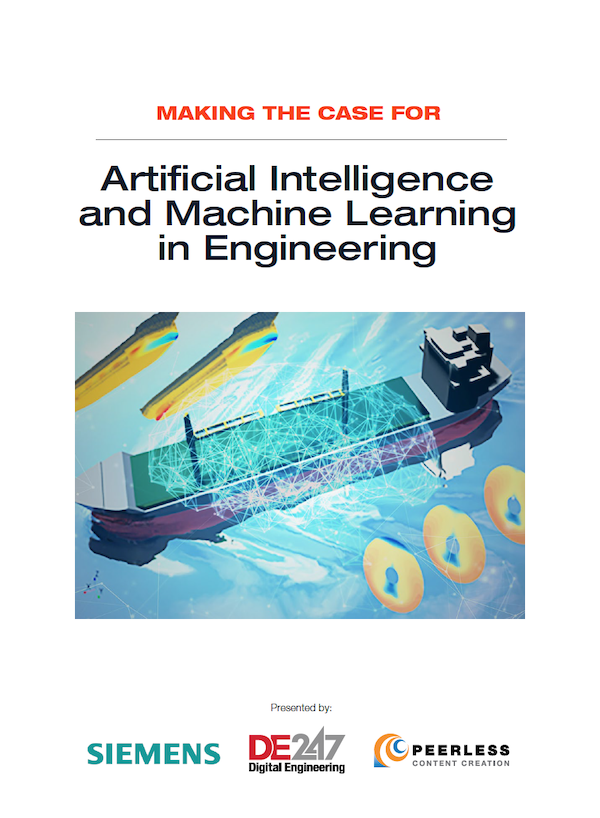
Making the Case for Artificial Intelligence and Machine Learning in Engineering
In this paper, Siemens Digital Industries Software and Digital Engineering will provide an overview of how AI/ML-enabled software can improve design workflows, while also addressing common questions and concerns around implementing this technology in an engineering organization.

DE's editors contribute news and new product announcements to Digital Engineering. Press releases may be sent to them via [email protected].
Follow DE
Join over 90,000 engineering professionals who get fresh engineering news as soon as it is published.






About Us · Contact Us · Editorial Team · Advertising · Privacy Policy · Subscriber Services · © 2026 Digital Engineering 24/7 · Peerless Media