Helping design and engineering professionals discover, evaluate and specify technologies and processes that shorten the design cycle and enable success.


Alert!
Digital Engineering ceased publication on July 1, 2026. This website remains available as an archive of engineering content.
For inquiries or information, please email [email protected].
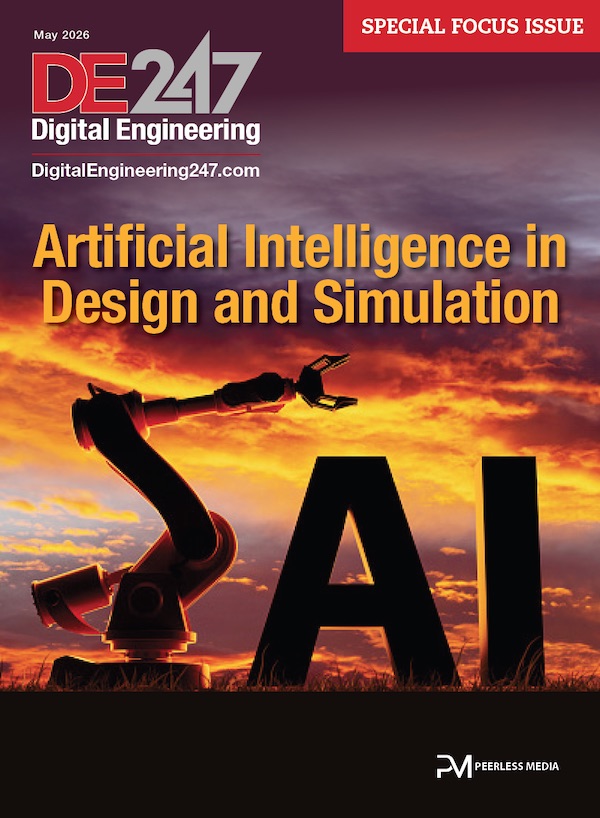
May 2026 Special Focus: Artificial Intelligence in Design and Simulation
In this Special Focus Issue, learn about the latest developments in the integration of artificial intelligence into engineering workflows.

Design & Simulation Software Guide 2025
In this Special Issue, Digital Engineering presents its second annual guide to design and simulation software vendors.
Siemens PLM Software introduced a solution for the development of autonomous driving systems during the Siemens U.S. Innovation Day in Chicago in late March. The solution, part of the Simcenter portfolio, reportedly minimizes the need for extensive physical prototyping while reducing the number of logged test miles necessary to demonstrate the safety of autonomous vehicles.
Autonomous vehicle prototypes would have to be driven hundreds of millions of miles, and in some cases hundreds of billions of miles, over the course of several decades to demonstrate their reliability in terms of fatalities and injuries – an outcome the authors deemed inconsistent with the near-term commercial viability of self-driving cars, according to the findings of a report issued by the Rand Corporation. For possible solutions to these challenges, the researchers pointed to testing methods such as advanced simulation technologies.
Leveraging advanced, physics-based simulation and sensor data processing technologies, the Siemens solution is designed to help automakers and their suppliers address this industry challenge with the potential to shave years off the development, verification and validation of self-driving cars, the company reports.
The new solution integrates autonomous driving technologies from recent Siemens acquisitions Mentor Graphics and TASS International. TASS’ PreScan simulation environment produces realistic, physics-based simulated raw sensor data for an unlimited number of potential driving scenarios, traffic situations and other parameters. The data from PreScan’s simulated LiDAR, radar and camera sensors is then fed into Mentor’s DRS360 platform, where it is fused in real time to create a high-resolution model of the vehicle’s environment and driving conditions. Customers can then leverage the DRS360 platform’s perception resolution and processing to test and refine proprietary algorithms for object recognition, driving policy and more.
“Automakers are quickly realizing that physical prototypes and road testing alone cannot reproduce the multitude of complex driving scenarios self-driving cars will encounter. In fact, many of the deadliest scenarios are impossible to reproduce, while others are so dangerous to reproduce that ethics preclude pre-testing,” says Dr. Jan Leuridan, senior vice president, Simulation and Test Solutions, Siemens PLM Software. “It is clear that the near-term commercial availability of fully autonomous vehicles is highly dependent on advanced, physics-based simulation technologies, where Siemens is setting the pace for the larger worldwide automotive industry.”
Siemens PLM Software is working with many manufacturers of LiDAR, radar and vision sensing products to develop physics-based, 3D simulated versions of specific sensor modules. Compatible with the new Siemens toolchain, the simulated sensors are attuned using detailed design information from sensor suppliers, and validated using real-world measurement data for accuracy. One named sensor partners is Cepton Technologies, a Silicon Valley-based company that makes long-range, small-footprint LiDAR sensors. Additional sensor partners will be announced later this year.
The Siemens PLM Software automated driving solution is planned for availability in the third quarter of this year.
For more info, visit Siemens PLM Software.
Sources: Press materials received from the company.


DE's editors contribute news and new product announcements to Digital Engineering. Press releases may be sent to them via [email protected].
Follow DE
Join over 90,000 engineering professionals who get fresh engineering news as soon as it is published.






About Us · Contact Us · Editorial Team · Advertising · Privacy Policy · Subscriber Services · © 2026 Digital Engineering 24/7 · Peerless Media