Helping design and engineering professionals discover, evaluate and specify technologies and processes that shorten the design cycle and enable success.


Alert!
Digital Engineering ceased publication on July 1, 2026. This website remains available as an archive of engineering content.
For inquiries or information, please email [email protected].

Design & Simulation Software Guide 2025
In this Special Issue, Digital Engineering presents its second annual guide to design and simulation software vendors.

Design & Simulation Software Guide
In this Special Issue, Digital Engineering presents its inaugural guide to design and simulation software vendors, including listings for CAD, CAM, simulation, generative design, PLM, rendering and visualization, design for additive manufacturing,…
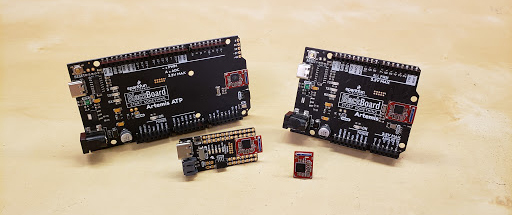
SparkFun Electronics’ SparkX division, led by founder Nathan Seidle, has released the company’s first open-source, embedded-systems module—SparkFun Artemis, Engineering Version—to empower engineers, prototypers and R&D teams to integrate the TensorFlow machine-learning platform into any design. Additionally, the team has launched three boards with the unshielded module: BlackBoard Artemis; BlackBoard Artemis Nano; and BlackBoard Artemis ATP.
“Our goal is to enable anyone to integrate low-power machine learning into their designs and projects without being locked into a specific toolchain,” says SparkFun founder and engineer, Nathan Seidle. “The Artemis module is the first product to bridge the gap between hobbyists and consumer products, providing a single module from prototype to production.”
Beyond its small size (15.5x10.5 mm including antenna), key features of the ultra-low-power Artemis module include: Cortex-M4F based BLE module using the Apollo3 microcontroller from Ambiq; advanced HAL (hardware abstraction layer); capability of running machine learning algorithms with the low current consumption of 6μA/MHz at 3.3V; integrated Bluetooth 5 low-energy radio and 2.4GHz antenna; all necessary circuitry for easy integration; programming over pre-configured serial bootloader or JTAG; ISO7816 Secure ‘Smart Card’ interface; secure firmware update system; flexible serial peripherals; set of clock sources; and camera capable.
“SparkFun has always been about making emerging technologies available to a wider audience—the Artemis module is no exception,” says SparkFun CEO Glenn Samala. “Our goal is to blow the doors open for innovation in the area of machine learning with our open-source-hardware model—the Artemis module moves us several steps in the right direction.”
The three carrier boards provide form factors and enable anyone to flex the capabilities of Artemis module. All three boards have a digital MEMS microphone. The boards have built-in BLE radio, are fully compatible with SparkFun's Arduino core and can be programmed easily under the Arduino IDE. The boards have an exposed JTAG connector. They also include Qwiic connectors for easy prototyping and daisy-chain capabilities for the Qwiic ecosystem, which includes 70+ sensors, outputs, and controllers.
The SparkFun BlackBoard Artemis comes in the Uno footprint. The BlackBoard Artemis Nano is the smallest form factor of the three boards and offers great flexibility for smaller projects.
SparkFun is currently seeking FCC/CE approval for the Artemis module, which will be released as shielded modules and will be available in tape-and-reel quantities. The Engineering Version has released.
Sources: Press materials received from the company and additional information gleaned from the company’s website.


DE's editors contribute news and new product announcements to Digital Engineering. Press releases may be sent to them via [email protected].
Follow DE






About Us · Contact Us · Editorial Team · Advertising · Privacy Policy · Subscriber Services · © 2026 Digital Engineering 24/7 · Peerless Media