Helping design and engineering professionals discover, evaluate and specify technologies and processes that shorten the design cycle and enable success.



Digital Engineering April 2026
In the latest issue of Digital Engineering, we take a look at the latest innovations in design for additive manufacturing, including the use of natural language inputs, social media cosplayers, and AI integration. The issue also includes a feature…

January Special Focus Issue: Design for Additive
In this Special Focus Issue of Digital Engineering, learn about the latest advancements in design for additive manufacturing, including new software tools, additive in automotive, custom medical devices, and more.
At Autodesk University, Stratasys and Autodesk unveiled the first full-scale turbo-prop aircraft engine model produced using Stratasys FDM (Fused Deposition Modeling) technology.
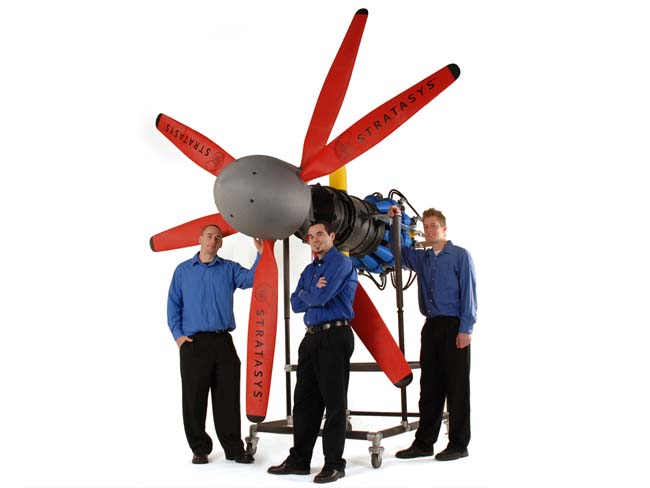 |
The engine’s design was created using Autodesk Inventor 2010 mechanical design and engineering software, and it was produced on both Fortus 3D Production Systems and Dimension 3D Printers from Stratasys. The engine model sets a new precedence in scale, and it showcases the potential of 3D printing.
The engine’s gear box includes two sets of gears, which operate two sets of propellers that move in counter rotation to each other. With an engine length of over 10 ft., a blade-span of 10.5 ft., and 188 components, the engine model is massive in size. It includes several large parts, such as six propeller blades, each measuring 4.5 ft.
Building this physical model with FDM helped improve its design by identifying four opportunities to make components fit or operate with better precision. Assembling a physical model helps design engineers be certain of component form, fit, and function.
The turbo-prop engine was designed by Nino Caldarola, a freelance designer for Autodesk. He shared his concept with Autodesk who wanted to bring a full-scale model to life using Inventor software and FDM technology. Caldarola’s design is a hybrid of newer engine and classic engine design and was partially inspired by the Piaggio Avanti II aircraft engine, the TP 500. Caldarola worked with engineers at RedEye On Demand prototyping and production service, a business unit of Stratasys, to make adjustments that would ensure an accurate physical model.
All 188 components were produced in 4 weeks and assembled in 2.5. Using conventional fabrication processes, such as machining and casting (with in-house and outside resources) a manufacturer would expect to spend 9 months or more producing a model like this.
Check out DE’s slideshow of Autodesk University, which includes more images of the model.
For more information, visit Stratasys and Autodesk.
Sources: Press materials received from the company and additional information gleaned from the company's website.


DE's editors contribute news and new product announcements to Digital Engineering. Press releases may be sent to them via [email protected].
Follow DE
Join over 90,000 engineering professionals who get fresh engineering news as soon as it is published.






About Us · Contact Us · Editorial Team · Advertising · Privacy Policy · Subscriber Services · © 2026 Digital Engineering 24/7 · Peerless Media