Helping design and engineering professionals discover, evaluate and specify technologies and processes that shorten the design cycle and enable success.


Alert!
Digital Engineering ceased publication on July 1, 2026. This website remains available as an archive of engineering content.
For inquiries or information, please email [email protected].

Digital Engineering April 2026
In the latest issue of Digital Engineering, we take a look at the latest innovations in design for additive manufacturing, including the use of natural language inputs, social media cosplayers, and AI integration. The issue also includes a feature…

January Special Focus Issue: Design for Additive
In this Special Focus Issue of Digital Engineering, learn about the latest advancements in design for additive manufacturing, including new software tools, additive in automotive, custom medical devices, and more.
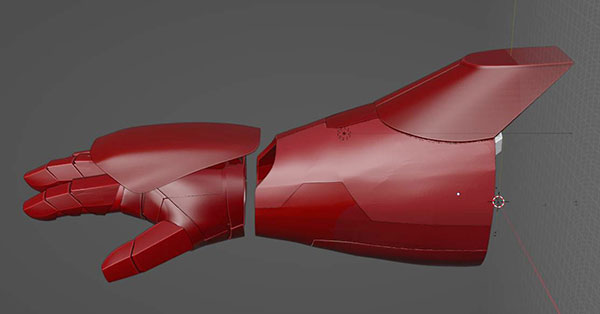
Tommy Davenport leads a double life, just like his beloved Marvel and DC superheroes. In one world, he is a systems engineer in the defense sector. In the world of YouTube and TikTok, he is TommyTech, a superhero costume maker. His latest project is to recreate the Iron Man gauntlet, tailor-made to fit his own hand.
“It’s a transformable wearable, based on Iron Man 3 [released in 2013],” says Davenport. “In the movie, the suit transforms to fit Iron Man’s body. It is different from the medieval armor pieces that usually need a couple of helpers to put on.”
The first step in Davenport’s Iron Man gauntlet design was getting a digital scan of his own hand. He started out with a LiDAR scanner, but swiftly discovered more affordable methods. “Nowadays even the front-facing camera on your smartphone or photogrammetry is an option,” he says.
He wasn’t in a position to call up Walt Disney Co., the movie’s IP owner, and ask for reference 3D CAD designs. Besides, he points out, “What you saw in the movie was made possible with visual effects. It wasn’t reality. So I had to fill in the gaps to make it function like that in reality.”
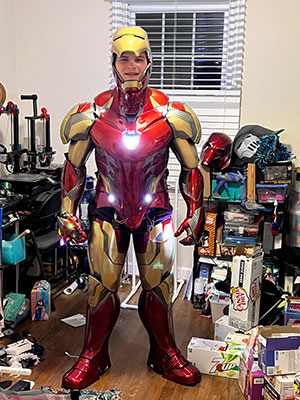
Zachary Derman in the Iron Man suit he made using 3D-printed pieces. Image courtesy of Zachary Derman.
Davenport owns two 3D printers, the Bambu P1S (~$400) and P2S (~$550). Bambu markets its P series printers as all-around affordable printers for consumers, makers, and hobbyists. The company also offers the H series printers, meant for personal or professional manufacturing tasks. He usually uses PLA Pro filaments, available from Amazon and other online sellers.
Davenport also bought off-the-shelf electronic parts to drive the self-assembling features of the gauntlet. “The goal is to make it easy for anyone watching my videos to make the gauntlet themselves,” he says. “So anybody can take a look at my part list, buy what they need, get them shipped to themselves, and print the gauntlet themselves.”
The Iron Man Gauntlet went through nearly 10 major iterations. But for smaller components, such as mechanical joints connecting different parts, the iteration count might be much higher.
Davenport uses SOLIDWORKS CAD at work, but for his superhero costumes, he uses a combination of Autodesk Fusion 360 and Autodesk Blender. “Both [SOLIDWORKS and Fusion] CAD programs are parametric, but with Blender, it feels more like sculpting,” he notes. “I spent roughly seventy percent of my time in Blender for the Iron Man Gauntlet project.”
Some parts began as parametric 3D parts, but they ultimately ended up in Blender for final touchups. To print the pieces, Davenport exported STL files from Blender.
In total, Davenport estimated he’d spent “at least a few hundred hours” on the gauntlet. “It’s a lot more art than science,” he recalls. He’s not quite finished yet. “My next challenge is to add a missile to the gauntlet, so it could pop out from under a lid when I want it. I don’t want to use a button; it should be gesture-activated,” he reveals. But for safety reasons, he said the missile would be purely decorative; it wouldn’t actually fire.
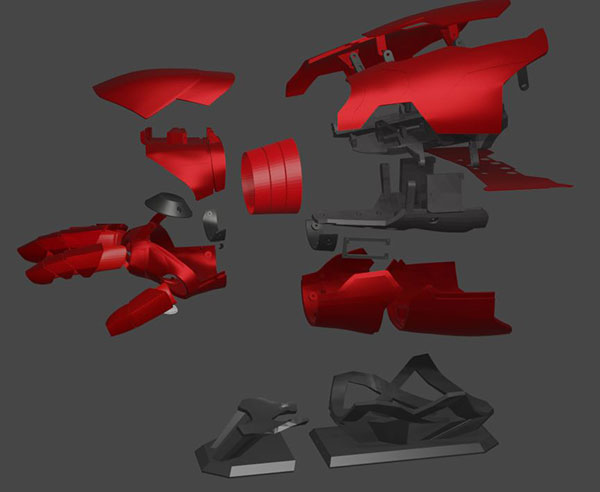
Exploded view of the Iron Man Gauntlet, designed for 3D printing. Image courtesy of Tommy Davenport.
Five years ago, Zachary Derman decided to go after the Mandalorian’s head. Specifically, he wanted the helmet of the legendary bounty hunter from the Star Wars universe. Back then, he hadn’t yet learned 3D modeling, so he got the 3D file of the helmet from Thingiverse, a downloadable 3D content site. That kickstarted his superhero costume-making passion. Later, he would improve on the helmet with another file found on Do3D, which maintains a catalog of print-ready files, downloadable for a fee.
“I use a software program called Armorsmith Designer [editing software for cosplayers, developed by Armored Garage]. I put in my body measurements, then got a 3D version of myself. Then I upload the downloaded 3D file and resize it until it fits before I print it,” explains Derman.
Currently a college freshman studying mechanical engineering, Derman is learning to use Autodesk Fusion 360. For modeling superhero costumes, he relied heavily on YouTube tutorials from other cosplayers and makers. “I was able to model the Iron Man face plate, and the mask of the Invincible [a superhero character created by Robert Kirkman and illustrated by Cory Walker and Ryan Ottley, for Image Comics],” he says. “I designed them in Fusion 360.”
Still a newbie at CAD modeling, he frequently got stumped. “I modeled half of the Invincible mask, then I didn’t know how to use the mirror command to create the other half,” he recalls.
Derman’s first 3D printer was the Creality Ender 3 ($200 on Amazon). He subsequently upgraded it to Bambu Lab ($400 from Bambulab.com) and ELEGOO Neptune 3 Max ($350 on Amazon). With a mix of downloaded files, some CAD modeling, and home-based 3D printing, he managed to produce a Wolverine suit and Iron Man suit, among others.
“When I was making the Iron Man suit, I didn’t have the Neptune 3 Max [with bigger print capacity]. So I had to print my part in pieces and solder them together,” says Derman.

On Quora and Reddit, superhero fans discussed how much their favorite superheroes’ suits might cost, hypothetically. One Iron Man fan pointed out the life-saving arc, a critical piece in Iron Man’s suit, would cost $36 million. “I can make the Mandalorian helmet for $10, with a single roll of filament,” says Derman. But with iterations and experimentation, the cost of filament and paint could add up. “Paint is $15 a can, and I would go through five or six [for a single project]. And definitely don’t underestimate the time it takes,” he adds.
Derman had to put in time and labor to sand the printed parts and paint them to give them a metallic finish. In newer versions of his Wolverine suit and a brand new Superman suit, Derman plans to incorporate cut foam pieces to create muscle layers, so he’s now learning to sew. He’s also looking for brands that might be interested in sponsoring his costume-making videos on TikTok and Instagram.
On Instagram, Derman (@zachderman3d) posted a video, wearing his Iron Man suit. “I’m trying to get invited to the Avengers: Doomsday premiere. As you can see, I have my own Iron Man suit. It’ll be a dream come true for me. I love making costumes. It would be awesome to show up in one of these,” he made his case, hoping to get the attention of the film’s PR firm or a Marvel Comics executive. On TikTok, he made the same pitch, but wearing his bright yellow Wolverine costume.


Autodesk is a world leader in 3D design, engineering, and entertainment software. They produce software for the architecture, engineering, construction, manufacturing, media, and entertainment industries.

Kenneth Wong is Digital Engineering's resident blogger and senior editor. Email him at [email protected] or share your thoughts or suggestions at digitaleng.news/facebook.
Follow DE






About Us · Contact Us · Editorial Team · Advertising · Privacy Policy · Subscriber Services · © 2026 Digital Engineering 24/7 · Peerless Media