Helping design and engineering professionals discover, evaluate and specify technologies and processes that shorten the design cycle and enable success.


Alert!
Digital Engineering ceased publication on July 1, 2026. This website remains available as an archive of engineering content.
For inquiries or information, please email [email protected].

Digital Engineering April 2026
In the latest issue of Digital Engineering, we take a look at the latest innovations in design for additive manufacturing, including the use of natural language inputs, social media cosplayers, and AI integration. The issue also includes a feature…

January Special Focus Issue: Design for Additive
In this Special Focus Issue of Digital Engineering, learn about the latest advancements in design for additive manufacturing, including new software tools, additive in automotive, custom medical devices, and more.
Although the additive manufacturing market offers several metals suitable for production of complex parts — ranging from nickel alloys and aluminum to titanium — many simply do not offer the strength and reliability required for demanding applications. All these factors have ramped up pressure on technology providers to deliver the means to produce a broader array of 3D-printable steel.
“The microstructure of steels is more complex than nonferrous alloys,” says Professor Wei Xiong, a research scientist at the University of Pittsburgh’s Physical Metallurgy & Materials Design Laboratory. “We want to make sure that we can print steel with the same mechanical property as we do in subtractive processing. We design alloy microstructure because it is the key to control of the mechanical properties. Different processing parameters can lead to different microstructure. Therefore, producing desirable microstructure is the key to the printing process and post-heat treatment of the alloy after printing.”
These complex material-process interactions, in turn, call for greater control of the printing process.
“The impediments to developing 3D-printable steels depend on the printing process,” says Harald Lemke, vice president of engineered powders, NanoSteel. “In the powder bed fusion process, high cooling rate is a challenge because this causes many materials to crack. In binder jet and in fused deposition modeling, the main challenge is [performing] a complete sintering to make a fully dense (near 100%) part.”
Manufacturers are particularly keen to harness the power of tool steel because its hardness provides high tolerance for heat and abrasion. In addition, production facilities can choose from multiple grades of tool steel to support a variety of applications.
According to Lemke, “there are many applications, such as tooling, where the benefits of 3D printing are quite apparent because they are making small batches, face long lead times, and see advantage in being able to increase the intricacy of the design in ways not compatible with casting or machining. These applications are varied, and examples include tooling, such as dies or jigs, and components, such as valves or bearings.”
Potential users are looking for processes that reliably produce steel of the same quality as that manufactured by traditional processes. “The physical properties that are important in 3D-printable steel greatly depend on the application,” says Lemke. “These include hardness, strength, thermal conductivity, and fatigue resistance. Regardless of the end use property sets, the steels need to be reliably printable at or near room temperature without cracking, independent of part geometry.”
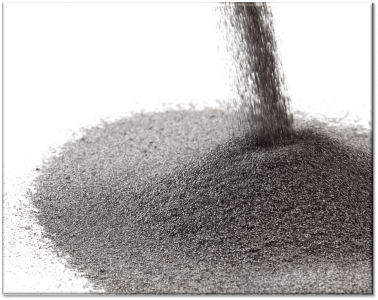
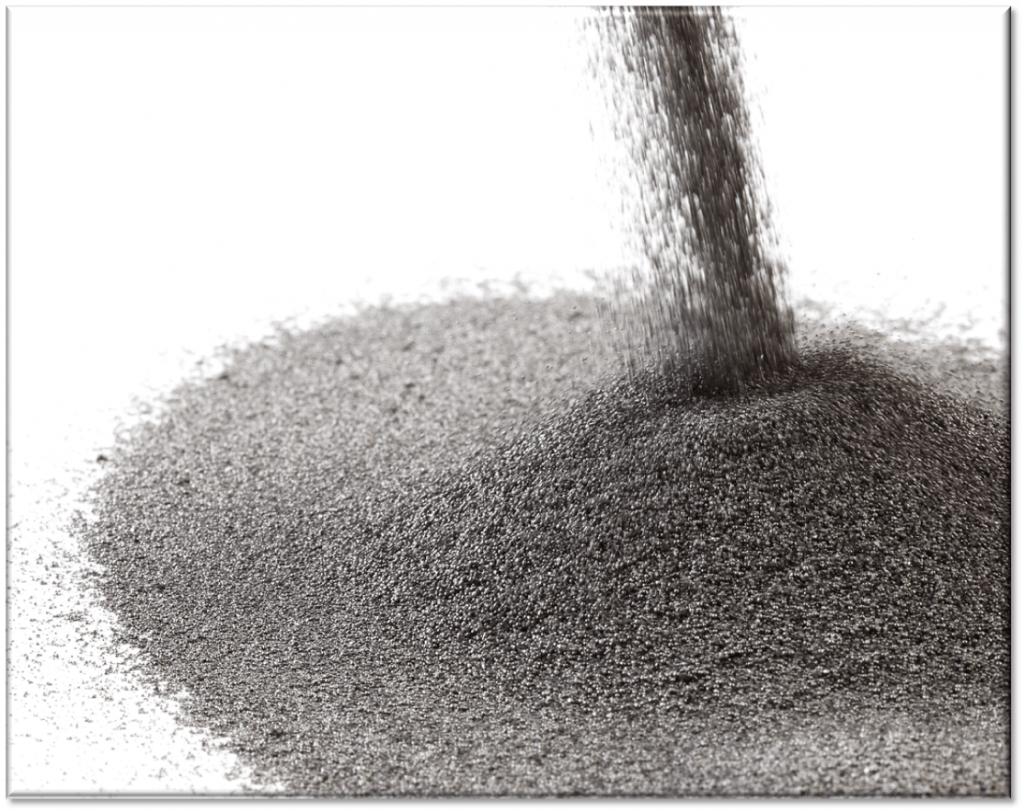 NanoSteel has created the BLDRmetal family of customized steel powders for additive manufacturing. The powders use a combination of conventional steel alloying elements to create a material sufficiently hard to print tooling and rugged components. (Image courtesy of NanoSteel.)
A printable steel powder, BLDRmetal L-40 features as-built hardness in excess of 40 HRC, which increases after heat treatment to over 50 HRC, while maintaining high ductility and toughness. In addition, case hardening can elevate the material’s surface hardness to 74 HRC without impacting the core properties, according to the company.
BLDRmetal L-40 has lower carbon content than typical tool steels. Therefore, the company says it doesn’t crack during the printing process, as is often the case with H13 tool steel. “BLDRmetal L-40 can be processed at typical printing temperatures [RT to 200 C] and has higher hardness and ductility than M300 maraging steel, the only other commonly printed tool steel,” says Lemke. “Most other tool steels are either not printable through this process at all or require elevated temperatures, nonstandard equipment, and restricted geometry.”
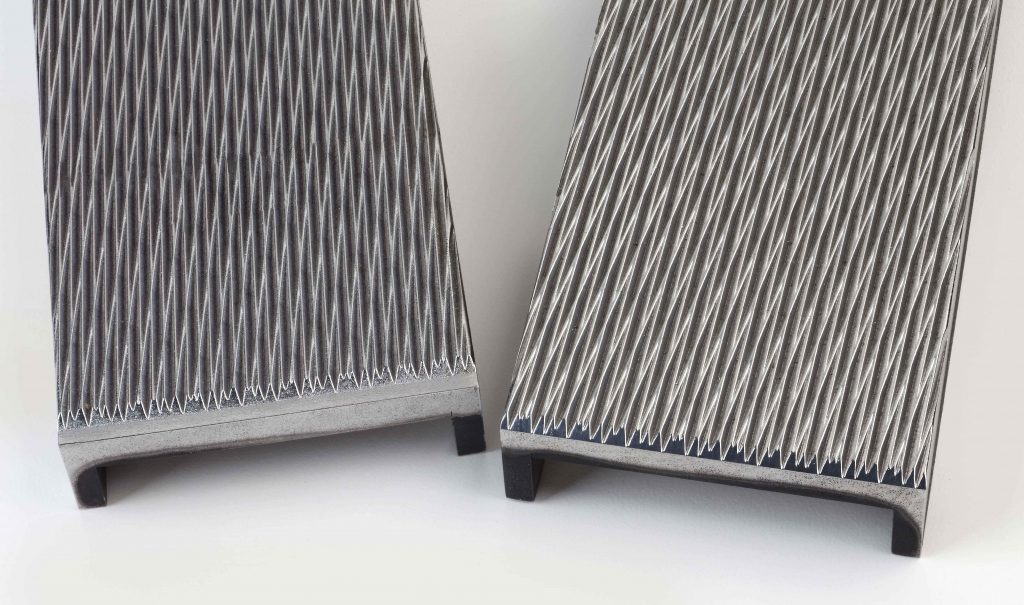 NanoSteel’s BLDRmetal L-40 represents a new class of printable steel powders that promise both high hardness and toughness. (Image courtesy of NanoSteel.)
BLDRmetal L-40 is the first alloy in NanoSteel’s emerging powder bed fusion alloy portfolio. According to the company, BLDRmetal steel powders are printable on standard equipment, some are tailored for powder bed fusion (selective laser melting) 3D printers, and others for binder jet 3D printing.
 MarkForged’s Atomic Diffusion Additive Manufacturing powder enables engineers to print complex geometries like this impeller with corrosion-resistant 316L stainless steel, reducing production time and cost. (Image courtesy of MarkForged.)
This 3D printing method promises design engineers and manufacturers a number of advantages. “Workflows are simplified, and lead times are slashed compared with traditional means of creating metal parts,” says Jon Reilly, vice president of product for MarkForged. “Our technology also increases design flexibility, unlocking new geometries like captive infills, which could not be produced before.”
The Office of Naval Research has awarded a $449,000 grant to the University of Pittsburgh's Swanson School of Engineering to develop next-generation metals, especially steel. The work will focus on creating a high-strength, low-alloy steel for naval construction. Using integrated computational materials engineering tools, the researchers will engineer the composition of the materials, optimizing them for direct metal laser sintering. The scientists will also work on post-process optimization to enhance the materials’ mechanical properties and ability to resist corrosion.
This research promises to lay the groundwork for future metal 3D printing. “We need to explore new theory and methods for designing 3D-printable steels,” says Xiong. “This will further push the current alloy design capability.”


Tom Kevan is a freelance writer/editor specializing in engineering and communications technology. Contact him via [email protected].
Follow DE






About Us · Contact Us · Editorial Team · Advertising · Privacy Policy · Subscriber Services · © 2026 Digital Engineering 24/7 · Peerless Media