Helping design and engineering professionals discover, evaluate and specify technologies and processes that shorten the design cycle and enable success.



May 2026 Special Focus: Artificial Intelligence in Design and Simulation
In this Special Focus Issue, learn about the latest developments in the integration of artificial intelligence into engineering workflows.

April 2026 Special Focus Issue: Generative Design
In this Special Focus Issue, Digital Engineering takes a look at how generative design solutions can be used across different types of design problems and with a variety of manufacturing approaches to accelerate design space exploration, and…
This week, analyst firm Greenlight Insights hosts xRS Week, a conference dedicated to extended reality (AR-VR) technology strategy.
Varjo, one of the xRS Week sponsors, is releasing VR-2, a new generation of its head mounted display unit, touted for its human-eye resolution.
VR-2 is available in Regular and Pro editions. It supports Steam VR content and OpenVR development platform (developed by Valve), which gives developers the chance to build apps with 4K-per-eye resolution rendering, according to Varjo's announcement.
The Varjo headset includes eye-tracking technology. In the new version, calibration takes less time, according to the company. Eye tracking lets you use your eyesight itself as the pointer for navigation, so you can focus in on one area -- for instance, a control dial in a virtual cockpit or an item in a virtual supermarket aisle -- to activate context-relevant menus.
VR 2 Regular and Pro are listed as $4,995 and $5,995 respectively. Software and support services run about $795. The prices reflect the company's strategy to target professional users and enterprise deployment, where the demand for high-fidelity visuals can offset the investment.

Unity, the company behind the Unity game engine, is also a participant at the conference. At the conference, Unity executive Tony Parisi, Global head of AR-VR brand solutions, talks about the use of the Unity game engine in experiential marketing -- the emerging sector revolving around delivering immersive experiences.
Unity sits between CAD programs and AR-VR apps, providing a bridge to make data transfer simpler. Its technology has been used by partners like Innoactive, to build design review and training apps for Volkswagen; and Lightshape, to build similar apps for Audi.
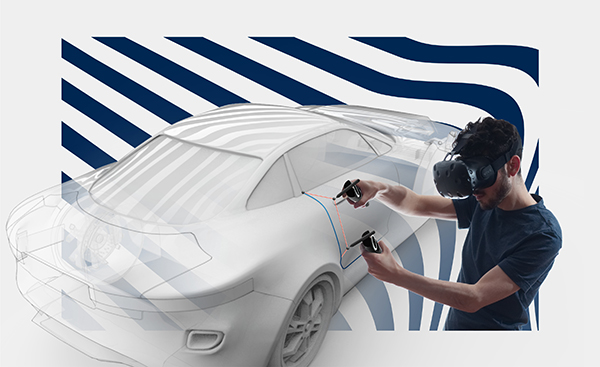
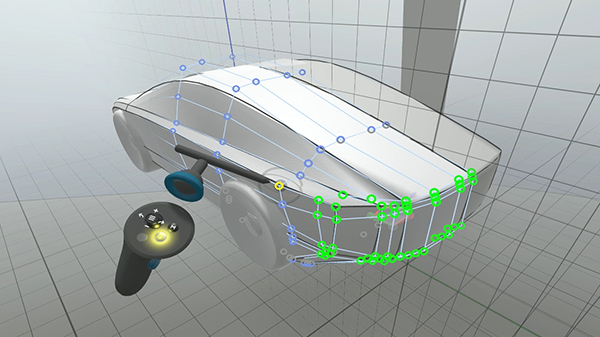
This week, flyingshapes releases the first commercial version of its CAD application for VR. Available today for Oculus Rift and HTC Vive headsets, the flyingshapes VR CAD program uses Unity technology and leverages midrange and high-end NVIDIA and AMD GPUs for rendering.
Different from the design review applications for viewing CAD data inside VR, flyingshapes' program includes sketching and surfacing tools, operable inside the VR environment. Unlike CAD modeling on a workstation, the flyingshapes program lets user virtually stands in 3D space as he or she draws, sketches, extrudes profiles, and adds surfaces to sculpt geometry.


Kenneth Wong is Digital Engineering's resident blogger and senior editor. Email him at [email protected] or share your thoughts or suggestions at digitaleng.news/facebook.
Follow DE
Join over 90,000 engineering professionals who get fresh engineering news as soon as it is published.






About Us · Contact Us · Editorial Team · Advertising · Privacy Policy · Subscriber Services · © 2026 Digital Engineering 24/7 · Peerless Media