Helping design and engineering professionals discover, evaluate and specify technologies and processes that shorten the design cycle and enable success.


Alert!
Digital Engineering ceased publication on July 1, 2026. This website remains available as an archive of engineering content.
For inquiries or information, please email [email protected].

Digital Engineering April 2026
In the latest issue of Digital Engineering, we take a look at the latest innovations in design for additive manufacturing, including the use of natural language inputs, social media cosplayers, and AI integration. The issue also includes a feature…

January Special Focus Issue: Design for Additive
In this Special Focus Issue of Digital Engineering, learn about the latest advancements in design for additive manufacturing, including new software tools, additive in automotive, custom medical devices, and more.
Liz Havlin wants all that discarded plastic to do something productive, such as fueling the demand for filament required by 3D printers. To that end, she’s begun a project called Wastestream to Mainstream with the goal of building filament extruders fueled by recycled plastic. Still in the planning stages for now, the project will move to Kickstarter and the crowdfunding scene to seek startup capital.
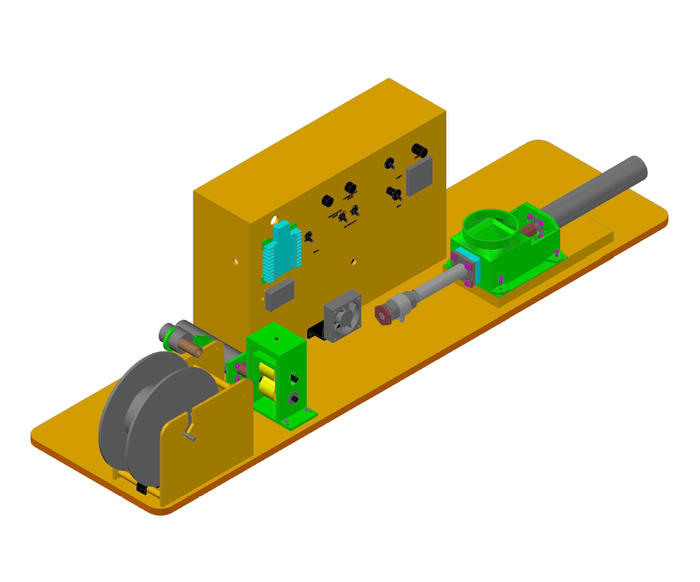
Havlin’s extruder design is based on Hugh Lyman’s award-winning model with Lyman’s blessings. Lyman’s original design used pellets to produce filament, and the new extruder, called the Legacy, works on the same principle. The only significant change in design is a spooling device at the end of the extrusion process that tidies up the filament.
The other difference is the makeup of the pellets. Havlin has contacted companies that make pellets from recycled plastic, and they’ve agreed to provide pellets for her program in exchange for plastic to recycle. While not as direct a route as simply chucking bits of plastic into a grinder yourself, nearly any program that looks for a cost-effective method of recycling plastic waste is a step in the right direction.
The only real drawback I can see to Havlin’s program is the cost of the extruders. Pre-launch, a fully assembled Legacy filament extruder will cost $699. If you are a big user of filament that might end up saving you money at a time when spools run from $35-$80. If you’re just a dabbler, it’d be hard to justify the expense. Unassembled kits are less expensive, but they are just that: unassembled.
Assuming the Kickstarter campaign goes well, Havlin has promised that for every five extruders pledged, the project will send one to areas of the world (such as India) where plastic has piled up nearly sky high. Not only would an extruder or two (or 20) in such areas help reduce the amount of trash, it could also support the local economy by providing goods to be sold.
Below you’ll find a video demonstrating Lyman’s design for a filament extruder.
Source: Kickstarter


John Newman is a Digital Engineering contributor who focuses on 3D printing. Contact him via [email protected] and read his posts on Rapid Ready Technology.
Follow DE






About Us · Contact Us · Editorial Team · Advertising · Privacy Policy · Subscriber Services · © 2026 Digital Engineering 24/7 · Peerless Media