Helping design and engineering professionals discover, evaluate and specify technologies and processes that shorten the design cycle and enable success.


Alert!
Digital Engineering ceased publication on July 1, 2026. This website remains available as an archive of engineering content.
For inquiries or information, please email [email protected].
Sponsored

Digital Engineering April 2026
In the latest issue of Digital Engineering, we take a look at the latest innovations in design for additive manufacturing, including the use of natural language inputs, social media cosplayers, and AI integration. The issue also includes a feature…

January Special Focus Issue: Design for Additive
In this Special Focus Issue of Digital Engineering, learn about the latest advancements in design for additive manufacturing, including new software tools, additive in automotive, custom medical devices, and more.

 Dear DE Reader:
You know 3D printers are a fast, inexpensive way to get your mitts on prototypes. But you may be less certain or even skeptical that they can make industrial-grade parts. That's why the online paper “3D Printing for End-Use Production” is a must-read. New processes and materials are increasingly positioning additive manufacturing as a complement and a competitor to traditional processes like machining and injection molding. This paper looks at some technology leaders and appraises their industrial-grade 3D printing capabilities.
It begins with a straightforward argument for 3D printed production parts: 3D printing can upend normal routines by enabling you to make end-use parts that perform as well as conventionally made parts cost-effectively and in volumes that make time and money sense. You can make one part or a few thousand without expensive machining costs or wondering if you should invest in high-volume machining. Real-world use cases show you that this is happening now.
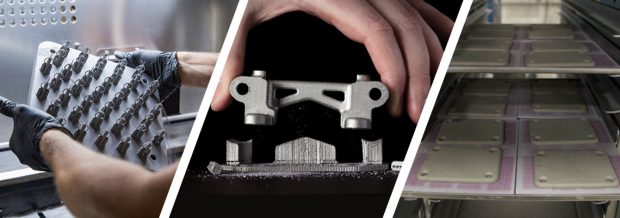 The medical parts on the left were produced using direct metal laser sintering. The center image shows a part made with Desktop Metal's fabrication process, which is said to be similar in capability and product integrity to metal injection molding (MIM). At right, for comparison, are MIM-made parts. Center image courtesy of Desktop Metal Inc. Other images courtesy of Proto Labs Inc.
The paper then segues into a look at additive manufacturing processes for industrial-grade parts production. Sorted by plastic and metal processes, this section is plainly yet engagingly written. It emphasizes a given technology's pros and notes its cons. You may get a little business bio of the developer, but you always get key details on their technology. Part images abound.
On the plastics side, fabrication technologies covered are SLS (selective laser sintering), HP's MJF (Multi Jet Fusion), FDM (Fused Deposition Modeling) and Carbon's CLIP (Continuous Liquid Interface Production). Metal fabrication looks at DMLS (direct metal laser sintering) and a pair of technologies from Desktop Metal. Both Carbon and Desktop Metal are relative newcomers as is MJF. Proto Labs offers links to their sites as well as HP's, enabling you to learn more about the technologies.
Next comes a comparison chart. It's the biggest reason why you'll want to bookmark this page. Arrayed down the left column are the fabrication processes. Across the top are five key specifications like materials, maximum part size and expected tolerance. All the details are filled in below and match up with the process.
The paper turns to stuff you need to consider about 3D printing metal and polymer industrial-grade parts. It wraps with some good words for processes like injection molding and milling, underscoring the complementary relationship between additive manufacturing and traditional methods.
Your takeaway: “3D Printing for End-Use Production” is terrific stuff. Hit the link to see for yourself.
Thanks, Pal. – Lockwood
Anthony J. Lockwood, Editor at Large, DE

Carbon works at the intersection of hardware, software, and molecular science. Our vision is a future fabricated with light, where traceable, final-quality parts are produced at scale with CLIP technology. CLIP Continuous Liquid Interface…

Anthony J. Lockwood is Digital Engineering's founding editor. He is now retired. Contact him via [email protected].
Follow DE






About Us · Contact Us · Editorial Team · Advertising · Privacy Policy · Subscriber Services · © 2026 Digital Engineering 24/7 · Peerless Media