Helping design and engineering professionals discover, evaluate and specify technologies and processes that shorten the design cycle and enable success.


Alert!
Digital Engineering ceased publication on July 1, 2026. This website remains available as an archive of engineering content.
For inquiries or information, please email [email protected].
CD-adapco (New York and London) has just released the version 2011 of SPEED, the electric machine design software it acquired from the University of Glasgow in June 2011. SPEED is intended for the design of electric machines with induction motors (polyphase/1-phase), brushless permanent-magnet motors (square wave/sine wave), DC brush motors, switched reluctance motors, and synchronous reluctance motors. SPEED features embrace four main engineering segments: automotive; aerospace; industrial; and refrigeration, domestic appliances and water.
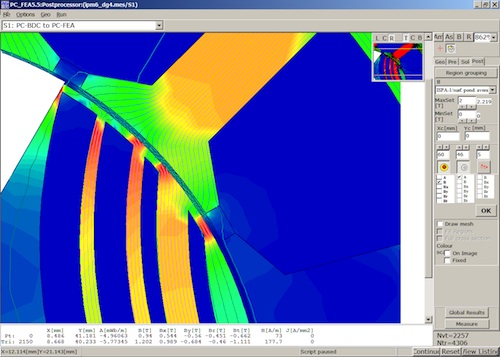
Detail of a synchronous reluctance motor showing the multi-layer structure
and the saturable bridges in the rotor. Image courtesy of CD-adapco.
According to the company, many of the more than 350 updates and new features in SPEED version 2011 are also intended for applications involving generators. To this end, SPEED version 2011 offers a new embedded finite-element solver to handle a variety of load specifications and automatic calculation of generator characteristics for wound-field synchronous generators. In addition, doubly-fed induction machines have been added. Other areas of improvement include machine geometry, finite-element analysis, drive control, and thermal modeling.
For automotive applications including hybrid and electric vehicles as well as commercial, industrial, and special vehicles for agriculture and mining, SPEED’s finite-element GoFER and embedded solver combine with analytical models that are said to cover all facets of the design of these machines, including thermal as well as electromagnetic and drive control aspects. The company says enhancements have been made in the design calculations to improve accuracy and address a broader range of machine geometry. The company stresses that of particular importance is the efficient utilization of magnets and even the elimination of magnets. The SPEED suite of programs is now structured to give seamless design capability over the entire range of permanent-magnet machines and alternatives, including hybrid combinations.
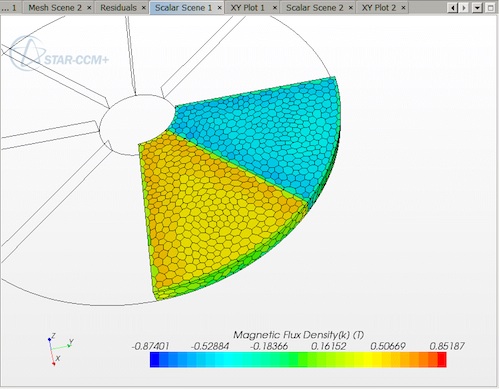
SPEED version 2011 can now transfer many geometries to STAR-CCM+
directly. This color map of flux-densities in STAR-CCM+ shows two magnets
in an axial-flux motor. Image courtesy of CD-adapco.
For refrigeration, home appliances and water, updates have been made in relation to machine geometry, loss calculations, drive control, and finite element analysis. The technology covers induction motors (both 1-phase and 3-phase), permanent-magnet brushless motors, and line-start PM motors. Switched reluctance motors are also used in a few applications.
For the aerospace industry, SPEED is said to be suitable for many applications including actuators, pumps, and starter-generators. Brushless PM machines and switched reluctance machines are the main technologies. In both of these areas, SPEED has new features for the range of machine geometry as well as calculating electromagnetic and thermal performance.
“One compelling reason why we’ve joined forces with CD-adapco is to make SPEED even better,” said Dr. Tim Miller, originator of SPEED and now a consultant to CD-adapco, in a prepared statement. “An early sign of SPEED’s progress is the intense collaboration now underway to share geometry and other design parameters with STAR-CCM+. Another is the development of a 3D electromagnetic solver in STAR-CCM+. And a third is the intense training activity that SPEED is running -- two or three times the previous level.”
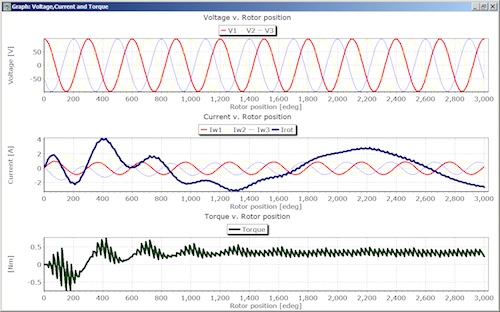
This SPEED image depicts the transient calculation for an induction machine
in which the inductances of the stator coils and rotor bars are calculated
individually instead of using the classical equivalent circuit. This new method
is said to avoid the simplifying assumptions made in the classical theory in
relation to the effect of space harmonic effects. Image courtesy of CD-adapco.
For a detailed list of enhancements in SPEED version 2011, go here.
Read the announcement of CD-adapco's acquisition of SPEED.
See why DE's editors selected SPEED version 2011 as their Pick of the Week.
Sources: Press materials received from the company and additional information gleaned from the company's website.


DE's editors contribute news and new product announcements to Digital Engineering. Press releases may be sent to them via [email protected].
Follow DE






About Us · Contact Us · Editorial Team · Advertising · Privacy Policy · Subscriber Services · © 2026 Digital Engineering 24/7 · Peerless Media