Helping design and engineering professionals discover, evaluate and specify technologies and processes that shorten the design cycle and enable success.


Alert!
Digital Engineering ceased publication on July 1, 2026. This website remains available as an archive of engineering content.
For inquiries or information, please email [email protected].
Sponsored
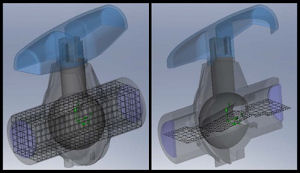 Computational fluid dynamics (CFD) tools for mechanical engineers and designers have proliferated over the past few years. Many mechanical engineers and designers, however, feel -- or indeed are -- out of their element when executing fluid flow or heat transfer simulations of their 3D CAD models. In particular, the critical step of establishing the mesh and grid system for your 3D CFD simulation and analysis can seem the most baffling. Today’s Check It Out paper from Mentor Graphics can help you make sense out of this process on both the granular and macro levels.
“How to Choose an Effective Grid System for CFD Meshing” is a 26-page PDF written by and for engineers. It’s an important paper because it covers so much CFD-related material in an even-handed way. There are many parts to this paper, and all of them are as fascinating as they are in-depth. While the non-CFD expert might deem none of this paper cursory, I’m willing to bet that even the CFD maven will pick up a few things here.
The synopsis is that this paper discusses widely deployed meshing and grid methodologies. It argues that automated adaptive meshing technology in the company’s FloEFD CFD tool can help you mesh designs effectively and thus obtain accurate analyses quickly and with less pain. Because automated adaptive meshing, which in the form of FloEFD operates as an embedded application in major MCAD systems, works quickly, says the company, it enhances productivity.
But do not think of this as a product brochure. It is anything but. Rather, it starts right at the beginning: What is a grid system and what are my choices? You then move on to factors and considerations, cell shapes, and even discussions on major research work going on in places like the University of Cambridge and NASA Ames. That’s all before you get to structured or unstructured grid arrangements and considerations to keep in mind as you generate grids.
After all that and more is laid out in front of you, the discussion turns to FloEFD … on page 19. What’s demonstrated here are the principles underlying FloEFD’s operations and how you interact with them. Again, there’s no puffery -- just an engineer-to-engineer illumination of capabilities. So, you can say what preceded this section was the contrast that you get to compare with FloEFD.
“How to Choose an Effective Grid System for CFD Meshing” is well illustrated with a dozen screen shots and graphs, and you get a few equations for good measure. The image on page 5 showing side-by-side what the main types of CFD grid systems look like is worth the download alone.
Knowledge is power. “How to Choose an Effective Grid System for CFD Meshing” is a powerful piece of knowledge building material. Hit the link over there to get your own copy.
Thanks, Pal. -- Lockwood
Anthony J. Lockwood
Editor at Large, Desktop Engineering


Anthony J. Lockwood is Digital Engineering's founding editor. He is now retired. Contact him via [email protected].
Follow DE






About Us · Contact Us · Editorial Team · Advertising · Privacy Policy · Subscriber Services · © 2026 Digital Engineering 24/7 · Peerless Media