Helping design and engineering professionals discover, evaluate and specify technologies and processes that shorten the design cycle and enable success.


Alert!
Digital Engineering ceased publication on July 1, 2026. This website remains available as an archive of engineering content.
For inquiries or information, please email [email protected].

Digital Engineering April 2026
In the latest issue of Digital Engineering, we take a look at the latest innovations in design for additive manufacturing, including the use of natural language inputs, social media cosplayers, and AI integration. The issue also includes a feature…

January Special Focus Issue: Design for Additive
In this Special Focus Issue of Digital Engineering, learn about the latest advancements in design for additive manufacturing, including new software tools, additive in automotive, custom medical devices, and more.
ESI Group has released the 2018 version of PAM-STAMP, its solution focused on minimizing tryout times and the cost of sheet metal forming manufacturing. The 2018 release, ESI reports, offers a tool to help engineers eliminate the last uncertainties before entering the physical tryout. It also can help engineers predict the perceived quality of a full component after the assembly process, the company adds.
PAM-STAMP provides the potential to effectively incorporate the full behavior of the press and die system during the forming process and to derive the material parameters for accurate material models automatically. New features introduced in the 2018 version also enable review of the final part quality in ESI’s Virtual Light Room.
ESI reports that, with the latest release of PAM-STAMP, automotive OEMs (original equipment manufacturers) can benefit from a solution that enables complete virtual tryout. This, it explains, can eliminate the last uncertainties before physical tryout, the company says.
To make sure the final assembled component is within tolerances, not only individual parts can now be managed, but also the full assembly process for doors and closures. PAM-STAMP 2018 addresses thermal joining effects due to spot-welding and intermediate distortion analysis (that is, springback). New capabilities are also available for (roll-) hemming, with or without gluing of the components. Final dimensional control is enabled, and the quality of assembled panels can be reviewed in a Virtual Light Room.
For the highest possible simulation accuracy, ESI says its development team worked on an efficient material characterization wizard that enables engineers to work with the most advanced material models at no additional cost or effort. All material parameters are obtained from standard uni-axial tensile test data automatically.
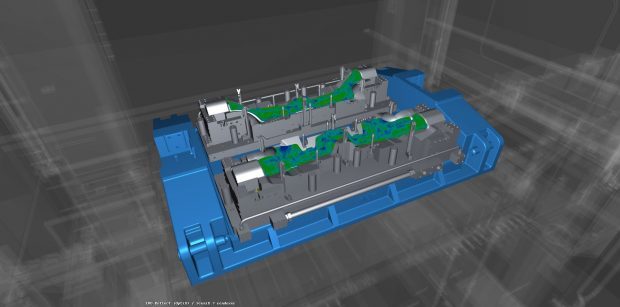
With this latest release, PAM-STAMP introduces a method that couples stamping simulations and tool deformation simulations in real time. This, explains the company, replicates tool shape changes during the entire forming process. The method enables users to achieve accuracy for springback prediction and cosmetic defects analysis, it adds.
To help users fully benefit from all recent developments and run simulations with the highest accuracy, ESI says it has improved the HPC (high-performance computing) capabilities of PAM-STAMP's sheet metal forming solvers significantly. The company reports that excellent scalability is now available up to 128 cores,/ This means that even for the largest panels a minimum of two iterations of high-quality forming simulation can be completed during working hours, according to ESI.


Anthony J. Lockwood is Digital Engineering's founding editor. He is now retired. Contact him via [email protected].
Follow DE






About Us · Contact Us · Editorial Team · Advertising · Privacy Policy · Subscriber Services · © 2026 Digital Engineering 24/7 · Peerless Media