Helping design and engineering professionals discover, evaluate and specify technologies and processes that shorten the design cycle and enable success.


Alert!
Digital Engineering ceased publication on July 1, 2026. This website remains available as an archive of engineering content.
For inquiries or information, please email [email protected].

Digital Engineering April 2026
In the latest issue of Digital Engineering, we take a look at the latest innovations in design for additive manufacturing, including the use of natural language inputs, social media cosplayers, and AI integration. The issue also includes a feature…

January Special Focus Issue: Design for Additive
In this Special Focus Issue of Digital Engineering, learn about the latest advancements in design for additive manufacturing, including new software tools, additive in automotive, custom medical devices, and more.
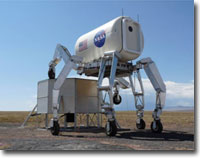
The robot called ATHLETE (All-Terrain Hex-Legged Extra-Terrestrial Explorer), is being built by NASA’s Jet Propulsion Lab (JPL), and has been in the testing phase for a number of years now. It was designed specifically to explore the surface of the moon, and now may be refitted to add AM elements.
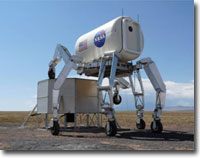
Unlike the ESA’s plan, which is based on Monolite UK’s D-Shape technology, ATHLETE would use microwaves to sinter lunar soil, a process that NASA has dubbed SinterHab. Eliminating the binding agent used in D-Shape would further reduce the necessity of materials transportation for what would have to be the longest supply chain ever.
"It would have a very good cost-value ratio as you don't need to import as much material from Earth,” said JPL scientist, Tomas Rousek. “The whole expandable module, with the membranes to cover the base when built, would be carried by the same rocket that would bring other modules of the outpost, but it can build a volume four times bigger than a rigid cylindrical module. Since we don't have the necessary transport capacity to the Moon at the moment, estimating a price now would be very inaccurate. As a comparison, the International Space Station has so far cost approximately $150 billion (£99bn) but a lunar base could be designed much more cheaply with private companies."
We’ll have to wait and see if the ESA responds to NASA’s one-upmanship. Competition and friendly rivalry are generally good for innovation. Until then, I have to say I find the giant robot version to be the more interesting approach.
Below you’ll find a video of the ATHLETE during testing.
Source: Arstechnica, JPL


John Newman is a Digital Engineering contributor who focuses on 3D printing. Contact him via [email protected] and read his posts on Rapid Ready Technology.
Follow DE






About Us · Contact Us · Editorial Team · Advertising · Privacy Policy · Subscriber Services · © 2026 Digital Engineering 24/7 · Peerless Media