Helping design and engineering professionals discover, evaluate and specify technologies and processes that shorten the design cycle and enable success.


Alert!
Digital Engineering ceased publication on July 1, 2026. This website remains available as an archive of engineering content.
For inquiries or information, please email [email protected].


Digital Engineering April 2026
In the latest issue of Digital Engineering, we take a look at the latest innovations in design for additive manufacturing, including the use of natural language inputs, social media cosplayers, and AI integration. The issue also includes a feature…

January Special Focus Issue: Design for Additive
In this Special Focus Issue of Digital Engineering, learn about the latest advancements in design for additive manufacturing, including new software tools, additive in automotive, custom medical devices, and more.
 It was a year ago this month that HP CEO Meg Whitman announced the company’s intention to build 3D printers, igniting all sorts of speculation by saying "We will have something by the middle of next year." That timeline was later pushed back to October, as HP tackled what Whitman described as two major issues with additive manufacturing: speed and material quality.
“We actually think we’ve solved these problems,” Whitman reported at HP’s annual shareholders meeting in March. “The bigger market is going to be in the enterprise space, manufacturing parts and prototypes in ways that were not possible before.”
More speculation followed as the company advertised a job opening for a "Robotics Scientist for 3D Printing." Part of the job description indicated HP was interested in incorporating glass as a 3D printing material, possibly in a system that includes both additive and subtractive — i.e. hybrid — capabilities:
HP Labs’ research into printing of inorganic materials is working towards hybrid printing of glass (and other inorganic materials) onto items that are already mass produced. As part of this activity we have a vacancy for someone primarily with experience in robotics, to lead the building of novel prototype robotic platforms that will be used to produce 3D printed structures on the surface of objects that are not planar.
In the invitation to this morning's HP webinar launch, the company promised to "announce what it believes to be the year’s most groundbreaking technologies that will help close the gap between the digital and physical worlds, empowering consumers and professionals to create, interact and inspire like never before."
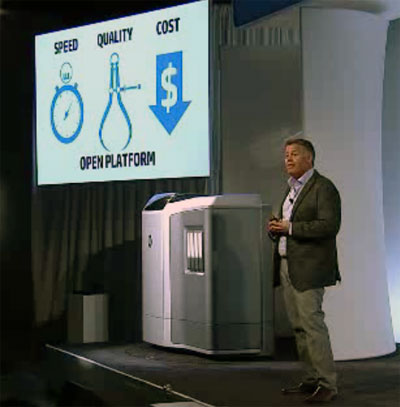 HP's Dion Weisler introduces the company's Multi Jet Fusion 3D printer.
Time will tell if the company's announcement fulfills those promises, but it did introduce a new 3D printing technology called Multi Jet Fusion as part of an HP initiative it calls "blended reality." (But no glass or additive-subtractive hybrid capabilities as of yet.)
"We believe it can change the world," said HP Executive Vice President, Printing and Personal Systems, Dion Weisler of the blended reality vision during the launch event. The Multi Jet Fusion technology is just part of that vision — the offramp, as Weisler called it.
While technical details were sparse, Multi Jet Fusion technology appears to leverage HP's strengths in inkjet and scanning to place more than 350 million drops per second at 21 microns. According to HP's press release, Multi Jet Fusion uses a "proprietary multi-agent printing process utilizing HP Thermal Inkjet arrays that simultaneously apply multiple liquid agents to produce best-in-class quality that combines greater accuracy, resiliency and uniform part strength in all three axis directions."
HP says it is 10x faster than competing technologies, providing an example of 3D printing 1,000 gears. The company said such a task would take 83 hours with material extrusion, 38 hours with laser sintering and just 3 hours with HP Multi Jet Fusion.
HP also said Multi Jet Fusion will not only be faster and higher quality, but will cost less than competing 3D printing systems, and that it will cost less to operate. The company is targeting industrial customers and says it could "revolutionize traditional manufacturing."
While the 3D printer was revealed on stage, as were parts created by it, it is not immediately available. HP is currently working with beta customers and plans for a widespread release in 2016. Weisler said Multi Jet Fusion is currently capable of printing in color, and the company is working to add built-in material "elasticity" and texture to parts. This video from HP includes a number of possibilities — including form, texture, friction, strength, elasticity, electrical, thermal properties and more — that Multi Jet Fusion could be capable of in the future:
A gear assembly created via HP's Multi Jet Fusion 3D printing technology. #3dprinting #HPLiveStream pic.twitter.com/bPMy7KCLtr— Desktop Engineering (@DEeditor) October 29, 2014
If Multi Jet Fusion is on the offramp, the onramp to closing what HP sees as the chasm between technology and creativity is Sprout. Sprout is a platform based around hardware that incorporates a touchscreen computer, 3D camera, and a projector that allows users to interact with digital elements on a canvas that sits in front of the screen.
Demonstrations during the event showed users placing physical objects on the canvas, which captured them digitally, allowing users to manipulate them on the screen or canvas. It reminded me a lot of the original Microsoft Surface Table, now rebranded as Microsoft PixelSense. Microsoft, Intel, 3M and Texas Instruments were recognized as launch partners during the announcement.
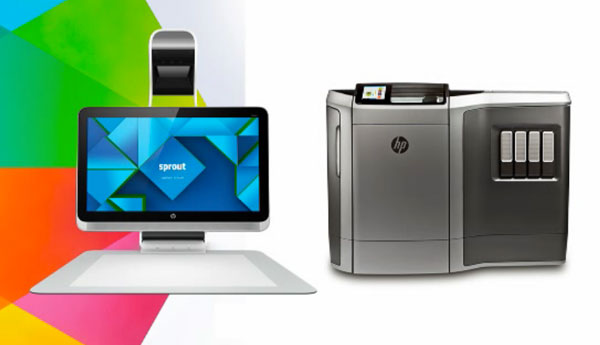 HP's vision for "blended reality" includes Sprout (left) and Multi Jet Fusion 3D printing (right).
HP is releasing a software development kit for Sprout today that will allow others to develop applications for Sprout. A few big names, such as Evernote and Martha Stewart, have already developed apps for the platform.
Sprout will be on sale Nov. 9, and though it is initially targeted toward artists and consumers, Weisler said the platform will eventually be extended to education and commercial applications. It was easy to imagine design engineers placing a part on the canvas to work with at the conceptual stage, or even exploring a CAD model with their hands using Sprout.
Below is a video HP played at today's announcement featuring Terry Wohlers of Wohlers Associates, alongside Carl Bass and LeeAnn Manon of Autodesk, discussing industrial 3D printing.
Finally, the HP-produced video below shows off some of Sprout's capabilities:


Jamie Gooch is the former editorial director of Digital Engineering.
Follow DE






About Us · Contact Us · Editorial Team · Advertising · Privacy Policy · Subscriber Services · © 2026 Digital Engineering 24/7 · Peerless Media