Helping design and engineering professionals discover, evaluate and specify technologies and processes that shorten the design cycle and enable success.



Digital Engineering April 2026
In the latest issue of Digital Engineering, we take a look at the latest innovations in design for additive manufacturing, including the use of natural language inputs, social media cosplayers, and AI integration. The issue also includes a feature…

January Special Focus Issue: Design for Additive
In this Special Focus Issue of Digital Engineering, learn about the latest advancements in design for additive manufacturing, including new software tools, additive in automotive, custom medical devices, and more.
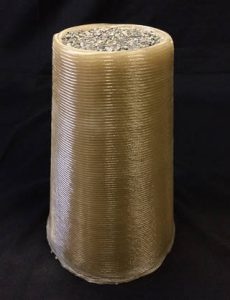 Foster + Partners was the top scorer in the Level 2, Phase 1 Compression Test Competition of NASA's 3D-Printed Habitat program. Image: NASA
Foster + Partners | Branch Technology of Chattanooga, TN, (which was awarded $85,930) and the University of Alaska – Fairbanks (which was warded $14,070) were the two top scorers of the seven teams in the Phase 2: Level 1 Compression Test Competition.
The goal of the 3D-Printed Habitat Challenge is to develop technologies that could be used to create habitats out of local materials and recyclable materials.
These systems could be used to create affordable housing on Earth, or to build shelter for human explorers on distant planets like Mars. The program is a partnership between NASA’s Centennial Challenges Program and Bradley University in Peoria, IL.
“Seeing tangible, 3D-printed objects for this phase makes the goals of this challenge more conceivable than ever,” said Monsi Roman, program manager of Centennial Challenges. “This is the first step toward building an entire habitat structure, and the potential to use this technology to aid human exploration to new worlds is thrilling.”
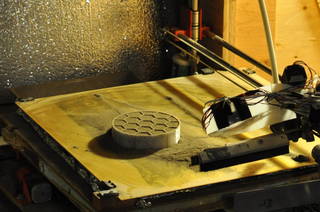 The University of Alaska team printed a cone as part of the compression test competition. Image: NASA
Phase 2 includes three sub-competitions. The compression test required teams to develop printable materials to create a cone and a cylinder. Points were scored based on lab test results. The teams will next create a beam for testing.
Phase 1 of the challenge focused on design, and was completed in 2015. Phase 2 has a $1.1 million prize purse and focuses on material technologies. Phase 3 has a $1.4 million purse and will involve fabrication technologies.
"Innovation is a key focus of Bradley University, which is one of the many reasons we are so very proud to be a part of the 3D-Printed Habitat Challenge with NASA,” said Bradley University President Gary Roberts. “The winners of Phase 1 and this first stage of Phase 2 are to be commended for their innovation in creating a solution that will fit not only in our world but beyond. I look forward to the next phase and seeing teams work to advance critical systems needed for human space exploration like never before."
Source: NASA


Brian Albright is the editorial director of Digital Engineering.
Contact him at [email protected].

Join over 90,000 engineering professionals who get fresh engineering news as soon as it is published.






About Us · Contact Us · Editorial Team · Advertising · Privacy Policy · Subscriber Services · © 2026 Digital Engineering 24/7 · Peerless Media